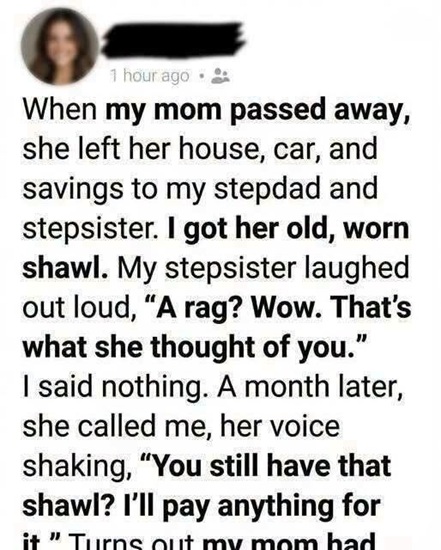
When the lawyer began reading my mother’s will, I believed I was prepared for whatever came next. I had spent weeks telling myself that possessions were insignificant compared with losing her, yet sitting in that quiet office made everything feel different. My sister Lila sat across from me, while several relatives waited nearby. One by one, the things my mother had spent a lifetime acquiring were distributed. The house, the car, savings, furniture, jewelry, and other possessions all went to different members of the family.
Then the lawyer reached my name. He paused, looked down at the document, and reached for a small package beside his desk. What he handed me was not an envelope containing money. It was not jewelry. It was not a property document. It was an old shawl. The fabric had faded with age, and several edges were visibly frayed. It looked exactly like something most people would have placed inside a forgotten storage box years earlier. I stared at it, waiting for the lawyer to continue.
He didn’t. “That is what your mother specifically left to you,” he said. Across the room, Lila laughed. She tried to disguise it as a cough, but nobody was fooled. “So that’s it?” she asked. The lawyer looked at her. “That is the item specifically designated for her.” Lila leaned back in her chair and glanced at me with an expression I knew too well. Our relationship had always been complicated. She measured affection through visible gestures, expensive presents, and the amount of attention someone received. To her, the will seemed to confirm something she had occasionally implied throughout our childhood.
Mom valued her more.
Lila was receiving assets with obvious financial worth.
I was receiving worn fabric.
After the meeting, she caught up with me outside.
“I wouldn’t take it personally,” she said.
I looked at her.
“You’re clearly taking it personally enough for both of us.”
She smiled.
“I’m just saying Mom knew exactly what she was doing.”
That sentence stayed with me.
I didn’t argue.
I placed the shawl carefully inside my bag and drove home.
That evening, I sat alone at the kitchen table and unfolded it.
For the first time, I noticed its faint scent.
Lavender.
Immediately, a memory returned.
The shawl had belonged to my grandmother.
I had not thought about that in years.
Grandma had been a difficult woman. Even people who loved her admitted it. She could be stubborn, critical, and almost impossible to please. Arguments followed her through much of her life, and over time several relatives stopped visiting regularly.
My mother did not.
Even when Grandma criticized her, Mom returned.
When Grandma became older and needed help with shopping, Mom helped.
When appointments became difficult, Mom drove her.
When ordinary household tasks became exhausting, Mom quietly took responsibility for them.
She rarely discussed any of this.
That was simply how my mother loved people.
She was not someone who made dramatic speeches about loyalty.
She practiced it.
Suddenly, I remembered seeing the shawl during those years.
Grandma often wore it while sitting near the window.
Later, after Grandma died, Mom kept it.
Sometimes she placed it around her shoulders while reading in the evening.
I remembered once asking why she kept something so worn.
Mom had smiled.
“Not everything valuable looks valuable.”
At the time, I thought she was talking about sentiment.
Sitting at my kitchen table years later, I wondered whether the will had been her final attempt to remind me of that lesson.
Perhaps the shawl was not an insult.
Maybe it was the object she believed I would understand.
I folded it carefully and stored it inside a drawer.
Then I returned to ordinary life.
Several weeks passed.
One afternoon, my phone rang.
It was Lila.
She sounded different.
The confidence from the lawyer’s office had disappeared.
“Do you still have Mom’s shawl?”
The question surprised me.
“Yes.”
“Where is it?”
“At home.”
There was a pause.
“Would you sell it to me?”
I laughed because I assumed she was joking.
She wasn’t.
“Why would you want it?”
“I’ve been thinking about Grandma.”
That explanation made no sense.
Lila had never shown sentimental interest in Grandma’s possessions.
“How much?” she asked.
“I didn’t say I wanted to sell it.”
“I’ll give you five thousand.”
I stopped smiling.
“For an old shawl?”
“Ten.”
“Lila, what’s going on?”
“Twenty.”
Now I knew something was wrong.
Only weeks earlier, she had laughed because the shawl supposedly proved that Mom had left me nothing of value.
Now she was offering thousands for it.
“Tell me what you know.”
She became quiet.
Finally, she said we needed to talk in person.
The following morning, we met at a coffee shop.
Lila arrived carrying a folder.
She placed it on the table but kept one hand over it.
“The lawyer contacted me.”
“Why?”
“Grandma apparently had assets we didn’t know about.”
I stared at her.
“What kind of assets?”
“Financial accounts and investments.”
“How much?”
She hesitated.
“Enough.”
That was not an answer.
“How much, Lila?”
She looked away.
“A lot.”
Then she explained the fictional legal arrangement at the center of this story.
According to documents discovered while the estate records were being reviewed, Grandma had created a separate inheritance arrangement years earlier. Certain assets had been placed under specific conditions.
The shawl was explicitly identified in those documents.
Under the terms described in the fictional estate paperwork, possession of that particular family heirloom was connected to the beneficiary designation for those assets.
I thought I had misunderstood.
“You’re telling me the shawl is connected to Grandma’s estate?”
“Yes.”
“And Mom knew?”
“She had to know.”
Suddenly, everything changed.
The will.
Mom’s decision.
Lila’s laughter.
The lavender smell.
Mom’s old sentence about value.
Not everything valuable looks valuable.
Lila leaned toward me.
“I’ll give you fifty thousand for it.”
“No.”
“Think about it.”
“I have.”
“You don’t even know how much the assets are worth.”
“That isn’t the point.”
Her expression hardened.
“Of course that’s the point.”
“No. That’s your point.”
She looked frustrated.
“You walked out of that lawyer’s office thinking Mom had humiliated me.”
“I never said that.”
“You laughed.”
She said nothing.
“You believed you got everything that mattered because your inheritance looked expensive.”
“That’s not fair.”
“Neither was laughing at me.”
Lila pushed the folder toward me.
“Read it yourself.”
I did.
Even within the fictional framework of the story, the documents were more complicated than Lila had made them sound. There were procedures to follow, questions about ownership, and legal requirements that needed professional review.
I did not suddenly become wealthy simply because someone said a shawl was important.
The estate had to be handled properly.
Attorneys needed to confirm the documents.
The relevant financial assets had to be identified.
Everything needed to follow the applicable fictional legal process.
But one point became clear.
Mom had deliberately left the shawl to me.
She knew its significance.
What I had interpreted as rejection was actually an act of trust.
That realization affected me more deeply than the possibility of money.
For weeks, I had carried one painful question.
Why had my mother thought so little of me?
Now I had the answer.
She hadn’t.
She had understood me better than I understood her final decision.
Mom knew Lila would notice the house.
She knew relatives would notice the car.
Everyone would understand savings and jewelry.
But she believed I would take an old shawl home instead of throwing it away simply because nobody else thought it mattered.
She had trusted me with something that required patience.
That was the inheritance I cared about first.
The legal process continued for some time.
The lawyers reviewed documents and confirmed the relevant details before anything was distributed.
Eventually, the financial assets associated with Grandma’s estate were resolved according to the fictional arrangement described in the story.
The amount was substantial enough to change practical parts of my life.
I paid off debts.
I created savings for the future.
I made decisions slowly because I could still hear Mom telling me never to confuse having money with understanding its value.
But I did not sell the shawl.
Not to Lila.
Not to anyone.
Once the legal questions were settled, its financial significance became almost irrelevant.
I kept it because of Grandma.
And because of Mom.
The frayed edges that had embarrassed me at the lawyer’s office began looking different.
They were evidence of use.
Someone had wrapped that fabric around tired shoulders.
Someone had carried it from one room to another.
My grandmother had worn it.
My mother had preserved it.
And eventually, Mom had chosen me to receive it.
The object connected three generations of women whose relationships had never been simple.
Grandma could be difficult.
Mom had stayed beside her anyway.
Mom and I had disagreements too.
There were things I wished I had asked while she was alive.
There were conversations I assumed we would eventually have.
Like most people, I believed there would always be another opportunity.
The shawl became a reminder that sometimes there isn’t.
Lila and I eventually spoke again.
Our relationship did not magically become perfect.
Money rarely simplifies complicated families.
Sometimes it reveals tensions that were already there.
She apologized for laughing at me.
I accepted the apology.
But I also told her something I should have said years earlier.
“Stop measuring how much people love you by what things cost.”
She looked at me for a long time.
Then she nodded.
Perhaps she understood.
Perhaps she didn’t.
That was no longer something I could control.
What I could control was what I carried forward from Mom.
Years later, the shawl remained carefully stored in my home.
Occasionally, I unfolded it.
The lavender scent gradually faded.
The memories did not.
I remembered Grandma sitting beside the window.
I remembered Mom placing the shawl over her shoulders.
I remembered the lawyer handing it to me.
I even remembered Lila laughing.
But that moment no longer hurt.
Everyone in the room had judged the inheritance according to what they could immediately see.
A house looked valuable.
A car looked valuable.
Money obviously looked valuable.
The shawl looked worthless.
That was precisely why the moment became such an important lesson.
Visible price and personal value are not always the same thing.
In this fictional story, the hidden estate eventually gave the shawl enormous financial significance.
But even without the money, it already carried something the other possessions could not.
History.
Sacrifice.
Memory.
It represented the years my mother had spent caring for a difficult parent without demanding recognition.
It represented Grandma’s complicated place in our family.
And it represented Mom’s belief that I would preserve something others might dismiss.
That was why I never replaced the shawl with something newer.
I never repaired every damaged edge until it looked untouched.
Age was part of its story.
Its imperfections proved that it had been used.
Loved.
Carried.
Kept.
Eventually, I stopped thinking of the inheritance as the money Grandma had hidden.
My real inheritance had begun the moment the lawyer placed faded fabric in my hands.
At first, I believed my mother had left me the least valuable object in the room.
I was wrong.
She had left me the object that required me to remember.
And perhaps she knew I would.
My relatives had looked at the shawl and seen what it was worth that afternoon.
Mom had looked at it and understood what it represented across generations.
There is a difference.
Sometimes the most meaningful things families pass down are not the possessions that receive the highest appraisal.
Sometimes they are ordinary objects connected to extraordinary memories.
For me, it was an old shawl carrying the faint scent of lavender.
It taught me one final lesson from my mother:
Never decide what something—or someone—is worth only by what you can see on the surface.
