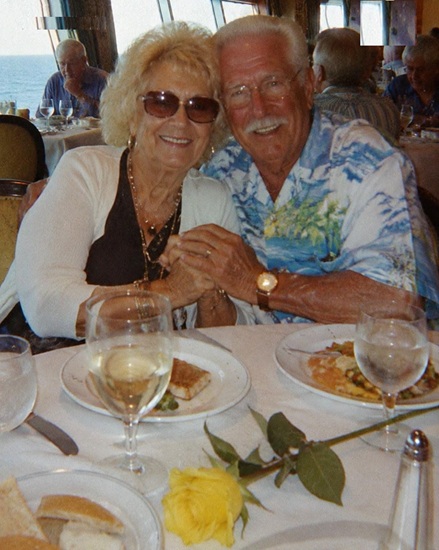
At seventy-one, I believed I had already experienced most of the surprises life could offer. I had been married for thirty-eight years, raised a daughter, buried my husband Peter, and slowly learned how to build a life without the person who had once handled so many of its practical details. My first solo cruise was supposed to prove something simple to myself: I could still travel because I wanted to, not because someone else was there to organize everything for me.
Then I met Richard. He was seventy-four, widowed, funny without trying too hard, and patient enough to let a conversation wander. We met at dinner on the first evening when he complained that the ship somehow served more food than anyone could eat while still failing to provide the one thing he actually wanted. I laughed. The following morning, he happened to be near my breakfast table. By the third day, we were walking the promenade together.
I began looking forward to seeing him. That frightened me more than I admitted. Three years had passed since Peter died, and I had convinced myself that romance belonged to a previous version of my life. Richard challenged that assumption without ever saying so directly. We talked about travel, old marriages, bad knees, adult children, and what it felt like to suddenly have a future you had never planned. On Tuesday night, he asked me to dance. On Thursday, he told me about his late wife, Ellen.
By the final evening, we were sharing champagne.
“To unexpected second chances,” he said.
I remember thinking that maybe he was right.
Less than an hour later, I followed him below deck.
Something about the way he had abruptly left dinner bothered me. He had received a message, glanced at his phone, and disappeared with barely an explanation. I told myself not to be ridiculous.
Then I followed anyway.
The corridor below the main guest decks felt wrong immediately. It was quieter, narrower, and clearly not designed for passengers wandering around. I found Richard near an open door.
Then I saw my suitcase.
It was sitting outside the room.
Inside, on the bed, lay my scarf.
My stomach dropped.
On the wall were photographs.
Photographs of me.
Boarding the ship.
Eating breakfast.
Waiting near an elevator.
Standing alone near the rail.
I stepped into the room.
“What is happening?”
Richard turned so quickly that I frightened him.
“Margaret, please.”
“No.”
An alarm began pulsing through the corridor.
I pointed toward the bed.
“My suitcase is here. My scarf is here. And you have photographs of me from before we even met.”
Richard’s expression changed.
It was not quite guilt.
It looked more like fear.
“For once,” I said, “do not ask me to trust you.”
Then he told me someone had entered my cabin approximately twenty minutes earlier.
The person had apparently used a copied keycard.
I stared at him.
“How do you know that?”
Before he could answer, I looked more carefully at the photographs.
I was not the only person appearing repeatedly.
In several pictures, the same man stood somewhere near me.
Blue baseball cap.
At embarkation.
At breakfast.
Near the elevators.
Always close enough to watch without looking obvious.
“Who is he?”
Richard hesitated.
That hesitation was enough to make my anger worse.
The ship’s alarm stopped.
A calm voice came over the speakers announcing that a security situation had been resolved and asking guests to remain in public areas for the time being.
Security.
Not fire.
Not a drill.
I looked back at Richard.
“Start talking.”
He stayed near the open doorway, apparently aware that closing it would make me even more nervous.
“My name really is Richard,” he began.
“Excellent start.”
“I really am seventy-four.”
“Wonderful.”
“I really am widowed.”
“Are we reviewing your dating profile?”
His mouth almost moved into a smile.
Then he stopped.
“I used to be a police detective.”
That was the first major truth he had hidden.
He had told me he worked in insurance.
Technically, that was also true.
After twenty-nine years in law enforcement, he had spent time working in insurance-related investigations.
But none of that explained me.
“Why are there pictures of me?”
Richard took a breath.
“Because I was asked to watch you.”
I felt something inside me go completely still.
“By whom?”
“Your daughter contacted the cruise line.”
I laughed because the answer sounded absurd.
Claire worried about everything.
Falls.
Food poisoning.
Blood clots.
Scams.
Bad weather.
Travel insurance.
She had spent the months before my trip sending me articles about every possible danger connected to traveling alone.
But hiring someone to follow me?
That seemed impossible.
Richard explained that Claire had not hired him personally.
She had contacted the cruise line after learning about suspicious calls I had received before the trip.
That part was true.
For nearly two months, a man claiming to represent the cruise company had called me repeatedly.
He knew my booking number.
My travel dates.
My cabin deck.
At first, I assumed he was legitimate.
He offered upgrades and transportation.
Then the questions changed.
Was I traveling alone?
Did I normally carry expensive jewelry?
Would anyone be staying at my house?
Did I keep spare keys somewhere accessible?
I finally realized something was wrong and ended the call.
I told Claire.
She panicked when she learned I had confirmed my home address before becoming suspicious.
I blocked the number.
The caller returned using another one.
Eventually, I stopped telling Claire because I knew she would insist I cancel the trip.
Richard already knew all of this.
“How?”
“Because the calls continued,” he said.
Then came the part that frightened me most.
My name had appeared on a list recovered during an unrelated fraud investigation.
There were twelve people from the same cruise on that list.
Most were older.
Most were traveling without spouses.
Ship security suspected that a small theft operation had access to passenger information.
The man in the blue cap was traveling under the name Jason Miller, although investigators were not certain that was his real identity.
They believed he was connected to a group targeting older solo travelers.
Their suspected methods included posing as cruise representatives, travel agents, insurers, or transportation companies before a trip.
Once they obtained enough information, they could target passengers onboard or potentially use the travel schedule to commit crimes elsewhere.
Cash.
Cards.
Passports.
Banking details.
Keys.
In some previous cases under investigation, homes had allegedly been burglarized while travelers were away.
I finally sat down.
Not because Richard asked me to.
Because my knees suddenly felt unreliable.
“So I was being watched for my protection?”
Richard looked uncomfortable.
“You were being monitored because investigators thought someone might approach you.”
“And you sat beside me at dinner deliberately?”
“Yes.”
That answer hurt more than I expected.
Our first conversation had not been chance.
His seat near breakfast had not been luck.
The walk around the promenade had begun as part of an assignment.
I asked the question I was almost afraid to hear answered.
“Was any of it real?”
Richard looked at me for a long moment.
“I sat near you because I was supposed to.”
I stood.
“Thank you.”
“But breakfast the next morning was not required.”
I stopped.
“The champagne wasn’t required either.”
I turned toward him.
“Neither was dancing with you. Or telling you about Ellen. Or asking where you would live if you could choose anywhere.”
My anger remained.
But it became more complicated.
Then I remembered the suitcase.
“How did it get here?”
Richard explained that the man in the blue cap had entered my cabin while I was at dinner.
Security believed he had used an illegally copied keycard.
He took my suitcase.
Richard and ship personnel followed him.
The room where we were standing was not Richard’s cabin at all.
It was a security room connected to a service corridor.
The man had abandoned my suitcase while escaping.
My scarf fell out when the zipper opened.
The photographs were not trophies.
They were evidence.
Some had been taken by Richard.
Others came from ship cameras.
Together, they formed a timeline showing me moving around the ship with the same man repeatedly nearby.
Then Richard opened my suitcase.
On top of my clothes sat a small device sealed inside an evidence bag.
“What is that?”
“A card-reading device, possibly.”
“It isn’t mine.”
“We know.”
Another evidence bag contained a keycard that appeared different from an ordinary guest card.
Security believed the items had been placed inside my suitcase deliberately.
Investigators were still trying to determine why.
One theory was that the suspect planned to abandon the luggage and create confusion by making it appear that stolen or unauthorized equipment belonged to me.
That possibility was not proven, Richard emphasized.
But the objects had not been mine.
I felt sick.
“Why me?”
His answer was simple.
“Because you were traveling alone.”
Four words.
They hurt.
I had booked the cruise precisely because I wanted to prove that being alone did not mean being incapable.
For thirty-eight years, Peter had handled maps, reservations, tickets, and most travel problems.
After he died, I realized how many small responsibilities I had handed over simply because it was easier.
This cruise was supposed to be evidence that I could still go somewhere by myself.
Someone else had apparently looked at that independence and seen opportunity.
What angered me even more was realizing that Claire had responded to the danger by secretly allowing people to make decisions around me.
Richard understood that.
He told me about Ellen.
His wife had lived with Alzheimer’s disease before she died.
During her final years, Richard had made more and more decisions for her.
At first, necessity required it.
Eventually, he admitted, control became a habit.
“There were moments she could still choose,” he said. “And I stopped asking.”
Then he said something I remembered long afterward.
“Fear can make control feel like love.”
That sentence described Claire perfectly.
And perhaps Richard too.
A female security officer named Elena arrived shortly afterward and explained the situation more formally.
Several individuals had been under observation.
The man believed to be using the name Jason had entered my cabin.
He had taken my suitcase.
When confronted, he ran and later attempted to enter another restricted part of the ship, triggering the security response I had heard.
Another passenger was being questioned.
A possible connection involving access to passenger information was also being investigated.
I asked Elena the question nobody else seemed willing to answer directly.
“Was I in danger?”
She paused.
“We had no information indicating an intention to physically harm you.”
“That isn’t what I asked.”
She nodded.
“There was risk.”
I appreciated that answer.
Then I asked whether I should have been told earlier.
Another pause.
“Yes.”
That mattered more than she probably understood.
I did not need another person explaining that secrecy had been for my own protection.
I needed someone to acknowledge that I had a right to know what was happening around me.
I provided a statement.
Then I took my suitcase and returned to the guest decks.
Richard followed me only as far as the elevator.
He apologized.
Not merely for lying about how we met.
He apologized for allowing me to become part of an investigation without giving me enough information to make my own decisions.
That apology mattered.
The following morning, the ship docked.
Claire was waiting for me.
She had traveled to meet me after learning what had happened.
The moment she saw me, she ran forward and hugged me.
I let her.
Then I said, “You and I are going to have an enormous argument.”
She started crying.
“I know.”
I asked why she had not told me what she knew.
Her answer was painfully simple.
“Because I knew you would still go.”
I stared at her.
“Exactly.”
She had not hidden information because I was incapable of deciding.
She had hidden it because she feared I might make a decision different from the one she preferred.
That was not the same thing as protecting me.
Claire apologized.
I believed her.
I remained angry.
Both things could be true at once.
Twenty minutes later, Richard appeared.
Claire looked from him to me and immediately understood that the situation was more complicated than a security investigation.
Richard approached carefully and handed me an envelope.
Inside was only his phone number.
No photograph.
No report.
No explanation.
“If you ever want to call,” he said, “I’d like that.”
“And if I don’t?”
“I’ll understand.”
I put the paper in my purse.
I did not call him for two weeks.
I needed to know whether I missed Richard himself or merely missed the romantic version of the cruise I had thought was real.
Annoyingly, I discovered that I missed Richard.
So I called.
Our first actual date happened on land.
I chose the restaurant.
I drove myself.
I told Claire where I was going because I wanted her to know, not because she demanded it.
Richard arrived early and looked genuinely nervous.
That pleased me more than it probably should have.
We talked for three hours.
This time, I asked many questions.
This time, he answered them.
Months later, we were still seeing each other.
Slowly.
Deliberately.
Without pretending that trust could be repaired overnight.
Claire changed too.
She stopped tracking my location.
I changed passwords, reviewed my financial accounts, strengthened security at home, and became far more cautious about unsolicited calls asking for personal information.
Those choices did not make me less independent.
They made me better informed.
That distinction became important to me.
There is nothing weak about taking reasonable precautions.
There is also nothing protective about withholding information from a capable adult simply because you fear the choice they may make with it.
People sometimes ask whether I was lucky Richard happened to be there.
I was.
But that was not the only lesson.
I was also glad I asked questions.
Glad I followed when something felt wrong.
Glad I refused to accept vague reassurance when I knew information was being withheld.
At seventy-one, I learned something I should have understood much earlier.
Being loved does not require surrendering your right to know.
Not to your adult child.
Not to a new partner.
Not even to people who sincerely believe they are protecting you.
Richard and I still occasionally order champagne.
Every time he lifts his glass, he asks the same question.
“What are we drinking to?”
And I always give him the same answer.
“Full disclosure.”
Then we drink to that.
