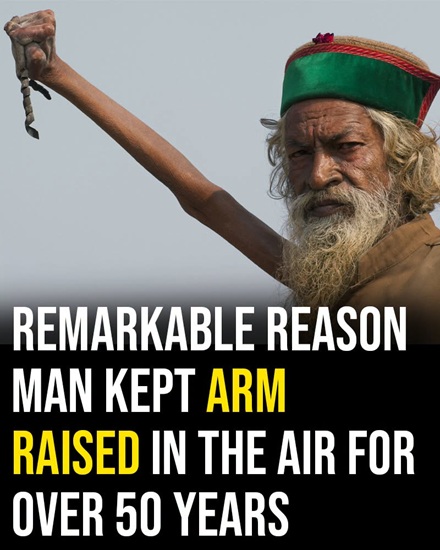
For decades, photographs and reports about an Indian Hindu ascetic named Amar Bharati have attracted attention around the world because of an extraordinary spiritual practice. Bharati is widely reported to have kept his right arm raised above his head continuously for many years as an expression of religious devotion and a symbolic appeal for peace. Images taken years apart show the same striking posture: one arm extended upward, visibly thinner than the other and apparently changed substantially after an exceptionally long period without normal movement.
His story has been repeated internationally, although some biographical and medical details remain difficult to independently verify. According to published accounts, Bharati was once living a conventional family life before becoming a sadhu, a Hindu ascetic who renounces many ordinary attachments in pursuit of spiritual goals. Reports commonly describe him as having been married, having children and working before leaving that life behind. Some accounts say he worked at a bank and was around 28 when he began his transformation during the early 1970s.
Because these details largely come from later profiles rather than comprehensive contemporary records, they are best described as reported elements of his biography rather than independently documented facts. Becoming a sadhu represented a profound change in the direction of his life. Hindu ascetic traditions are diverse, and individual sadhus may adopt very different disciplines, practices and forms of renunciation.
Bharati has been associated in published accounts with devotion to Shiva, one of the principal deities of Hinduism. His decision to keep an arm raised has consequently been presented not as a stunt or athletic challenge but as a religious vow connected to devotion and his stated desire for peace.

Reports differ somewhat on the precise year when Bharati began permanently holding his right arm upward. Some place the beginning of the practice in the early 1970s, while other widely circulated accounts give a slightly later date. That uncertainty matters when calculating claims about exactly how many years his arm has remained raised. What is clear from photographs and reporting spanning decades is that the practice has continued for an extraordinarily long period.
Bharati has explained the meaning behind his sacrifice in interviews and accounts reproduced over the years. He has spoken about conflict, hostility and violence between people and expressed a desire for peace both within India and around the world. His raised arm became a visible representation of that message as well as of his religious devotion. For him, the physical sacrifice was reportedly inseparable from the spiritual meaning attached to it.
The gesture belongs to a broader category of extreme ascetic practices sometimes undertaken as expressions of faith, discipline or renunciation. It should not, however, be interpreted as something ordinary followers of Hinduism are expected to do. Hindu religious life contains an enormous variety of traditions and practices, and Bharati’s prolonged arm raising is an exceptional individual act rather than a general religious requirement.
What makes his story particularly striking is the physical transformation visible in photographs of his raised arm. The limb appears dramatically thinner than his normally positioned arm. His hand and fingers have also changed considerably, and his fingernails have been photographed growing into long, curved shapes.

Those visible changes are consistent with the general principle that prolonged lack of normal movement can have significant effects on the human body. Muscles require regular use to maintain strength and mass. When a limb is immobilized for extended periods, muscle atrophy can occur, meaning the muscles gradually decrease in size and strength.
Joints can also become increasingly stiff when they are not moved through their normal range. Long-term immobility may lead to contractures, in which muscles, tendons and other tissues shorten or tighten enough to restrict normal movement. These effects are well recognized medically, although Bharati’s precise condition cannot responsibly be diagnosed from photographs or media descriptions alone.
Accounts about the beginning of Bharati’s vow describe the experience as extremely painful. Holding an arm overhead for even a relatively short period creates fatigue because muscles must continually work to maintain the position. Reports about Bharati say that he experienced intense discomfort during the early stages but refused to lower the limb.
Some profiles claim that the severe pain lasted for approximately two years before diminishing. They further report that Bharati eventually lost much of the sensation in his arm. These claims have been repeated frequently, but detailed publicly available medical records documenting the progression of his condition are not readily available.
For that reason, it would be inappropriate to make a definitive medical diagnosis about the present condition of Bharati’s arm based solely on media reports.
The photographs themselves nevertheless demonstrate that the limb has undergone profound visible changes.
His right arm appears significantly reduced in muscle mass compared with what would be expected from a normally functioning limb. The elbow remains in a fixed position, while the hand has also been affected by the decades-long posture.
Perhaps the most immediately noticeable feature is the appearance of his fingernails. Without ordinary trimming and use of the hand, the nails have grown to unusual lengths and curved into spiral-like shapes. Images of the raised hand have become among the most recognizable photographs associated with Bharati.
A frequently repeated question is whether he could simply decide to lower his arm.
There is no straightforward publicly documented answer.
Some accounts claim that decades of immobility have made normal movement extremely difficult or impossible. Others emphasize that Bharati continues keeping the arm raised because voluntarily lowering it would violate the vow that gives the practice its meaning.
Both explanations may contain elements of truth, but a reliable assessment of his current physical ability would require direct medical examination.
Claims that lowering the arm would necessarily break his elbow or cause specific catastrophic injuries should therefore be treated cautiously. Such statements have appeared in popular reporting, but they should not be presented as established medical facts without clinical evidence.
What can safely be said is that attempting to restore movement to a limb after extraordinarily prolonged immobilization could present significant medical challenges.
After decades without ordinary movement, muscles, joints, tendons and surrounding tissues would not be expected to function as they would in a healthy, regularly moving arm.
Medical professionals normally approach severe contractures or prolonged immobilization carefully rather than simply forcing a joint through a range of motion.
Bharati’s situation is unusual enough that general medical principles cannot establish precisely what would happen in his individual case.
Yet focusing only on the physical consequences risks overlooking what Bharati himself has described as the purpose of the gesture.
His raised arm was never intended to demonstrate physical strength.
It was intended as sacrifice.
According to accounts of his statements, Bharati has repeatedly questioned why people continue fighting and expressed a desire for peaceful coexistence.
The arm therefore functions symbolically within his personal spiritual practice.
Each year that passes increases the physical consequences of maintaining the vow, but it also extends the duration of the message he believes the gesture represents.
Bharati’s unusual commitment has attracted visitors, photographers, journalists and curious observers for decades. Photographs of him have circulated internationally, particularly as the internet made unusual human-interest stories easier to share across countries.
Unfortunately, widespread circulation can also strip away context.
Images of an extremely thin arm with dramatically curved fingernails may encourage sensational descriptions without explaining the religious motivation behind the practice.
A more accurate account recognizes both elements.
The physical transformation is extraordinary.
But Bharati’s stated reason for accepting that transformation is spiritual rather than recreational.
His example has reportedly influenced other Hindu ascetics who adopted similar practices. Some sadhus have been photographed keeping an arm raised for extended periods as part of their own religious commitments.
Reports indicate that those followers have generally not maintained the posture for as long as Bharati is said to have done.
Again, these practices should not be generalized to Hinduism as a whole.
India contains hundreds of millions of Hindus whose religious practices differ enormously according to tradition, region, community and individual belief.
Extreme ascetic practices occupy a particular place within some traditions and should be described in that context.
The story also illustrates how dramatically the human body can adapt—and deteriorate—when normal movement is removed for an exceptionally long period.
Human arms are designed to move regularly through the shoulder, elbow, wrist and fingers.
Everyday activities continually activate muscles and move joints.
Bharati deliberately abandoned that ordinary pattern in one arm.
Over time, the visible differences between his two arms became increasingly pronounced.
The raised limb became not only the instrument of his vow but also a permanent physical record of its duration.
That transformation helps explain why photographs of Bharati continue attracting attention decades after the story first became known internationally.
But there is another important distinction.
Physical endurance alone does not explain why someone would maintain such a difficult practice.
Bharati’s own reported statements consistently frame his decision around devotion and peace.
He has questioned hatred and conflict and expressed the hope that people can live peacefully together.
For observers outside his religious tradition, the decision may be difficult to understand.
Some may view it primarily as an extraordinary example of endurance.
Others may see it as a powerful spiritual commitment.
Still others may question whether such severe physical sacrifice is worthwhile.
Those interpretations belong to observers.
Bharati’s stated interpretation is that the gesture represents devotion and a desire for peace.
Maintaining that distinction avoids assigning motivations to him that he has not expressed.
It also prevents his religious practice from being reduced to an internet curiosity.
There remain gaps in the publicly available documentation surrounding his story.
Different publications have reported slightly different timelines.
Some medical claims are based on secondhand descriptions rather than published clinical examinations.
Details about his life before becoming a sadhu have also been repeated across outlets without extensive primary documentation.
Those limitations do not mean the central story should be dismissed.
Bharati has been photographed with his arm raised across many years, and his practice has been documented repeatedly.
They simply mean that precision is necessary when distinguishing visible evidence and Bharati’s own reported statements from claims that cannot be independently confirmed.
More than half a century after the period when he reportedly began this practice, the image of Amar Bharati with one arm extending above his head remains extraordinary.
The physical cost is visible.
The arm is severely atrophied.
The hand has changed.
The fingernails have grown and curled dramatically.
And the posture that began as a voluntary act appears to have become an enduring feature of his body.
Whether Bharati physically could lower the arm today cannot responsibly be determined from photographs alone.
Whether he wants to lower it is far less ambiguous in the accounts that have documented his commitment.
His vow derives its meaning from continuing it.
To Bharati, lowering the arm would therefore represent far more than changing physical position.
It would mean ending a spiritual practice to which he has devoted a substantial portion of his life.
That perspective helps explain why descriptions focusing only on whether his elbow could move miss an essential part of the story.
The remarkable element is not simply that an arm has remained raised.
It is that an individual chose to organize decades of his life around the meaning he attached to keeping it there.
For Bharati, the gesture has reportedly remained connected to Shiva, spiritual discipline and a hope for peace among people.
For medical observers, the visible condition of the limb demonstrates the profound consequences associated with extreme long-term immobility.
For the public, the story remains an unusual example of how far personal conviction can influence human behavior.
None of those observations requires exaggerating uncertain details.
There is no need to claim that his elbow would definitely break if moved.
There is no basis for diagnosing the precise neurological condition of his arm from photographs.
And where accounts disagree about dates or biographical details, those uncertainties should remain acknowledged.
What remains is already remarkable.
Amar Bharati is an Indian sadhu who has been widely documented keeping his right arm raised for decades as part of a religious vow.
His arm has undergone severe visible physical changes during that time.
He has associated the gesture with his devotion and with a message calling for peace.
Other ascetics have reportedly followed his example.
And the extraordinary duration of the practice has made Bharati internationally recognizable.
His story is therefore not merely about enduring pain.
It is about an unusual intersection of faith, sacrifice, the limits of the human body and an individual’s commitment to a message he believes deserves a lifetime.
Decades after he first raised his hand, the gesture continues to communicate the idea Bharati has repeatedly associated with it:
a hope that people can live with less conflict and greater peace.
