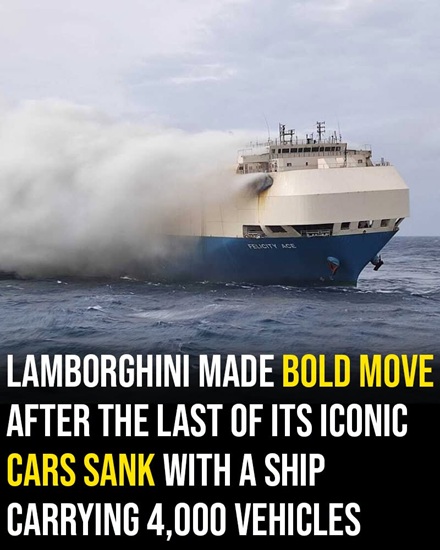
Lamborghini believed it had reached the end of an important chapter when production of the Aventador approached its conclusion. The V12-powered supercar had been part of the company’s lineup for more than a decade, and the limited Aventador LP 780-4 Ultimae was created as a final celebration of the model. Then an unexpected maritime disaster complicated those plans. In February 2022, the vehicle carrier Felicity Ace caught fire in the Atlantic Ocean while transporting thousands of cars. Weeks later, the ship sank near the Azores, taking its cargo with it.
The Felicity Ace was carrying roughly 4,000 vehicles belonging to brands within the Volkswagen Group. Among them were cars from Porsche, Audi, Bentley, Volkswagen and Lamborghini. The loss immediately created logistical and financial problems for several manufacturers because many of the vehicles were already assigned to customers. For Lamborghini, however, one portion of the cargo presented a particularly unusual problem. Fifteen Aventador Ultimae models were on board, and those cars belonged to a limited final-production series that was already reaching the end of its manufacturing run.
Lamborghini later confirmed that 85 of its vehicles had been aboard the ship. Most were Urus SUVs, but the 15 Aventador Ultimae models were especially difficult to replace because the company had effectively brought Aventador production to an end. The Ultimae was not simply another regular-production configuration that could easily be added back into the schedule. It had been designed specifically as the final evolution of the Aventador and the closing chapter of Lamborghini’s traditional naturally aspirated V12 flagship.
The Aventador itself had entered production in 2011 and became one of Lamborghini’s defining modern models. It succeeded the Murciélago as the company’s flagship V12 supercar and remained in production through numerous variants for more than a decade. Over that period, Lamborghini introduced versions such as the Aventador S, SV, SVJ and various limited editions. By the time the Ultimae arrived, Lamborghini wanted to combine several of the strongest qualities developed throughout the Aventador’s lifespan into a single farewell model.
The LP 780-4 Ultimae was announced as the final series-produced Aventador. Lamborghini planned 350 coupes and 250 roadsters, creating a limited run of 600 cars in total. The company described the Ultimae as the culmination of approximately a decade of Aventador development. Its combination of power, styling and chassis technology was intended to represent a final expression of the model before Lamborghini moved toward a new generation of electrified V12 vehicles.
Performance was one of the Ultimae’s defining characteristics. Lamborghini equipped it with a naturally aspirated 6.5-liter V12 producing 780 metric horsepower, equivalent to approximately 769 horsepower. According to Lamborghini’s official specifications, the coupe could accelerate from 0 to 100 km/h, or 0 to 62 mph, in 2.8 seconds. Its claimed maximum speed was 355 km/h, equivalent to approximately 221 mph. These figures placed the Ultimae among the most powerful and fastest road-going Aventador variants ever produced.
The car also incorporated many of Lamborghini’s advanced chassis systems. It used electronically controlled all-wheel drive, rear-wheel steering and Lamborghini Dynamic Steering. Multiple selectable driving modes allowed drivers to alter the behavior of the engine, transmission, steering and suspension depending on road conditions or personal preference. The Ultimae was therefore not merely a cosmetic farewell edition. It represented a technical summary of many features Lamborghini had developed across the Aventador family.
That limited-production status made the loss of 15 examples aboard the Felicity Ace much more complicated than losing ordinary inventory. Lamborghini could not simply pull another batch of identical cars from an ongoing production line. Suppliers had already been preparing to move on from the Aventador program, and manufacturing capacity was being reassigned to other vehicles. Replacing the lost cars meant revisiting parts of a production process that was already being shut down.
CEO Stephan Winkelmann publicly confirmed that Lamborghini intended to replace the cars. He explained that the company had worked through the problem and would make sure customers whose cars had been lost would eventually receive replacements. Lamborghini also told Car and Driver that rebuilding the Ultimae cars required considerable effort because the company needed to re-establish the relevant supply chain.
That phrase—re-establishing the supply chain—is important because modern cars depend on hundreds of suppliers and thousands of individual components. A manufacturer does not simply press a button and restart an older model after production has ended. Specialized parts, carbon-fiber components, electronics, interior materials, powertrain hardware and unique trim pieces may all need to be sourced again. Suppliers may already have changed production schedules or reassigned equipment to other programs.
The situation was made even more complicated by broader manufacturing pressures affecting the automotive industry in 2022. Semiconductor shortages were still disrupting global car production, while supply chains were dealing with additional instability. Porsche CEO Oliver Blume, discussing the company’s own losses aboard the ship, specifically referenced semiconductor and supply-chain challenges when explaining the effort required to replace vehicles.
Despite those difficulties, Lamborghini committed to replacing all 15 Aventador Ultimae models lost in the disaster. The decision meant the Aventador would effectively receive an additional production chapter after what was supposed to be its conclusion. Reports at the time often described this as Lamborghini “restarting” Aventador production, which accurately captured the unusual situation even though the company was primarily completing replacement cars for existing customers rather than launching an entirely new sales run.
For the customers involved, the decision was significant. These were not ordinary cars that could be replaced by selecting a similar vehicle from dealership inventory. Aventador Ultimae buyers had ordered a limited-edition version of Lamborghini’s final non-hybridized Aventador V12. Many examples were also configured individually through Lamborghini’s extensive customization options. Recreating those cars therefore involved restoring not only the model itself but also the specific orders customers had been waiting to receive.
The maritime incident began on February 16, 2022, when a fire broke out aboard the Felicity Ace while the ship was crossing the Atlantic. The crew members were evacuated safely, but efforts to save the vessel continued for days. The ship eventually sank on March 1 near Portugal’s Azores archipelago. By that point, the thousands of vehicles inside represented one of the most closely watched automotive cargo losses in recent years.
Because the cargo included many premium and performance vehicles, the financial loss attracted widespread attention. Porsche alone had more than 1,000 cars on the vessel, while Lamborghini had 85. Audi, Bentley and Volkswagen vehicles were also among the cargo. The exact individual configurations varied, but the combination of large vehicle numbers and high-value models made the sinking especially noteworthy within the automotive industry.
For Lamborghini enthusiasts, however, the 15 Ultimae models became the symbolic center of the story. They represented what were supposed to be some of the final examples of one of the company’s most important V12 supercars. Instead of arriving with customers in the United States, the cars disappeared with the ship beneath the Atlantic. Lamborghini then faced the unusual responsibility of recreating cars from a production run that was intended to be finished.
The Aventador had already achieved remarkable production numbers by that point. When Lamborghini finally brought assembly to a definitive end later in 2022, the company had produced 11,465 examples across the model’s lifespan. That was a major number for a flagship Lamborghini V12 and reflected how much the company’s production volumes had expanded compared with earlier generations.
In fact, the Aventador became more commercially successful than any previous Lamborghini V12 model. Reports surrounding the end of production noted that Lamborghini produced more Aventadors than all of its earlier V12 models combined. The Aventador surpassed the total production of its predecessor, the Murciélago, relatively early in its own lifecycle. That success helped turn the model into one of the defining Lamborghinis of the 2010s.
Its design also played a major role in that identity. The Aventador used a carbon-fiber monocoque structure designed to combine strength with relatively low weight. Sharp bodywork, dramatic scissor doors and a low, wide stance maintained visual connections with earlier Lamborghini flagships while introducing a distinctly modern appearance. The Ultimae retained those core characteristics while adding details intended to distinguish the farewell edition.
Inside, Lamborghini offered carbon-fiber elements, Alcantara upholstery and extensive personalization options through its Ad Personam program. Limited-series identification helped differentiate Ultimae examples from ordinary Aventadors. For collectors, those features increased the significance of receiving the exact configuration they had ordered rather than being offered another Lamborghini as a substitute.
This helps explain why Lamborghini did not simply offer affected customers a different model. Huracán and Urus vehicles could be replaced through their ongoing production programs, but the Aventador Ultimae required a different solution. The company chose to reconstruct the lost cars even though doing so demanded additional coordination with suppliers and modifications to production planning.
The rebuilt cars also meant that the story of the “last Aventador” became somewhat more complicated. Lamborghini had originally planned for the Ultimae production run to mark the end. After 15 cars were lost, suppliers had to resume supplying parts necessary to create the replacements. As a result, the ultimate conclusion of Aventador production occurred later than initially expected.
By September 2022, Lamborghini announced that Aventador production had finally ended. The final example was an Aventador LP 780-4 Ultimae Roadster finished in a special blue shade and destined for a customer in Switzerland. Lamborghini’s announcement brought a genuine conclusion to the Aventador era after the unexpected interruption caused by the Felicity Ace disaster.
There is a slight detail worth clarifying because reports about the final production date sometimes differ. Lamborghini announced the end of assembly in late September 2022, while later reporting stated that the final car itself had rolled off the production line earlier, in July. The important point is that by the fall of 2022 Lamborghini considered Aventador production definitively complete after replacing the cars lost at sea.
The final roadster was also notable for its design inspiration. It was configured through Lamborghini’s Ad Personam customization program and connected stylistically with the historic one-off Miura P400 Roadster. This gave the final Aventador additional symbolic significance by linking the end of one important Lamborghini V12 lineage with an earlier icon from the company’s history.
From a manufacturing perspective, the Felicity Ace episode demonstrated how complicated automotive production becomes when a limited-edition car disappears after its assembly process has essentially concluded. Modern supercars rely on specialized parts and suppliers that cannot always be restarted easily. A lost finished vehicle may therefore represent much more than its retail value—it can require reopening relationships and processes that manufacturers believed were complete.
The episode also highlighted the importance of logistics within the luxury-car business. Manufacturing a car is only one part of delivering it to a customer. Vehicles must be transported across continents and oceans before reaching dealerships or owners. Even after a car has successfully left the factory, unexpected events during shipping can prevent the transaction from being completed.
Fortunately, the crew of the Felicity Ace was evacuated, preventing the loss of human life from becoming part of the disaster. The destruction of the vehicle cargo was financially significant, but cars can ultimately be replaced. Lamborghini’s response focused on doing exactly that for customers whose vehicles had disappeared with the vessel.
Insurance also played a role in managing the losses. Volkswagen Group confirmed that insurance would cover damage associated with the vehicles aboard the ship. Individual manufacturers then worked to determine how quickly replacement cars could be produced and delivered. For ordinary production models, this could involve assigning new production slots. For the Ultimae, however, it meant reactivating part of a finished production program.
That distinction is what made the Aventador story so widely discussed. It was not simply a case of an automaker building 15 more cars because demand was strong. Lamborghini was preserving orders that had already been completed before an extraordinary shipping accident destroyed the vehicles. The replacement cars were therefore tied directly to customers whose original vehicles had been lost.
The limited Ultimae production numbers did not represent an open-ended continuation of Aventador sales. Lamborghini had originally announced 350 coupes and 250 roadsters, and the replacement effort was meant to restore vehicles from that intended production rather than expand the model into a new generation.
The distinction is also important for collectors because limited-production totals can influence a model’s identity and desirability. Lamborghini was not attempting to dilute the Ultimae series by adding an extra commercial batch. It was replacing examples that technically existed and had already been destined for customers before being destroyed during transport.
Another detail sometimes repeated in retellings concerns specific individual customers who reportedly had multiple vehicles aboard the ship. Stories from automotive personalities and collectors have described losses of specially ordered cars, including Aventador Ultimae examples. Those accounts illustrate the personal impact on buyers, but the most strongly documented part of the overall event is Lamborghini’s confirmation that all 15 lost Ultimae models would be replaced.
The company followed through on that commitment. By later in 2022, replacement production had been completed and the Aventador reached its definitive end. That conclusion allowed Lamborghini to move forward toward the model’s successor while closing a chapter that had unexpectedly remained open for several additional months.
The transition was particularly important because Lamborghini’s next flagship would represent a major technological change. The company had already announced that the Aventador replacement would retain a V12 engine while adding plug-in hybrid technology. The move reflected Lamborghini’s broader electrification strategy while preserving the twelve-cylinder configuration closely associated with its flagship cars.
That means the Ultimae holds a distinctive place in Lamborghini history. It was not merely the final Aventador. It represented the end of an era in which Lamborghini’s regular flagship V12 supercar could rely solely on internal combustion without hybrid assistance. The Aventador’s successor would continue using a V12, but in a fundamentally different electrified configuration.
For that reason, the 15 lost cars were more than expensive pieces of cargo. They were examples of a model deliberately created to celebrate the closing of a technological and historical chapter. Rebuilding them allowed Lamborghini to fulfill existing commitments while preserving the significance of the farewell series.
The numbers behind the Ultimae underline its exclusivity. Its 6,498-cc naturally aspirated engine produced 780 CV at 8,500 rpm and sent power through an electronically controlled all-wheel-drive system. Lamborghini quoted 355 km/h as its maximum speed and 2.8 seconds for acceleration from 0 to 100 km/h. Those specifications placed the final Aventador very close to the performance level of the track-focused SVJ while offering a somewhat broader grand-touring character.
Lamborghini described the Ultimae as combining characteristics from several important Aventador variants. It blended the performance associated with the SVJ, the styling refinement of the Aventador S and the core character of the original Aventador. That approach made the model an intentional “greatest hits” interpretation rather than a completely separate design.
The Felicity Ace disaster could easily have left 15 buyers without those final cars. Instead, the event created one of the most unusual production stories in Lamborghini’s modern history. A model had reached the end of its planned life, finished vehicles had already been shipped, those vehicles were destroyed at sea, and the manufacturer then worked backward through its supply chain to reproduce them.
That process is the more accurate version of the frequently repeated claim that Lamborghini simply “reopened the factory.” Aventador production was revived specifically to replace lost cars, but Lamborghini’s Sant’Agata Bolognese plant itself had not literally closed as an entire facility. The factory continued producing other models. What had to be restored were production processes, parts supply and capacity associated specifically with the Aventador Ultimae.
Clarifying that point helps preserve what actually made the event remarkable. The challenge was not turning the lights back on in an abandoned factory. It was reconstructing a discontinued supercar production process within a working plant that had already begun moving toward other priorities.
The result ultimately gave the Aventador one final extension. Production that was expected to conclude earlier in 2022 continued long enough for Lamborghini to fulfill the replacement orders. Then, in the second half of the year, the final Aventador left the line and the company’s long-running V12 flagship officially moved into history.
In total, 11,465 Aventadors were built during the model’s lifespan. The production run included coupes, roadsters, performance variants and special editions, culminating with the Ultimae.
The model’s longevity was significant by supercar standards. More than a decade passed between its introduction and final production. During that period, automotive technology changed rapidly, yet Lamborghini continually updated the Aventador while preserving its naturally aspirated V12 and dramatic visual identity.
The loss of the 15 Ultimae cars therefore became an unexpected final event in an already long history. Few automotive production runs end with finished examples sinking in the Atlantic and suppliers being asked to resume work so replacements can be created.
There was also a broader lesson in the incident about how unpredictable global logistics can be. Customers may spend months or years waiting for highly customized vehicles, and even after manufacturing is complete there are still risks involved in transporting them around the world. Manufacturers must have contingency plans for situations in which vehicles are damaged or destroyed before delivery.
For Lamborghini, those contingency plans required extraordinary measures because there was no equivalent ongoing Aventador production from which to draw replacements. The company’s willingness to re-establish the necessary supply chain protected customers from bearing the consequences of the shipping disaster.
The story has continued to circulate because it combines several elements that rarely occur together: an enormous cargo-ship fire, thousands of luxury vehicles, a famous supercar reaching the end of production and an automaker effectively reviving that model to replace cars sitting at the bottom of the ocean.
Yet the documented facts are already dramatic enough without exaggeration. The Felicity Ace carried roughly 4,000 Volkswagen Group vehicles, including 85 Lamborghinis. Fifteen of those Lamborghinis were Aventador Ultimae models. Lamborghini confirmed that the cars would be rebuilt, and the company re-established the necessary supply chain to do so.
Later that same year, Aventador production finally ended for good. The last example was an Ultimae Roadster, completing a production run of 11,465 Aventadors.
The episode therefore gave the Aventador one of the most unusual farewells in modern automotive history. Lamborghini designed the Ultimae as the final expression of the model, believed production was coming to a close, lost 15 finished examples in a maritime disaster, rebuilt them for customers and then ended production once again.
For the buyers affected by the sinking, Lamborghini’s decision meant that their long-awaited vehicles were not permanently lost along with the ship. Replacement cars were produced despite the unusual difficulty of recreating a limited-edition model after its manufacturing program had already been winding down.
For Lamborghini itself, the event became a memorable final chapter in the story of a flagship that had been central to the brand for more than ten years. The Aventador survived one unexpected extension before finally giving way to Lamborghini’s next era of electrified V12 performance.
And for automotive history, the Felicity Ace disaster remains a remarkable reminder that even the carefully planned end of a legendary supercar can be rewritten by circumstances nobody anticipated. Lamborghini thought the Aventador story was almost finished. A fire at sea ensured that the company had to write one final chapter before it could truly say goodbye.
