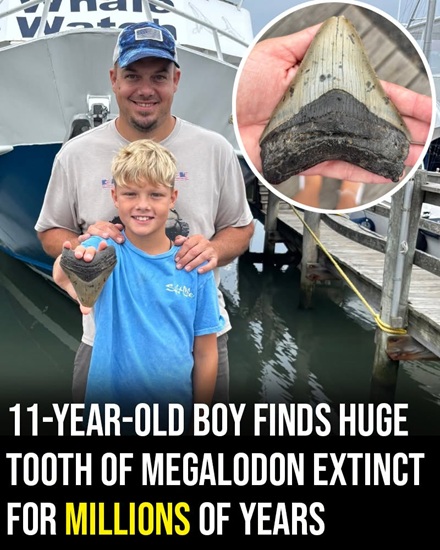
What began as an ordinary family vacation at the Jersey Shore turned into an extraordinary encounter with prehistoric history for 11-year-old Bo Bowers and his father, Mike Bowers. The Pennsylvania family was spending time in Sea Isle City, New Jersey, when the father and son went searching for shells along the beach. While examining rocks near a jetty, Mike noticed something unusual inside a narrow opening. He could see the object but could not fit his hand far enough into the space to retrieve it.
Bo, however, was small enough to reach inside. When the boy pulled the object free, the family quickly realized that this was no ordinary beach souvenir. The object was a large fossilized shark tooth measuring roughly four inches. Bo later described feeling both shocked and excited when he realized what he had recovered. His father was equally stunned, recalling that he had never expected their search along the beach to produce anything remotely comparable.
Their surprise was understandable: the tooth did not belong to a modern shark but to a megalodon, the enormous extinct shark that once inhabited oceans around the world. Megalodon disappeared from the fossil record millions of years ago, meaning the object Bo held in his hand represented an extraordinarily distant chapter in Earth’s natural history. The family did not simply assume that the unusual object was a megalodon fossil.
They sought expert opinions to determine exactly what they had discovered. According to NBC10 Philadelphia, the tooth was examined by experts associated with the Cape May Whale Watch and Research Center and the New Jersey State Museum. Both confirmed that it came from a megalodon. That professional identification transformed an exciting family discovery into a scientifically significant fossil find. For Bo, it also meant that something he had pulled from between rocks during a vacation had survived for millions of years before unexpectedly returning to the surface.
Daniel Iovino of the Cape May Whale Watch and Research Center described the discovery as an amazing sighting and emphasized how fortunate the family had been. He explained that only a small number of megalodon teeth have been recorded along New Jersey’s coastline. Matt Remuzzi, also associated with the center, was particularly impressed by the fossil’s preservation. He told NBC10 that it was the best-condition megalodon tooth he had personally seen. The quality of the specimen is notable because fossils exposed to ocean conditions can experience substantial wear over long periods.
Dana Ehret, a fossil-shark expert and natural-history curator at the New Jersey State Museum, has also explained why such discoveries are unusual in the state. In comments reported following the discovery, Ehret said megalodon teeth are highly uncommon in New Jersey because the appropriate geological sediments are generally not preserved at or near the surface. He described the Bowers family’s tooth as being in extraordinarily good condition for a specimen discovered in New Jersey. Teeth found under such circumstances can often be considerably more worn after spending long periods exposed to water and geological processes.
The way the tooth was discovered made the experience even more memorable. Mike had been searching around the rocks when he removed a shell and noticed an opening. Something inside caught his attention, but the space was too tight for his hand. He called Bo over, and the boy was able to reach into the opening and retrieve the object. The simple difference in the size of their hands ultimately allowed the fossil to be recovered. Mike later recalled his intense reaction to the discovery, while Bo said he was extremely excited. What had started as shell collecting had suddenly become a rare paleontological find.
The fossil also surprised the family because of its weight. Mike said the tooth felt considerably heavier than either of them had expected. Photographs of the specimen show a broad, triangular fossil that occupies much of Bo’s hand. Its substantial size provides a tangible reminder of the scale of the animal that once carried teeth like it. Megalodon teeth are among the most recognizable remains of the extinct shark because shark skeletons are primarily made from cartilage, which generally does not fossilize as readily as harder structures such as teeth. As a result, teeth provide scientists with some of their most important evidence about this prehistoric predator.
There is also a visible damaged area on the fossil, adding another intriguing detail to the specimen. Mike said the family was told that the chip could potentially have resulted from the shark biting into something hard, such as bone. While the precise event that caused damage to an individual tooth millions of years ago cannot simply be observed today, megalodon teeth and other fossils can provide researchers with clues about how these animals lived and fed. Scientists know from fossil evidence that megalodon was a major marine predator whose diet included large animals. The enormous shark occupied the upper levels of ancient marine food webs for millions of years.
Another question is how such a rare fossil ended up where Bo could reach it. Experts have suggested that a recent beach-replenishment operation may provide an explanation. During beach replenishment, sand can be dredged from offshore locations and pumped onto beaches to replace material lost through erosion. Researchers have speculated that the megalodon tooth may have been brought up with offshore material and deposited closer to the beach during such work. NBC10 reported that experts considered this a possible explanation for the fossil appearing along the Sea Isle City shoreline. It remains an expert hypothesis rather than a directly observed journey of the individual tooth.
Understanding why the discovery generated so much excitement requires looking at the animal itself. Megalodon, scientifically known as Otodus megalodon, was one of the largest predatory fish known from the fossil record. It inhabited the world’s oceans millions of years before modern humans existed. Although popular culture sometimes portrays it as an oversized version of a modern great white shark, scientists continue to study what its body actually looked like. Because no complete megalodon skeleton has ever been discovered, reconstructions have to rely on fossilized teeth, vertebral material and comparisons with other shark species.
Scientific estimates of the animal’s maximum size have also changed as researchers develop new methods and examine additional evidence. The Natural History Museum in London notes that a 2025 study involving 29 fossil-shark experts estimated that the largest megalodons may have reached approximately 24.3 meters in length. Under that reconstruction, an exceptionally large individual may have weighed as much as about 94 tonnes. These figures represent scientific estimates for the upper end of the animal’s possible size rather than measurements from a complete fossilized specimen. Earlier estimates commonly placed maximum length closer to approximately 15 to 18 meters.
Even the more conservative estimates make megalodon an extraordinary predator. The Natural History Museum describes it as not only the largest known shark but also one of the largest fish ever to have lived. Its teeth could grow to impressive dimensions, with some specimens reaching around 18 centimeters. In fact, the name “megalodon” is derived from words meaning “large tooth,” an appropriate description considering that teeth constitute much of the fossil evidence left behind by the animal. Researchers can examine the dimensions and characteristics of these fossils to learn more about megalodon’s size, biology and ecological role.
Megalodon was not simply a gigantic animal; evidence indicates that it was a formidable marine predator. Research discussed in reporting on the Bowers discovery has suggested that an enormous megalodon could have consumed very large prey. NBC10 noted research published in Science Advances indicating that the shark’s feeding capabilities may have allowed it to consume an animal comparable in size to a killer whale in only a handful of bites. Such estimates are based on scientific modeling and fossil evidence rather than direct observation, but they help researchers understand the scale of the predator’s energy requirements and feeding behavior.
Megalodon’s enormous size did not necessarily remain identical throughout its geographic range. Research reported by the Natural History Museum has suggested that individuals living in cooler waters tended to reach larger sizes than those inhabiting warmer environments. Scientists continue examining fossils from different regions to understand how temperature, prey availability and other environmental conditions may have influenced the species. These studies demonstrate why individual fossils remain scientifically valuable. Even a single tooth can contribute to a much larger body of evidence about an animal that disappeared millions of years before humans could observe it.
Megalodon is believed to have disappeared approximately 3.6 million years ago. Despite occasional fictional stories and online speculation suggesting that giant megalodons might still survive in unexplored parts of the ocean, scientific evidence supports the conclusion that the species is extinct. The Natural History Museum notes that there is no credible evidence of living megalodons today. Fossils instead allow paleontologists to reconstruct parts of the animal’s history and investigate how changes in climate, competition, prey populations and marine environments may have contributed to its eventual disappearance.
That immense passage of time puts Bo’s discovery into perspective. The tooth existed long before modern cities, recorded history or human civilization. It survived geological and environmental changes before eventually becoming accessible along a New Jersey beach. There is no way to reconstruct every stage of the fossil’s journey with certainty, which is why researchers have been careful to describe the beach-replenishment explanation as a possibility. What can be established is that experts examined the specimen and identified it as a genuine megalodon tooth, making the family’s discovery far more than an unusual-looking rock collected during a vacation.
The story also illustrates how important expert verification can be when unusual fossils are discovered. Objects found on beaches can sometimes resemble fossils without actually being prehistoric remains, while genuine fossils may not always look spectacular to an inexperienced observer. In this case, the Bowers family sought assistance from organizations with relevant expertise rather than relying solely on an online identification. Examination by the Cape May Whale Watch and Research Center and the New Jersey State Museum provided independent professional support for the identification and helped establish the significance of what Bo had recovered.
For the Bowers family, however, the scientific significance is only part of the story. The tooth is also a reminder of a father-and-son experience that would have been almost impossible to plan. They had gone to the beach looking for shells, not expecting to make a notable fossil discovery. Mike described the find as something worthy of a bucket list, while Bo intends to keep the tooth. The family therefore returned to Pennsylvania with something considerably more unusual than the typical souvenir from a beach vacation: a genuine piece of prehistoric marine history.
The discovery has attracted attention precisely because it combines an ordinary activity with an exceptionally unusual outcome. A child searching among rocks was able to retrieve an object his father could not reach, and that object turned out to have originated from one of the most remarkable predators in Earth’s history. Experts were impressed both by the rarity of a New Jersey megalodon find and by the condition of the fossil itself. No dramatic embellishment is necessary to make the story remarkable—the verified circumstances of the discovery already provide an extraordinary connection between a modern family vacation and a vanished ocean world.
For Bo, the most lasting part of the experience may ultimately be the story attached to the fossil. Millions of people visit beaches and return home with shells, stones and photographs. Very few discover a megalodon tooth that specialists consider an exceptional specimen for the region. The Bowers family has said it plans to keep the fossil, preserving both the object and the memory of the moment it emerged from between the rocks. What began as a simple search along the shoreline became a rare reminder that evidence of Earth’s distant past can sometimes appear in the most unexpected places.
