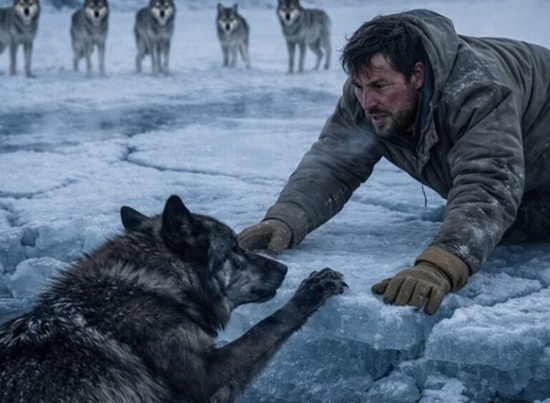
A forest ranger who had spent many years working deep within a remote nature reserve had grown accustomed to a life defined by silence and solitude. After experiencing significant personal loss earlier in his life, he chose to dedicate himself to nature, where the predictable rhythm of the wilderness offered him a sense of stability. His small wooden cabin sat at the edge of dense woodland, far from towns, traffic, and human noise. Each day followed a familiar routine of patrols, inspections, and quiet observation of the forest environment.
The frozen lake located deep within the reserve was one of the most dangerous areas under his responsibility. During winter months, its surface often appeared stable and solid, yet beneath the snow and ice lay unpredictable weaknesses. Cracks could form without warning, and thin ice could break under even moderate weight. Despite warning signs placed along common paths, occasional visitors still underestimated the risks, prompting the ranger to monitor the area regularly.
On a particularly cold morning, the forest felt unusually still. The wind was minimal, and even the usual sounds of wildlife seemed distant or absent. While walking one of his routine patrol routes, the ranger suddenly paused. In the silence, he detected a faint sound carried through the cold air. It was difficult to identify at first, something between a distant cry and a struggling call for help.
He stood motionless for a moment, listening carefully. The sound repeated, slightly stronger this time, confirming that it was not natural background noise. Instinct immediately told him that something was wrong near the direction of the frozen lake. Without hesitation, he adjusted his course and began moving quickly through the snow-covered terrain toward the source of the sound.
As he approached the lake, the situation became clearer. At a broken section of ice near the shoreline, a large she-wolf was struggling in the freezing water. The ice around her had fractured, creating unstable edges that broke apart with each attempt she made to climb out. Her movements were increasingly weak, suggesting exhaustion from repeated efforts to escape the icy water.
The ranger quickly noticed that the animal was not alone in her condition. Her rounded abdomen indicated that she was pregnant, which made her situation even more critical. The additional weight made it significantly harder for her to lift herself onto the ice, and each failed attempt drained her strength further. The cold water surrounding her posed a serious risk of hypothermia, leaving little time for hesitation.
Understanding the danger, the ranger carefully assessed the situation. Approaching a wild wolf, especially one in distress, carried significant risk. However, leaving the animal trapped was not an option he could accept. He moved cautiously toward the edge of the ice, distributing his weight carefully to avoid breaking the surface beneath him.
The she-wolf reacted instinctively as he got closer, baring her teeth in fear and confusion. Despite this, her physical exhaustion prevented any sustained resistance. The ranger spoke softly, not expecting understanding but hoping to reduce stress. He slowly extended his reach, carefully gripping the thick fur near her shoulders while maintaining balance on the unstable ice.
The ice cracked under pressure, and freezing water splashed around them. For a brief moment, the situation became even more dangerous, as both human and animal risked falling into the icy lake. The ranger tightened his grip and used controlled force to pull steadily rather than suddenly, knowing that sudden movement could worsen the situation.
After several difficult moments, the she-wolf finally began to move upward. Inch by inch, she was pulled from the water onto the surface of the ice. With one final effort, the ranger managed to drag her fully onto a safer section of frozen ground. Both of them collapsed in exhaustion, the ranger lying back briefly as he recovered from the physical strain and freezing exposure.
For a moment, the forest was completely silent again. However, that silence was quickly interrupted by movement in the surrounding area. The ranger slowly lifted his head and noticed several wolves standing at a distance near the edge of the trees. They had appeared quietly, watching the scene unfold without making any sound.
The pack remained still, observing both the ranger and the weakened she-wolf lying on the ice. The atmosphere changed immediately, becoming tense and uncertain. The ranger understood that from the perspective of the pack, he might appear as a potential threat rather than a rescuer. Wild animals often react based on perception rather than intent.
One of the wolves stepped forward cautiously, followed by another. Their movements were slow but deliberate, and the ranger knew that sudden action could trigger aggression. Carefully, he rose to his feet, keeping his posture calm and avoiding any rapid gestures. The frozen surface beneath him made movement difficult, adding to the tension of the moment.
For several seconds, there was no sound except the faint wind across the ice. Then, one wolf suddenly surged forward, breaking the stillness with rapid movement. The ranger braced himself instinctively, recognizing that escape would not be possible on the slippery surface.
Before the situation could escalate further, the injured she-wolf moved. Despite her weakened condition, she forced herself between the ranger and the advancing wolf. Her body language changed completely, shifting from vulnerability to protective instinct. She lowered her head slightly and released a warning growl toward the approaching animal.
The advancing wolf stopped immediately. The confrontation created a moment of intense silence, as both animals stood facing each other. After several seconds, the tension began to ease. The remaining wolves watched closely but did not advance further.
Gradually, the pack began to withdraw. One by one, they stepped back toward the forest edge, eventually disappearing into the trees. The immediate danger passed, leaving only the sound of wind moving across the frozen lake. The ranger remained still for a moment, processing what had just occurred.
The experience left a deep impression on him. He had acted on instinct to save a life, despite the risks involved. In return, the animal he helped had responded in a way that defied simple expectation, showing protective behavior toward him in a moment of potential danger.
As he carefully made his way back from the lake, the cold air felt unchanged, but his perception of the moment was different. In the quiet wilderness, he had witnessed an encounter that reflected the complexity of nature—where survival, instinct, and unexpected bonds could intersect in ways that could not always be predicted.
The forest returned to its usual silence, but the memory of that morning remained with him. It served as a reminder that even in the harshest environments, moments of connection and mutual recognition can emerge between humans and wildlife in ways that defy simple explanation.
