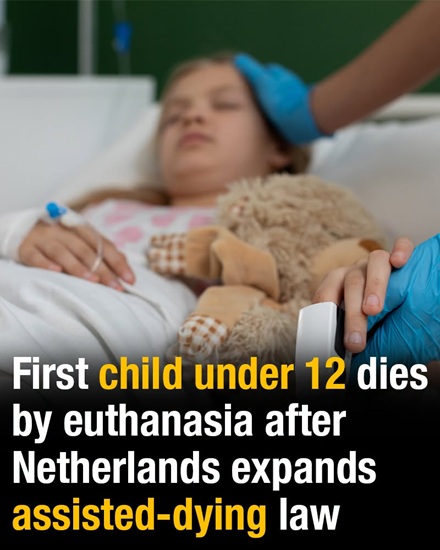
Reports from the Netherlands have drawn international attention after it was stated that a child under the age of 12 has died by euthanasia following changes to the country’s assisted dying framework for children. According to these reports, this marks the first known case involving a child under 12 since the updated rules were introduced. The situation has sparked renewed public discussion about medical ethics, legal safeguards, and end-of-life care for children suffering from severe illness.
Officials in the Netherlands confirmed that the child passed away last year, and the case was later included in an annual governmental review presented to parliament. The report covers cases involving late-term abortions and medically assisted deaths among minors. While confirmation of the case was made public, authorities did not release identifying information, including the child’s name, exact age, or detailed medical history, in order to protect privacy.
According to the information provided, the child was described as suffering from a severe and life-limiting illness. However, no further medical specifics were disclosed publicly. This lack of detail has been noted in various reports, reflecting the country’s strict privacy protections in sensitive medical cases involving minors. The focus of official statements has remained on legal and procedural oversight rather than individual circumstances.
The Dutch health minister, Sophie Hermans, reportedly acknowledged the case while presenting the annual review to lawmakers. The confirmation brought the case into public awareness and prompted renewed debate in political and medical circles. Discussions have since centered on how the law is applied in practice and how decisions are reviewed to ensure compliance with strict legal and ethical standards.
The Netherlands updated its assisted dying regulations in 2024, extending provisions to include children between the ages of 1 and 12 under very specific and tightly regulated conditions. According to official guidelines, such cases are only considered when a child is terminally ill and experiencing unbearable suffering with no expectation of recovery. The law emphasizes that all possible medical alternatives must first be explored.
Under these rules, euthanasia may only be considered when there is no reasonable treatment option available to relieve suffering, including palliative care measures. The intention of the framework, as described by authorities, is to address extreme and irreversible medical situations where continued suffering cannot be alleviated through conventional medical support. Each case is evaluated individually and under strict conditions.
The decision-making process requires close consultation between medical professionals and the child’s parents or legal guardians. Where possible, the child’s own perspective is also taken into account depending on age and ability to understand the situation. This collaborative process is designed to ensure that decisions are made carefully, transparently, and with the involvement of those closest to the patient.
Before any procedure can proceed, doctors are required to provide clear justification that all legal criteria have been met. This includes demonstrating that the child is suffering unbearably, that the condition is medically irreversible, and that no alternative treatment options remain. The documentation is then submitted for formal review under the national oversight system.
A specialized review committee is responsible for evaluating each case after it occurs. This committee typically includes medical experts from relevant fields, a legal professional, and an ethicist. Their role is to assess whether the attending physician acted in accordance with the law and followed appropriate medical standards during the decision-making process.
The committee’s findings are subsequently forwarded to the Public Prosecution Service, which determines whether the case complied with legal requirements. This layered oversight system is designed to ensure accountability and transparency in all cases involving medically assisted death. Authorities emphasize that such cases are subject to rigorous review after the fact.
Supporters of the framework argue that it provides a structured and humane option in the most extreme medical situations, where a child is experiencing continuous and unrelievable suffering. They emphasize that the law is not intended for general use but is strictly limited to exceptional circumstances where no other options remain available.
At the same time, the topic remains highly sensitive and continues to generate ethical debate both within the Netherlands and internationally. Critics and medical ethicists often raise concerns about the emotional weight of such decisions, the role of parental consent, and the long-term implications of extending assisted dying frameworks to younger age groups.
Public discussion has also focused on the importance of safeguards, transparency, and consistent application of medical guidelines. Many experts stress that every case must be handled with extreme care, ensuring that decisions are made independently and without external pressure. The involvement of multiple review bodies is intended to reinforce this principle.
In the wake of the reported case, attention has returned to how such laws are implemented in real-world medical settings. While official statements remain limited due to confidentiality rules, the case has nevertheless contributed to broader conversations about end-of-life care, medical ethics, and the balance between alleviating suffering and protecting vulnerable patients.
As the discussion continues, Dutch authorities maintain that all cases involving minors are subject to strict legal review and ethical oversight. The system is designed to ensure that decisions are made only in the most severe and medically documented circumstances, with multiple layers of evaluation to safeguard against misuse.
The reported case remains a focal point in ongoing debates about pediatric end-of-life care, highlighting the complex intersection of law, medicine, and ethics. While details remain limited due to privacy protections, the situation has nonetheless prompted reflection on how societies approach the most difficult decisions in modern healthcare.
