Lynda Wiesmeier had a relatively brief screen career, but her work remains connected with the unmistakable style of 1980s popular culture. Born Lynda Ann Wiesmeier on May 30, 1963, in Washington, D.C., she became known as both a model and actress before stepping away from the entertainment industry. Decades later, photographs and scenes from her films continue circulating online, sometimes attracting attention less for the productions themselves than for the fashion, cars and everyday visual details that instantly evoke another era.
Wiesmeier died on December 16, 2012, at the age of 49. Wiesmeier’s most prominent modeling breakthrough came in 1982. She was selected as Playboy’s Playmate of the Month for the magazine’s July 1982 issue and also appeared on that issue’s cover. Photographer Richard Fegley shot her centerfold. Her association with Playboy continued beyond that single appearance, with Wiesmeier participating in additional special editions, promotional work and video productions over the following years. That exposure helped make her recognizable as she simultaneously pursued opportunities in film.
Her screen credits began around the same period. Wiesmeier appeared in Ralph Bakshi’s animated drama American Pop, released in 1981, before accumulating a string of appearances throughout the 1980s. Her filmography includes Joysticks and Private School in 1983, followed by Preppies and R.S.V.P. in 1984. She then appeared in several 1985 releases, including Avenging Angel, Malibu Express, Wheels of Fire, Real Genius and Teen Wolf.

Some of those parts were small, but the films became enduring examples of 1980s genre entertainment. Real Genius developed a lasting reputation as a college comedy, while Teen Wolf became one of the decade’s recognizable youth-oriented films. Wiesmeier was never the central star of those productions, so it would be inaccurate to suggest that she became famous because of them. Nevertheless, appearing across so many releases within a relatively short period gave her filmography a distinctly 1980s character.
One of the most unusual titles associated with Wiesmeier is Evil Town. Although commonly listed as a 1987 film, its production history was extraordinarily complicated. Material used in the final movie originated with a project filmed in the 1970s. Producer-director Mardi Rustam later acquired the material and filmed roughly 20 additional minutes in the 1980s, including new scenes featuring Wiesmeier. The resulting production eventually became Evil Town.
Wiesmeier played a character named Dianne in the film. The cast also included James Keach, Robert Walker Jr., Dean Jagger, Michele Marsh and several other performers. Dean Jagger portrayed Dr. Schaeffer, whose experiments form the basis of the movie’s sinister plot. The story involves a community helping a scientist obtain victims for experiments intended to reverse aging, placing the film firmly within low-budget science-fiction and horror territory.

Another unusual connection involved Keith Hefner, the younger brother of Playboy founder Hugh Hefner, who also appeared in the film. Combined with Wiesmeier’s own Playboy background, his presence created a recognizable connection between the magazine’s world and the movie’s cast. However, that connection was simply an aspect of the casting and should not be overstated as being central to the production itself.
Evil Town eventually received a limited theatrical release in June 1987 after its unusually long and fragmented production process. Contemporary reference material lists June 2, 1987, as its limited theatrical release date, rather than the claim sometimes repeated online that theaters began screening it early because of overwhelming public demand. Available sources do not provide reliable support for that more dramatic version of events.
The film was not warmly received by critics. AllMovie critic Cavett Binion characterized it as a weak horror production assembled partly from footage originating with earlier unfinished material. That unusual construction helps explain why the final film can feel inconsistent in style and continuity. Nevertheless, obscure movies sometimes develop a second life long after their original release, particularly when clips and still photographs begin circulating among fans of retro cinema.

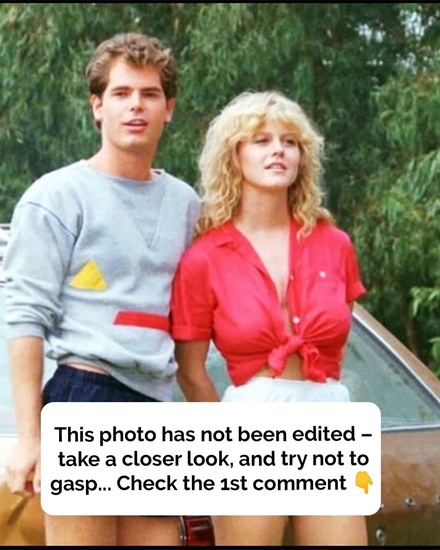
That appears to be part of what happened with images of Wiesmeier and actor Scott Hunter from the film. Hunter is credited as Tony, while Wiesmeier played Dianne. A photograph showing the two performers together has been repeatedly shared online as an example of distinctly 1980s fashion and styling. The appeal is easy to understand: clothing, hairstyles, automobiles and photography from an older production can serve as a visual time capsule even for viewers who have never watched the complete movie.
Wiesmeier’s clothing in such scenes reflected trends common during the period, including high-waisted shorts, bright colors and casual tops. Male fashion from the decade likewise frequently incorporated short athletic-style shorts, sweatshirts and combinations that can appear distinctly retro to modern viewers. There was never one single “1980s look,” however. The decade included everything from preppy styles and sportswear to punk, new wave, glam-inspired fashion and increasingly bold accessories.
That variety is one reason old photographs can generate powerful nostalgia. A relatively ordinary frame from a lesser-known movie may contain dozens of details associated with a particular period: the cut of clothing, the shape of a car, hairstyles, storefronts, furniture or even the way film stock reproduced colors. Viewers who lived through that period may recognize those details immediately, while younger audiences can encounter them as a form of visual history.
It is worth keeping that nostalgia separate from exaggerated claims about the past. Describing an image as capturing the atmosphere or fashion of the 1980s is reasonable. Claiming that everyone dressed in exactly that way or that life during the decade was objectively better would be a personal judgment rather than a verifiable fact. Wiesmeier’s photographs are interesting precisely because they document one small part of the entertainment and fashion culture of the period.
After her most active years in film, Wiesmeier largely left acting behind. Her credited film career is concentrated heavily in the first half of the 1980s, with Evil Town generally appearing as her last narrative feature credit. She continued to appear in Playboy-related video material, including productions released after some of her film roles. Her career therefore extended beyond traditional acting even after her movie appearances became less frequent.
Accounts published after her death describe her as eventually moving away from the entertainment business and focusing on a more private life. Some biographical material also reports that she attended autograph and fan events, maintaining a connection with people interested in her modeling and film work. Details about her private employment and family life are less consistently documented in major sources, so they are best treated cautiously rather than repeated as established facts without stronger confirmation.
What is consistently reported is that Wiesmeier died in Ramona, California, on December 16, 2012. She was only 49 years old. Multiple biographical sources identify a brain tumor as the cause of her death. Although some secondary accounts use the phrase “brain cancer,” the more consistently documented description is a brain tumor, so that is the more careful wording when recounting her death.
Her death came many years after the period when she was most visible in magazines and films, yet the internet has allowed performers with relatively compact filmographies to remain discoverable to new generations. Streaming services, movie databases, retro-film communities and social-media pages regularly revive actors, scenes and productions that might otherwise have remained largely forgotten.
Wiesmeier is a good example of that phenomenon. She was not one of the decade’s biggest box-office stars, and describing her that way would exaggerate her career. Instead, she was a model and working actress who appeared in a surprisingly broad collection of 1980s films, several of which later developed their own cult followings or nostalgic appeal. Her Playboy recognition also gave her an enduring place in the modeling history of that period.
The enduring interest in the Evil Town imagery illustrates how cultural memory often works. Audiences do not always rediscover an old movie because it was critically acclaimed. Sometimes one costume, automobile, location or photograph becomes enough to awaken memories of a period. A scene originally created simply to advance a low-budget horror film can decades later function as an accidental snapshot of fashion and filmmaking from another time.
That does not require turning Wiesmeier’s career into something it was not. Her documented accomplishments are interesting on their own: she was the July 1982 Playboy Playmate of the Month, worked extensively in modeling, appeared in numerous films during the 1980s and became part of productions ranging from comedy and teen movies to action and horror.
Today, photographs of Lynda Wiesmeier continue to circulate among fans of retro cinema and 1980s culture. For some viewers, they are reminders of movies watched decades ago; for others, they are simply fascinating glimpses of a visual style that has long since changed. Her story ultimately does not need sensational additions to remain interesting.
Lynda Wiesmeier had a short life and a relatively brief period in mainstream entertainment, but her surviving work preserves a recognizable piece of its era. From her 1982 modeling breakthrough to films including Real Genius, Teen Wolf, Malibu Express and the unusual production history of Evil Town, she remains part of the diverse collection of performers who helped give 1980s popular culture its distinctive look.
