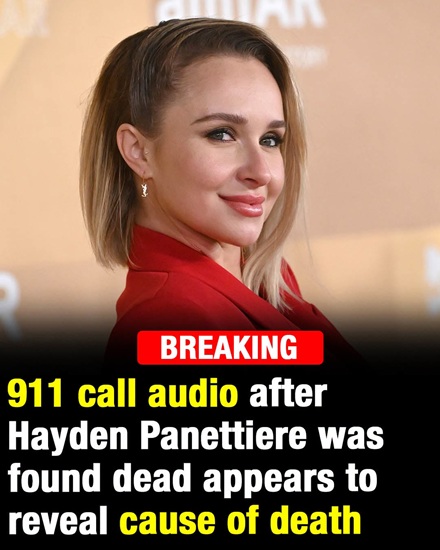
Hayden Panettiere’s sudden death at the age of 36 has prompted renewed questions after emergency-dispatch audio revealed additional details about the response to the South Carolina residence where she was found unresponsive. Panettiere, known internationally for Heroes, Nashville, Remember the Titans and the Scream franchise, died on Sunday, August 16, 2026, in Greenville. Police and emergency medical personnel responded to the residence at approximately 1:51 p.m. after an acquaintance contacted 911.
Dispatch communications referenced both an “overdose” and “cardiac arrest” while emergency personnel were responding. However, those communications do not represent a final medical determination of why Panettiere died. According to the Greenville Police Department, officers arrived with EMS personnel after receiving a report involving an unresponsive woman. Medical assistance was immediately provided, but Panettiere could not be revived.
She was pronounced dead at the scene, with subsequent reporting placing the time at approximately 2:32 p.m. The Greenville Police Department and Greenville County Coroner’s Office then began investigating the circumstances surrounding her death. Authorities said their preliminary findings showed no evidence of foul play or suspicious circumstances.
The emergency-dispatch recordings added information about what first responders encountered. Reports based on the audio said dispatchers referred to a possible overdose while noting that Panettiere was in cardiac arrest and that CPR was underway. Emergency crews reportedly used advanced cardiac life-support procedures while attempting to revive her. Those measures can include chest compressions and medications intended to support circulation during cardiac arrest. Despite those efforts, Panettiere did not regain consciousness.

One detail attracting particular attention is that Narcan was reportedly found at the residence. Narcan, the brand name for naloxone, is a medication used to rapidly reverse the effects of an opioid overdose. Its presence at the scene has contributed to reports describing Panettiere’s death as an “apparent” or “possible” overdose. However, finding naloxone near someone does not establish that opioids caused that person’s death, nor does it prove whether the medication was administered or why it was present. Toxicology and other medical findings are needed before an overdose can be confirmed as an official cause.
This distinction is particularly important because the Greenville County Coroner’s Office completed an autopsy after Panettiere’s death and reported that no signs of trauma contributing to her death were found. The coroner said the cause and manner of death remained undetermined while additional studies were being completed. That means the available evidence does not yet support stating definitively that Panettiere died from an overdose, cardiac event, or any other specific medical cause.
Cardiac arrest itself is also not necessarily an explanation for why someone dies. It describes the heart suddenly stopping its effective pumping function, something that can occur as the final result of many different medical emergencies. Dispatchers and paramedics may describe a patient as being in cardiac arrest because that is the immediate condition they are treating, while medical examiners later determine what caused the arrest. In Panettiere’s case, that underlying cause had not been officially announced when the initial investigation and autopsy findings were released.
The Greenville Police Department said the person who called 911 was an acquaintance of Panettiere. Reports indicate that she was found unresponsive before emergency services were contacted. Police have not publicly identified evidence suggesting that another person caused her death. Their preliminary investigation specifically found no signs of foul play or suspicious circumstances, while the coroner’s investigation continued separately to determine the medical cause.
Those facts provide the clearest framework for understanding the developing story. It is accurate to say that dispatch audio mentioned a possible overdose. It is also accurate to say that Panettiere was in cardiac arrest, that Narcan was reportedly present at the scene, and that emergency crews performed advanced resuscitation attempts. It is not yet accurate to state as a confirmed fact that an overdose caused her death.
Panettiere’s documented history with addiction has inevitably become part of the public discussion. During her lifetime, she openly acknowledged struggling with opioids and alcohol and described treatment and recovery in interviews. She spoke about periods in which addiction affected both her health and her personal life, and she did not attempt to hide the seriousness of those experiences. That openness became an important part of the way she discussed her later years. However, a person’s history with substance use does not by itself determine the cause of a later death.
This principle is especially important in responsible reporting. Panettiere’s past may provide biographical context, but it cannot substitute for toxicology results or an official determination from the coroner. Assuming that a previous addiction automatically explains her death would go beyond the available evidence. The same caution applies to the dispatch terminology. Emergency communications reflect what responders believed might be happening in real time; they are not the same thing as a completed forensic investigation.
Earlier in 2026, Panettiere had published her memoir, This Is Me: A Reckoning, in which she addressed some of the most difficult experiences of her life. She discussed growing up in the entertainment industry, addiction, postpartum depression, relationships, trauma, motherhood, recovery and the death of her younger brother, Jansen. The book gave Panettiere an opportunity to describe her experiences in considerably greater detail than she had in earlier interviews.
Her willingness to discuss addiction was particularly notable because she had spent much of her life associated with a polished celebrity image. Panettiere began working professionally as a small child and eventually became internationally famous as a teenager. For audiences, her career could appear extraordinarily successful from the outside. Her later interviews revealed that professional success existed alongside periods of serious personal difficulty.
Panettiere entered entertainment before she could fully understand what fame would eventually mean. She appeared in television and advertising as a child before taking on increasingly prominent acting roles. Her early work included One Life to Live and Guiding Light, followed by film and voice roles that introduced her to larger audiences.
In 1998, she voiced Dot in Pixar’s A Bug’s Life. Two years later, she appeared in Remember the Titans, the football drama starring Denzel Washington. The film became one of the best-known projects from the childhood stage of Panettiere’s career and helped establish her as a recognizable young actress.
Her international breakthrough came in 2006 with NBC’s Heroes. Panettiere played Claire Bennet, a high-school cheerleader whose extraordinary ability allowed her body to heal rapidly from injuries. Claire became central to the series, and the phrase “Save the cheerleader, save the world” became closely associated with the show during its period of greatest popularity.
The success of Heroes transformed Panettiere into one of television’s most recognizable young stars. She experienced international fame while still in her teens, appearing at major entertainment events and becoming a regular subject of celebrity coverage. Later in life, she would discuss how complicated it could be to mature while working continuously in an industry where other people were deeply involved in professional and personal decisions.
After Heroes, Panettiere continued working in film. In 2011, she played Kirby Reed in Scream 4. The character developed a lasting following among fans of the horror franchise, and Panettiere eventually returned as Kirby in Scream VI in 2023.
Her other defining adult role came through Nashville. Beginning in 2012, Panettiere played Juliette Barnes, a highly successful but emotionally complicated country singer. The role demanded dramatic and musical performances and ultimately earned Panettiere two Golden Globe nominations. She remained part of the series throughout its six-season run, which concluded in 2018.
While her professional career remained successful, her personal life became increasingly difficult. Panettiere welcomed daughter Kaya with former fiancé Wladimir Klitschko in December 2014. After giving birth, she experienced postpartum depression and later sought treatment.
She subsequently revealed that alcohol and opioid addiction had also become serious problems. Panettiere spoke about treatment, setbacks and recovery rather than presenting her struggles as something that disappeared after one intervention. Her later accounts emphasized that rebuilding her life required sustained effort and uncomfortable honesty about what had happened.
Those difficulties also affected motherhood. Panettiere eventually relinquished full custody of Kaya to Klitschko in 2018 while she was struggling significantly. She later rejected suggestions that she had simply abandoned her daughter and described living apart from Kaya as one of the most painful experiences of her life.
In her memoir and interviews, Panettiere explained that she believed Kaya needed stability during a period when she herself was unable to provide it consistently. She remained emotionally connected to her daughter and spoke repeatedly about how much she loved her. Friends discussing Panettiere after her death also said she had been planning to see Kaya again.
The actress experienced another devastating loss in February 2023 when her younger brother, Jansen Panettiere, died at 28. His family later said he died from complications related to an enlarged heart and the aortic valve. Hayden subsequently described losing her only sibling as feeling like losing part of herself.
Her grief became another important subject in later interviews. She acknowledged that Jansen’s death affected her emotionally and physically and that she continued carrying the loss while attempting to rebuild other areas of her life.
By 2026, Panettiere was publicly discussing both her past and her future. Her memoir represented an attempt to tell the story of her life in her own words after decades in which media coverage often defined her through roles, relationships and personal struggles.
Reports from people close to her suggested that Panettiere was maintaining relationships with friends and discussing plans before her death. One friend said she had spoken about traveling to see her daughter. Such accounts cannot determine what happened on August 16, but they add context to the life Panettiere was living before her sudden death.
The dispatch audio has nevertheless become one of the most discussed developments because it offers insight into the emergency response. The words “overdose” and “cardiac arrest” understandably attract attention, particularly because Panettiere had previously discussed addiction. But both terms require careful interpretation.
The word “overdose” in a dispatch recording indicates what responders were told or what was suspected during the emergency. It does not demonstrate what subsequent toxicology tests will show. First responders frequently operate with incomplete information because their priority is saving a person’s life rather than determining a final forensic explanation.
Similarly, finding Narcan at a residence does not prove that the deceased person consumed opioids. Naloxone has become increasingly available to individuals, households and community organizations precisely because it can save lives during suspected opioid emergencies. Its presence is potentially relevant evidence, but investigators must evaluate it alongside toxicology findings and all other information from the scene.
The autopsy finding of no significant trauma provides another piece of the investigation. It supports the police department’s preliminary statement that foul play was not apparent, but it still does not determine the medical cause of death. Toxicology testing and other specialized studies can take longer than the initial autopsy examination.
Until those results are complete, several important questions remain unanswered. Authorities have not officially identified what substance, if any, was present in Panettiere’s body at a fatal level. They have not formally concluded that an overdose caused the cardiac arrest described by dispatchers. And they have not announced the official manner of death.
That uncertainty means headlines should avoid turning a possibility into a certainty. “Dispatch audio references possible overdose” accurately reflects the evidence currently available. “Overdose confirmed as cause of death” would go beyond what officials have established.
The difference may seem small, but it matters greatly when reporting on a real person and a grieving family. Panettiere’s father confirmed her death while describing her as an extraordinary source of love and joy to those who knew her and to the audiences who followed her work. Her family requested privacy as they process the loss.
Her former colleagues have also begun publicly mourning her. Connie Britton, who starred alongside Panettiere in Nashville, shared a tribute reflecting on the actress’s energy and talent. Other colleagues and friends have similarly expressed shock at her sudden death.
Those reactions are another reminder that Panettiere’s life should not be reduced solely to the unanswered circumstances of her final afternoon. She spent more than three decades working professionally despite dying at only 36.
Audiences watched her move from childhood television into film, teenage stardom and adult dramatic roles. Claire Bennet, Juliette Barnes and Kirby Reed gave Panettiere recognizable characters across very different genres and stages of her life.
Her personal story was equally complicated. She became a mother, experienced postpartum depression, confronted substance-use problems, entered treatment and lived through the devastating death of her only sibling.
Panettiere eventually chose to speak openly about those experiences. Rather than allowing addiction and recovery to remain subjects of rumors, she discussed them herself and acknowledged both the difficulties she faced and the work required to change.
That openness now requires particular care after her death. It would be easy to use old statements about addiction to build a definitive narrative before medical authorities have reached one. Doing so would risk converting relevant history into unsupported certainty.
The available evidence supports a more measured account. Panettiere was found unresponsive at a Greenville residence on August 16. An acquaintance called emergency services at approximately 1:51 p.m. Responders attempted CPR and advanced life support. She was pronounced dead at approximately 2:32 p.m.
Dispatch communications mentioned an overdose and cardiac arrest. Narcan was reportedly found at the scene. Police found no preliminary evidence of foul play or suspicious circumstances. An autopsy found no signs of trauma contributing to the death.
The final cause and manner of death, however, remained under investigation pending additional testing. That is the most important fact when interpreting everything else.
It is therefore reasonable to describe investigators as examining circumstances consistent with a possible overdose, but not to present an overdose as officially confirmed. The distinction respects both the evidence and the investigative process.
If toxicology results ultimately establish that drugs were responsible, that conclusion can then be reported as an official medical finding. If the results point to another explanation, the reporting should change accordingly.
Until then, speculation adds little. The police and coroner have already provided a clear framework: no evidence of foul play has emerged, no contributing trauma was found, and further medical investigation is required.
Panettiere’s previous addiction struggles can be acknowledged without treating them as a verdict on what happened. Her life included addiction, but it also included decades of acting, motherhood, recovery efforts, friendships, grief and plans she was still discussing shortly before her death.
That fuller context is especially important for her 11-year-old daughter, Kaya, and for Panettiere’s family. Public curiosity about a famous person’s death is understandable, but accuracy remains more important than being first to declare a cause.
Her death at 36 is already tragic without embellishment. There is no need to exaggerate the available evidence or present preliminary emergency terminology as a completed autopsy conclusion.
For now, the 911 dispatch recordings provide a clearer picture of the emergency response but not a final answer about why Hayden Panettiere died. They show that responders were dealing with cardiac arrest, that a possible overdose was mentioned and that extensive lifesaving efforts were attempted.
The autopsy adds another important fact: no signs of trauma contributing to her death were found. Police likewise reported no evidence of foul play or suspicious circumstances.
What remains unknown is the medical event that led to Panettiere’s death. That question belongs to the Greenville County Coroner’s Office and the additional testing still being completed.
Until officials release those findings, the responsible conclusion is straightforward: an overdose is one possibility raised by emergency-dispatch information, but it has not yet been officially confirmed as Hayden Panettiere’s cause of death.
Her legacy meanwhile extends far beyond the final emergency call. Panettiere leaves behind a daughter, family members, friends, colleagues and audiences who watched her grow from a child performer into one of television’s most recognizable young stars.
From Remember the Titans to Heroes, from Nashville to the Scream franchise, she built an unusually extensive career before reaching 36. In her later years, she also chose to speak openly about struggles that had remained hidden behind that successful public image.
As official investigators continue their work, Hayden Panettiere’s death deserves the same accuracy she sought when telling her own story. The dispatch audio offers important new information, but it does not provide the final medical conclusion.
For now, the confirmed record remains limited but clear: emergency responders attempted to save her after she was found unresponsive, preliminary investigators found no evidence of foul play, an autopsy found no contributing trauma, and the official cause of death remains under investigation.
