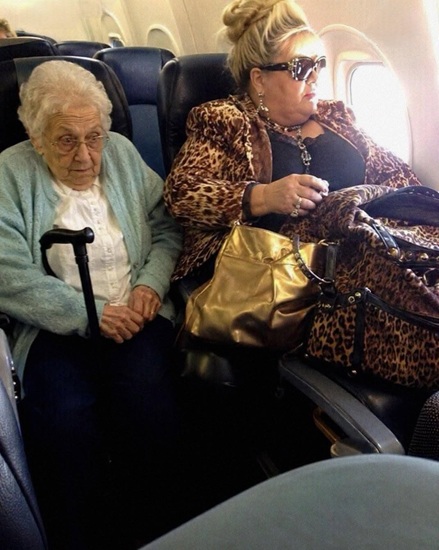
Rebecca had spent months planning a gift she hoped her grandmother would never forget. Rose was 86 and had lived a long life filled with responsibilities, family commitments, and dreams that had repeatedly been postponed. One of those dreams was surprisingly simple: she wanted to stand beside the ocean and see the horizon stretching farther than she could imagine. Rebecca decided that rather than buying another ordinary birthday present, she would save enough money to take Rose to Florida.
When she finally handed her grandmother the tickets, Rose became emotional, realizing that something she had talked about for decades was finally going to happen. The trip meant far more to Rose than an ordinary vacation. She had seen photographs of beaches, watched the ocean in movies, and listened to relatives describe warm sand and waves rolling toward shore, but she had never experienced any of it herself. Rebecca wanted their journey to be comfortable and memorable from beginning to end.
She helped Rose pack carefully, checked medication and identification, and made sure they arrived at the airport with plenty of time. Rose moved slowly because arthritis made long walks and sudden movements uncomfortable, but she remained cheerful and excited about what was waiting at the end of the flight. The first complication appeared when Rebecca checked their boarding passes and realized their assigned seats were separated. She had hoped to sit beside her grandmother, particularly because Rose sometimes needed assistance getting settled.
With the aircraft nearly full, changing seats was not immediately possible. Rebecca therefore escorted Rose to her assigned row before heading toward her own seat several rows away. She hoped the passengers sitting beside her grandmother would show a little patience.
When they reached the row, Rebecca noticed that another passenger was taking up part of the space intended for Rose. The woman, named Tiffany in this fictional account, had lifted the armrest and was positioned partly across the boundary between the seats. Rose was physically small, but arthritis made twisting into a narrow position painful. Rebecca politely asked whether Tiffany could move enough for Rose to sit normally.
Tiffany responded defensively. She insisted that she had paid for her seat and did not believe she should have to adjust herself. Rebecca tried to explain that nobody was asking her to leave the seat or surrender something she had purchased. She simply wanted her grandmother to be able to sit in the space assigned to her without being forced into an uncomfortable position.
A flight attendant named Cheryl came over after noticing the disagreement. She listened to both passengers and looked for another available seat. Unfortunately, the cabin was full enough that there was no simple relocation available. Cheryl reminded everyone that passengers needed to remain within their assigned seating area as much as possible and encouraged the group to work together.
Instead of allowing the conversation to end, Tiffany became increasingly irritated. She made a dismissive comment about Rose’s age and questioned why someone so old would want to travel. Rebecca immediately felt angry. The trip had been planned precisely because Rose had spent decades putting other responsibilities before herself, and the idea that age somehow removed her right to travel felt unnecessarily cruel.
Rebecca started to respond, but Rose quietly reached for her hand. She told her granddaughter that they had waited too long for this vacation to allow one stranger to determine how they felt about it. Rose had lived through enough difficult moments to understand that arguments often consumed more energy than they deserved.
Reluctantly, Rebecca returned to her own assigned seat. She kept looking toward her grandmother as passengers finished boarding and the cabin doors closed. Rose adjusted herself as comfortably as possible. The passenger seated on the aisle attempted to create a little additional space but had nowhere else to move.
The aircraft eventually pushed away from the gate and began taxiing toward the runway. Rose watched through the window with fascination. Even the uncomfortable seating arrangement could not completely suppress her excitement. Taking off still felt extraordinary to her, and she focused on the ground disappearing beneath the aircraft.
Rebecca remained concerned several rows behind. Every few minutes, she glanced forward, trying to determine whether Rose seemed uncomfortable. She knew her grandmother disliked becoming the center of attention and would probably tolerate more discomfort than she should rather than complain.
Once the aircraft reached cruising altitude and the seatbelt sign was switched off, passengers began moving around the cabin. Some retrieved items from overhead bins, while others opened laptops or phones. Tiffany remained absorbed in her own activities and seemed determined not to acknowledge Rose.
Rose, however, noticed something unusual about the woman beside her. At first, she hesitated to say anything because their earlier interaction had been unpleasant. She considered simply remaining silent.
Then Rose decided that allowing another person to experience avoidable embarrassment would not become acceptable simply because that person had been rude to her. She leaned slightly toward Tiffany and politely tried to get her attention.
Tiffany ignored her.
Rose waited a moment and attempted again. She explained that there was something Tiffany might want to check before standing up or walking through the cabin.
The comment only irritated Tiffany further. She told Rose to stop bothering her and returned her attention to her phone.
The aisle passenger noticed the exchange and looked toward Rose. From her expression, he could tell that she was not trying to start another argument. She appeared genuinely concerned about something.
He quietly suggested that Tiffany might want to listen.
Tiffany refused again. By that stage, the conversation had become loud enough that several nearby passengers were aware something was happening. Rose appeared uncomfortable with the attention and tried once more to explain discreetly.
She told Tiffany that part of her clothing had become caught awkwardly and that she might want to adjust it privately before moving around the cabin.
For the first time, Tiffany actually checked.
She immediately realized Rose had been trying to help her.
Her clothing had shifted in a way she had not noticed when sitting down. Rather than allowing the situation to continue, Rose had repeatedly attempted to warn her quietly.
Tiffany’s expression changed almost instantly. The confidence with which she had dismissed Rose disappeared, replaced by embarrassment and surprise.
She stood carefully and corrected the problem before heading toward the restroom to make sure everything was properly adjusted.
Some nearby passengers reacted to the awkward moment, but Rose did not join in. She did not point, laugh, or celebrate Tiffany’s embarrassment.
That reaction mattered. Rose had been insulted earlier, but she did not interpret Tiffany’s uncomfortable moment as permission to humiliate her in return. She had tried to prevent the embarrassment precisely because she believed dignity should extend even to people who had failed to show dignity to her.
When Tiffany eventually returned to the row, her demeanor was noticeably different. She did not immediately apologize, but she sat more carefully and remained within her own space.
Rose did not demand an apology.
The flight continued much more quietly.
Rebecca eventually walked forward when passengers were permitted to move around and checked on her grandmother. Rose assured her that she was fine.
Only later did Rebecca hear the full story.
She was initially astonished that Rose had tried so hard to help the same passenger who had treated her dismissively. Rose’s explanation was simple: another person behaving badly did not require her to behave badly as well.
That idea became more memorable than the awkward incident itself.
The story also illustrates why close seating on aircraft requires patience from everyone involved. Commercial aircraft bring strangers into extremely limited spaces, sometimes for many hours. Passengers may have different body sizes, mobility limitations, health conditions, ages, and comfort needs.
Seat disagreements can therefore become emotionally charged very quickly.
The safest response is usually to involve cabin crew instead of allowing frustration to become a confrontation. Flight attendants can clarify seating rules, look for available alternatives when possible, and help prevent disagreements from escalating.
Passengers can also make a significant difference simply by communicating respectfully.
Someone needing additional room does not deserve ridicule.
Someone with limited mobility does not deserve to be treated as an inconvenience.
Older travelers have the same right to dignity and ordinary courtesy as everyone else.
Age does not automatically mean confusion, weakness, or inability.
In Rose’s case, her age had given her decades of experience observing people and responding calmly to difficult situations.
Tiffany had initially interpreted Rose’s quiet demeanor as weakness.
The opposite was closer to the truth.
Rose possessed enough confidence that she did not need to win every argument.
She also had enough empathy to warn someone who had been unkind to her.
That did not excuse Tiffany’s earlier behavior. Courtesy does not require pretending that insulting comments are acceptable.
Instead, Rose demonstrated that a person can set boundaries without allowing another person’s rudeness to control their own behavior.
When the aircraft finally landed in Florida, Rebecca helped her grandmother gather her belongings and leave the cabin.
Neither wanted the flight to become the defining memory of their vacation.
They had traveled for something far more meaningful.
Later, after reaching the coast, Rose finally saw the ocean.
The experience was completely different from photographs.
She stood near the water and watched waves roll toward the sand before disappearing again.
The horizon seemed almost impossible to her.
For a few moments, there were no crowded aircraft seats, arguments, or impatient strangers.
There was simply an 86-year-old woman experiencing something she had wanted to see for most of her life.
Rebecca watched her grandmother take everything in.
The months of saving suddenly seemed worthwhile.
Rose eventually stepped close enough for the water to reach her feet.
She laughed when the first wave surprised her.
That moment became the memory Rebecca had wanted to create from the beginning.
The uncomfortable flight had been temporary.
The experience of fulfilling her grandmother’s dream would remain.
The fictional encounter on the aircraft also offers a broader lesson about judging people according to age.
Modern culture sometimes treats youth as if it automatically represents competence and age as if it represents decline.
Real people are far more complicated.
Older adults may need physical assistance while possessing extraordinary judgment, emotional control, and awareness.
Younger adults may be physically independent while still having much to learn about patience.
No generation owns wisdom.
It develops through experience and through a willingness to learn from mistakes.
The same principle applies to travel etiquette.
A passenger experiencing difficulty should be able to request assistance without being humiliated.
Another traveler should be able to raise a concern without automatically triggering hostility.
Air travel is already stressful enough without passengers intentionally making one another’s journeys more difficult.
Small acts of cooperation can transform an uncomfortable flight.
Moving an armrest when possible, keeping belongings within personal space, allowing someone with mobility problems additional time, and listening when another passenger politely speaks can make enormous differences.
The fictional story also emphasizes why embarrassment should not become entertainment.
When someone experiences an accidental clothing problem or another private mishap, recording or photographing that person would only increase the humiliation.
Rose’s response was different.
She tried to solve the problem quietly.
The fact that Tiffany had previously behaved rudely did not make public humiliation appropriate.
That distinction separates accountability from revenge.
Tiffany deserved to be reminded to respect another passenger’s space.
She did not deserve to have an embarrassing accident turned into public entertainment.
Rose understood both ideas at the same time.
Her response ultimately demonstrated more maturity than any dramatic comeback could have achieved.
She did not need to defeat Tiffany.
She simply refused to become like her.
By the time Rebecca and Rose returned home, the family had two very different stories from the vacation.
One concerned an uncomfortable encounter with another passenger.
The other concerned Rose standing beside the ocean for the first time at 86.
The second story mattered far more.
That may be the strongest lesson of all.
People cannot always control who sits beside them, what another person says, or how strangers behave.
They can control how much power those moments receive.
Rose refused to allow one unpleasant interaction to become bigger than a dream she had waited decades to experience.
She also refused to allow another person’s arrogance to erase her own values.
Respect remained respect even when it was not immediately returned.
Kindness remained kindness even when the recipient had not earned affection.
And dignity remained valuable regardless of whether someone was 26, 46, or 86.
The fictional story of Rose and Rebecca therefore is not really about an embarrassing moment on an airplane.
It is about how easily people underestimate others based on appearance, age, or first impressions.
It is about the difference between reacting impulsively and responding thoughtfully.
Most importantly, it is about refusing to allow another person’s behavior to decide what kind of person you become.
Rose arrived in Florida still excited about the ocean.
One rude passenger had not changed that.
When she finally stood on the beach with Rebecca beside her, the difficult flight became little more than an uncomfortable chapter on the way to something she had dreamed about for decades.
The waves continued arriving at the shore.
Rose watched them quietly.
And the vacation ultimately became what Rebecca had always intended it to be: a celebration of a long-delayed dream and a reminder that it is rarely too late to experience something beautiful.
