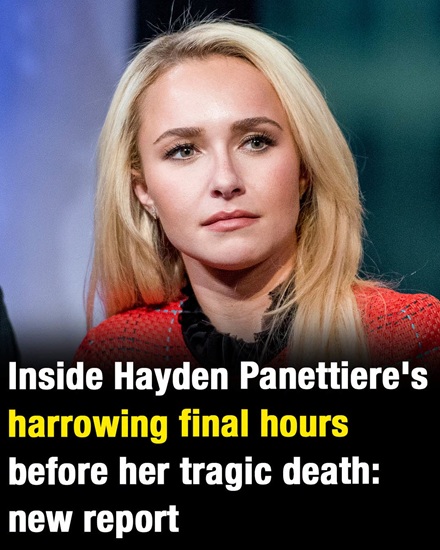
Hayden Panettiere’s sudden death at the age of 36 has prompted questions about the actress’s final days, particularly after reports emerged that she had been experiencing physical health problems before she was found unresponsive in South Carolina. Panettiere, widely known for Heroes, Nashville and the Scream franchise, died on Sunday, August 16, 2026, after emergency responders were called to a residence in Greenville. Police said their preliminary investigation found no signs of foul play or suspicious circumstances.
An autopsy later found no trauma that contributed to her death, while the official cause and manner remained pending further investigation. The emergency call was placed at approximately 1:51 p.m. from Judson Mill Lofts in Greenville. According to the Greenville Police Department, an acquaintance reported an unresponsive woman at the residence. Officers and emergency medical personnel arrived and found Panettiere in cardiac arrest.
Medical assistance was immediately provided, including resuscitation efforts, but she could not be revived. She was pronounced dead at approximately 2:32 p.m. Police subsequently confirmed that Panettiere’s death remained under active investigation. The department said there were no preliminary indications of foul play or suspicious circumstances, while the Greenville County Coroner’s Office began the separate medical process of determining what caused her death. Those statements are important because they establish what authorities actually know while avoiding conclusions that have not yet been medically confirmed.
The autopsy provided another significant piece of information. Greenville County Coroner Mike Ellis said no signs of trauma were discovered that would have contributed to Panettiere’s death. However, the coroner did not announce a final cause. Additional testing and studies were still required, meaning any attempt to connect her death definitively to one particular health condition remains premature.
Attention has also turned to Panettiere’s physical condition in the months before her death. TMZ reported that a source close to the actress said she had been complaining about back pain over the previous year. The outlet also reported that she had experienced mobility difficulties. Those reports are consistent with comments Panettiere herself made publicly several months earlier about a frightening and unexplained physical problem.
In a May 2026 interview with Women’s Health, Panettiere discussed what she described as a serious physical setback. She said she had suddenly woken up with intense tingling sensations extending from her waist downward. She also explained that she had been unable to properly move her toes or lift one of her feet. According to Panettiere, doctors had not been able to give her a clear explanation for what had caused the symptoms.
Panettiere described the experience as frightening because she did not initially know whether her mobility would return. The uncertainty surrounding the symptoms made the situation especially difficult. Rather than describing a clear diagnosis, she said she had spent considerable time resting and attempting to rebuild her physical strength.
The Women’s Health feature focused largely on her recovery and exercise routine. Panettiere had been working with movement and rehabilitation techniques designed to help rebuild strength after the unexplained physical episode. She discussed the experience as something she was recovering from rather than as a condition with a clearly identified medical cause.
Those comments have understandably attracted renewed attention after her death. However, there is currently no verified evidence establishing that the neurological symptoms or reported back pain caused, contributed to, or had any connection with what happened on August 16. The coroner has not publicly linked those earlier health concerns to her death.
This distinction is essential because separate medical facts can easily be connected after a sudden death even when investigators have not found a relationship between them. Panettiere experienced physical symptoms during the previous year, and she later died unexpectedly. Both statements are documented. A causal connection between them is not.
Reports have also focused on emergency-dispatch communications from the day she died. Audio referenced both cardiac arrest and a possible overdose while responders were dealing with the emergency. Narcan, a medication used during suspected opioid overdoses, was also reportedly found at the residence. Even those details do not establish the official cause of death.
Cardiac arrest describes what happens when the heart stops effectively pumping blood, but it does not by itself explain why that happened. Many different medical emergencies can result in cardiac arrest. The underlying cause must be determined through medical investigation, including an autopsy, toxicology testing and other studies.
Likewise, the word “overdose” appearing in dispatch communications represents what emergency personnel were told or suspected during an active response. Dispatch information is preliminary by nature. Emergency workers must make decisions quickly using incomplete information, while coroners and medical examiners can later examine evidence in far greater detail.
That is why the Greenville County Coroner’s Office has maintained that the cause and manner of Panettiere’s death remain pending. No final medical determination has yet connected her death to an overdose, her back pain, her earlier neurological symptoms, or another specific condition.
Panettiere had traveled from Los Angeles to South Carolina shortly before her death. TMZ reported that she and her on-again, off-again boyfriend Brian Hickerson flew south on Saturday, one day before emergency services were called. Hickerson had reportedly been staying at the residence as well.
The timing of that trip has led to additional public questions, but again, the known facts do not establish anything suspicious about the travel itself. Police have explicitly said their preliminary investigation found no signs of foul play or suspicious circumstances.
Panettiere’s father, Alan “Skip” Panettiere, confirmed his daughter’s death in a statement issued through her representative. He described Hayden as an extraordinary presence who brought love and happiness to people who knew her personally and to audiences who had watched her work throughout her career.
The announcement shocked viewers partly because Panettiere had been a familiar presence on television and film for most of her life. She began working professionally as a child and accumulated decades of acting credits before reaching the age of 36.
Her childhood career included television roles on One Life to Live and Guiding Light. She also appeared in numerous commercials before becoming increasingly visible in film.
Panettiere voiced Dot in Pixar’s A Bug’s Life and later appeared alongside Denzel Washington in Remember the Titans. The sports drama became one of her most recognizable early movie roles and helped introduce her to a wider audience.
Her international breakthrough arrived with Heroes in 2006. Panettiere played Claire Bennet, a high-school cheerleader who discovers she possesses extraordinary regenerative abilities.
Claire quickly became one of the defining characters of the series. The phrase “Save the cheerleader, save the world” became closely associated with Heroes and helped transform Panettiere into one of television’s most recognizable young performers.
The success of the show brought her international fame while she was still a teenager. Panettiere appeared at premieres, awards ceremonies and other major entertainment events while experiencing the intense public attention associated with becoming famous at a young age.
Later in her career, she took on another defining television role as Juliette Barnes in Nashville. Beginning in 2012, Panettiere portrayed an ambitious country singer whose professional success existed alongside complicated personal struggles.
The role allowed Panettiere to combine dramatic acting and music. Her performance earned two Golden Globe nominations and became one of the most acclaimed parts of her adult career.
Panettiere also developed a following among horror audiences as Kirby Reed in Scream 4. More than a decade later, she returned to the franchise in Scream VI, reprising the role in 2023.
Beyond acting, Panettiere became increasingly open about difficult experiences in her personal life. She discussed postpartum depression following the birth of her daughter Kaya in 2014 and later spoke about addiction involving alcohol and opioids.
Her willingness to acknowledge those struggles challenged the polished image often associated with celebrity. Panettiere explained that professional success had not protected her from serious problems behind the scenes.
She eventually entered treatment and described recovery as a difficult process involving setbacks and sustained effort. Her account did not present healing as something that happened immediately or permanently after one intervention.
Panettiere’s experiences with addiction are relevant biographical information, particularly because she chose to discuss them publicly. They should nevertheless not be used as proof of what caused her death.
A past history of opioid or alcohol addiction does not automatically mean a later sudden death was caused by either substance. That determination requires medical evidence.
The same principle applies to the physical difficulties she described in Women’s Health. Her neurological symptoms were real according to her own account, but investigators have not said they contributed to her death.
Panettiere had described waking up with unusual sensations in her lower body and temporarily being unable to properly move parts of her feet. The experience frightened her partly because doctors had not provided a definitive explanation.
Over time, she worked on rebuilding her physical strength. The May 2026 feature showed Panettiere participating in a barre-based rehabilitation routine.
Her comments indicated that movement had gradually improved. She was not presenting herself as someone who had received a terminal diagnosis or who knew the unexplained symptoms would threaten her life.
That makes it particularly important not to retroactively portray the symptoms as a known warning that she was about to die. There is currently no official evidence supporting such a conclusion.
The reported back pain likewise remains contextual information rather than an established explanation. TMZ attributed the detail to a source close to Panettiere, while the actress herself had previously described lower-body neurological symptoms.
Doctors and investigators may ultimately determine whether any relationship existed. Until they do, responsible reporting should keep those facts separate.
Panettiere’s personal life contained other major challenges as well. She became a mother in December 2014 when she and former fiancé Wladimir Klitschko welcomed daughter Kaya.
Following the birth, Panettiere experienced postpartum depression. She eventually sought treatment and later described how difficult that period had been.
Her addiction struggles affected her ability to provide the stability she wanted for her daughter. In 2018, Panettiere relinquished full custody to Klitschko while Kaya lived primarily with him.
Panettiere later strongly rejected claims that she had simply abandoned her child. She said the decision was one of the most painful of her life and explained that she believed Kaya needed stability while she worked on her health and recovery.
Motherhood remained an important part of Panettiere’s later interviews and her 2026 memoir, This Is Me: A Reckoning.
The book allowed Panettiere to discuss childhood fame, addiction, relationships, postpartum depression, motherhood and recovery in her own words.
Her brother Jansen’s death in 2023 also became a central subject. Jansen died at only 28 from complications associated with an enlarged heart and aortic valve problems.
Panettiere described losing her only sibling as devastating. She said the grief affected her emotionally and physically and remained something she was working through years later.
The memoir therefore presented her life as far more complicated than the roles that made her famous. It included professional success alongside addiction, motherhood, grief and attempts at recovery.
Panettiere was also continuing to work professionally. Her later projects demonstrated that she had not entirely stepped away from acting despite the difficulties she had experienced.
This broader context matters because a sudden death can quickly cause every previous health complaint or personal struggle to be reinterpreted as a warning sign.
That kind of retrospective interpretation can become misleading.
Panettiere’s back pain deserves to be reported because she had reportedly experienced it and publicly discussed serious mobility problems.
Her addiction history deserves to be acknowledged because she herself spoke about it.
The emergency response deserves to be described accurately because dispatchers referenced cardiac arrest and a possible overdose.
But none of those facts currently provides a final answer about why she died.
The official medical conclusion remains pending.
That uncertainty is not a gap that should be filled with speculation.
The coroner’s findings so far are straightforward: Panettiere was found in cardiac arrest, resuscitation attempts failed, the autopsy found no trauma contributing to her death, and additional studies are required.
Police findings are similarly clear. Their preliminary investigation has not indicated foul play or suspicious circumstances.
Those conclusions make unsupported theories involving violence inappropriate based on the evidence currently available.
They also mean that earlier health problems should not be declared responsible before medical authorities examine the complete evidence.
Panettiere’s physical symptoms may ultimately prove unrelated.
They may become medically relevant.
At this stage, neither conclusion has been officially established.
That is why careful language matters.
Saying Panettiere “had experienced back pain before her death” reflects current reporting.
Saying back pain “caused her death” would be unsupported.
Saying she described severe unexplained lower-body symptoms in May is accurate.
Saying those symptoms were a warning of her death would go beyond the evidence.
Similarly, it is accurate to report that dispatch communications referred to a possible overdose.
It remains inaccurate to describe overdose as the confirmed official cause until the coroner makes that determination.
The distinction protects accuracy during an active investigation.
It also respects Panettiere’s family and daughter, who are experiencing a private loss under intense international attention.
For audiences, the unanswered questions surrounding her final hours are understandably compelling.
A famous 36-year-old actress dying unexpectedly naturally leads people to want to understand what happened.
But the desire for an explanation cannot produce reliable medical evidence faster than investigators can obtain it.
Toxicology testing and other studies take time because laboratories must identify substances, determine concentrations and consider how different findings relate to one another.
The final conclusion must account for the full medical and investigative record.
Until that process is complete, Panettiere’s earlier physical symptoms remain one part of her recent health history rather than a confirmed explanation for her death.
Her death also should not eclipse the wider story of her life.
Panettiere spent more than three decades in entertainment despite being only 36.
She moved from child acting into international television fame and later established major adult roles.
Claire Bennet made her a defining face of Heroes.
Juliette Barnes demonstrated her dramatic and musical range on Nashville.
Kirby Reed connected her with generations of Scream fans.
Her later years revealed another side of Panettiere.
She became increasingly willing to speak about experiences that had been hidden behind those professional achievements.
Addiction, postpartum depression, motherhood, physical health concerns and grief became subjects she discussed publicly instead of allowing speculation to define them.
Her memoir represented one of the clearest attempts to take ownership of that story.
Now that Panettiere is gone, maintaining the distinction between what she actually said and what others speculate becomes even more important.
She did speak about frightening physical symptoms.
She did reportedly complain about back pain.
She did have a documented history of addiction.
She was found in cardiac arrest.
Police found no preliminary evidence of foul play.
An autopsy found no contributing trauma.
Those facts can all coexist without proving a single cause.
The final medical explanation remains unresolved.
When the Greenville County Coroner’s Office completes its additional studies, a clearer picture may emerge.
Until that point, reporting should describe the investigation as ongoing.
Hayden Panettiere’s death at 36 is tragic without adding conclusions authorities have not reached.
The evidence currently available tells the story of an actress who had been dealing with physical health concerns, who traveled to South Carolina shortly before her death, and who was found unresponsive the following day.
Emergency crews attempted to save her.
Their efforts were unsuccessful.
Investigators found no preliminary indication of foul play.
The autopsy found no trauma that contributed to her death.
The exact reason her heart stopped remains under investigation.
That is currently the most accurate way to understand what happened.
Panettiere’s earlier back pain and unexplained lower-body symptoms remain potentially relevant health details, but no official source has linked them to her death.
Whatever the final medical findings eventually show, her legacy will extend far beyond the unanswered questions surrounding August 16.
She leaves behind her daughter Kaya, her parents, friends, colleagues and millions of viewers who watched her perform throughout a career that began in childhood.
Her life contained remarkable professional achievement alongside serious personal challenges.
In her final years, she increasingly chose to discuss both.
For now, the responsible conclusion remains limited but clear: Hayden Panettiere had experienced significant physical symptoms and reportedly complained of back pain, but investigators have not established that those problems caused or contributed to her sudden death. The official cause and manner remain pending further medical investigation.
