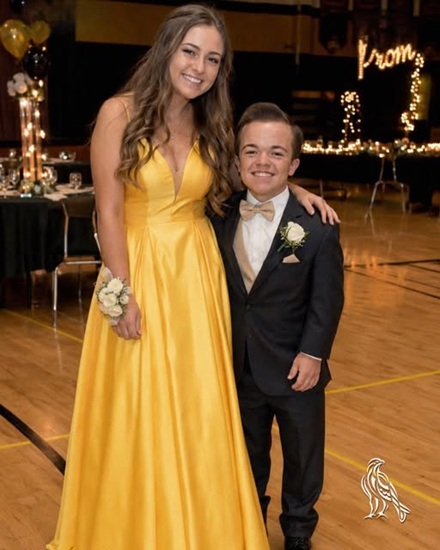
The laughter started the moment Elliot and I stepped through the gym doors, sharp and immediate, cutting through the music and decorations like something rehearsed and cruel. It wasn’t quiet curiosity or confused glances—it was full, open laughter that spread quickly across the crowded prom hall. Near the punch table, a girl leaned toward her friends, laughing loudly enough for us to hear clearly. “Did she seriously bring her little brother to prom?” she said, and the words triggered another wave of laughter from nearby students.
Someone from behind the balloon arch called out jokingly, “Looks like one and a half people showed up tonight,” and that line was enough to send several others into louder laughter, feeding off each other without hesitation or restraint. I felt Elliot’s fingers tighten around mine for a moment, a small reflex of tension, before he deliberately relaxed his grip. His voice stayed calm beside me. “Don’t look at them,” he said quietly, though we both knew ignoring it was harder than it sounded.
Elliot had transferred to our school during sophomore year, and I still remember how the entire classroom went silent when he first walked in behind the principal. The reaction wasn’t subtle, and neither were the assumptions that followed. He had achondroplasia, a form of dwarfism, and most people noticed his height before they noticed anything else about him—before they noticed his intelligence, humor, or the quiet confidence he carried into unfamiliar rooms.
The jokes started almost immediately, as if people needed to turn difference into entertainment. Some laughed because others laughed first, repeating comments they didn’t think would matter or cause harm in the long run. I never laughed. Three days later, I sat next to him in chemistry because nobody else chose that seat, expecting silence or awkward distance, but instead we ended up talking about movies, arguing about endings, and slowly becoming friends.
That friendship didn’t happen all at once. It grew through shared notes, late-night messages about homework, cafeteria conversations, and long walks home where silence eventually became comfort instead of distance. Over time, friendship turned into something deeper without either of us clearly naming when it changed. It simply shifted quietly into love, shaped by consistency, understanding, and the way he made everything feel less overwhelming.
Elliot was the first person who listened when I panicked about exams instead of telling me to relax. When I was sick one year, he showed up at my door with soup and handwritten notes from every class I missed. Even then, people didn’t stop talking. The jokes just shifted direction, turning toward me as well. “You could date someone normal,” they would say, or make comments about height that were meant to be funny but landed differently.
At first, those remarks hurt more than I admitted. Eventually I learned to ignore them, or at least pretend I had, while Elliot learned to carry them with quiet patience he had developed long before I met him. But sometimes I caught it—a brief change in his expression when he thought no one was watching. Not anger exactly, but something closer to exhaustion, like he was tired of constantly being observed instead of understood.
That was why prom mattered so much. I wanted him to have one night that didn’t feel heavy. Just one night where he wasn’t reduced to jokes or stares, but simply seen as himself. My mom helped me pick out my dress weeks in advance, while Elliot arrived at my house in a navy-blue suit with a small blue rose pinned neatly to his jacket, looking more nervous than I expected.
My dad shook his hand at the door, smiling in a way that felt genuine. “You look sharp tonight, son,” he said, and for a moment Elliot’s expression changed completely, like he had been given permission to belong. Now, inside the gym filled with lights, music, and laughter that followed us from the entrance, I felt that hope begin to collapse under the weight of attention we couldn’t escape.
The decorations looked beautiful in any other situation—strings of gold lights, couples dancing, teachers standing near walls pretending not to hear—but none of it softened the comments spreading through the room. Another voice called out across the dance floor, “Careful not to lose him in the crowd,” followed by more laughter, louder and more confident now, as if the room had decided what tonight was supposed to be.
I felt my throat tighten, but Elliot leaned slightly closer and whispered, “Ignore them.” I whispered back, “How?” because ignoring something doesn’t stop it from happening around you. Then, instead of walking away, Elliot surprised me. He guided me forward, not toward the exit or the tables, but directly into the center of the dance floor where everyone could see us more clearly.
The music shifted into a slower song, softer now, and Elliot placed one hand at my waist, looking at me as if the rest of the room had already disappeared from his awareness entirely. “Dance with me,” he said quietly, and for a moment, the noise behind us felt slightly distant, like it belonged to another space that wasn’t touching us directly anymore.
People still watched. Some still whispered. But Elliot kept his focus on me, gently moving with the rhythm as if the judgment around us had no authority over this moment. “They’re jealous,” he said suddenly, with a small smile. I almost laughed, unsure if he meant it seriously, but he nodded as if it was obvious. “Obviously,” he added.
For a brief moment, it almost worked. The weight of the room faded slightly, replaced by something softer, something closer to normal, like we might actually get through the night. Then a voice cut through again—louder, sharper—mocking us openly. Laughter followed immediately, harsher this time, and I saw several students turning just to watch our reaction. That was when something in Elliot’s expression changed. Not anger, not retaliation—just a quiet crack of humiliation that made everything feel heavier than before.
I leaned closer to him, voice shaking. “Let’s go,” I whispered. “Please.” He nodded once, and we turned toward the exit together, ready to leave without another word. But before we could move far, a hand touched my shoulder. I turned and saw Mrs. Parker, our math teacher, standing behind us with an expression that didn’t match the room’s energy at all. She didn’t speak immediately. Instead, she looked across the gym, visibly upset, and then said firmly, “Elliot. Olivia. Come with me.” Her tone left no space for argument.
Confused murmurs spread as she led us toward the stage area beside the DJ booth. Students shifted, trying to understand what was happening as she climbed the steps and took the microphone. Without warning, she stopped the music completely. The change was immediate and uncomfortable, like the entire room had been unplugged from its noise and left exposed. “Everyone, quiet. Right now,” she said firmly. The tone made the gym fall into uneasy silence, with students exchanging uncertain looks but obeying.
She turned toward Elliot first. “I’m sorry,” she said softly. “I should have said this earlier. Much earlier than tonight.” Then she faced the entire room. “For the past two years, many of you have mocked this student. You turned differences into entertainment instead of showing basic respect.”
The silence deepened. No one laughed now. No one interrupted. Even the students who had been loud moments earlier avoided eye contact completely. “What most of you don’t know,” she continued, “is that Elliot has been tutoring struggling freshmen after school multiple times a week, without asking for recognition or credit.” A shift moved through the room—small at first, then spreading. The story people thought they knew about him began to change in real time.
“He never asked for attention,” she said, holding a small envelope. “But he has demonstrated the highest level of character our faculty has seen this year.” “This year’s Heart of the School Award goes to Elliot Carter,” she announced clearly, and for a second, no one reacted as if they needed time to understand what had just been said. Elliot froze. “What?” he whispered, genuinely confused. Mrs. Parker handed him the envelope gently. “You earned it,” she said simply.
Applause started slowly from the back, then spread as students who had been helped by him stood up one by one, speaking out in support. “He helped me pass math,” someone said. “He stayed after school with me,” another added. The sound built until the room felt completely different from minutes earlier. Then Mrs. Parker raised her voice again. “One more thing,” she said, and the gym went quiet again, uncertainty returning immediately.
“Tonight’s prom has been livestreamed for families,” she explained. “And some of the comments made earlier were clearly heard by parents watching at home.” The mood shifted instantly. A few students went pale. The reality of consequences replaced the comfort of anonymity they had relied on earlier.
“For some of you,” she said, “this will be addressed formally next week.” No one spoke. The weight of her words settled heavily across the room. Then, unexpectedly, Marcus—the soccer captain—stepped forward. He looked uncomfortable, but sincere. “I’m sorry,” he said. “That wasn’t okay. At all.”
Others followed. Apologies came quietly, unevenly, but they came. The energy of the room shifted away from laughter and toward reflection, even if imperfectly. Mrs. Parker handed the microphone to Elliot. “You don’t have to speak,” she told him gently, but he took it anyway after a pause.
“I used to think ignoring it would make it stop,” he said slowly. “But sometimes silence just makes it easier for people to keep going.” The room stayed completely still. No interruptions. No jokes. Only attention. “So tonight,” he continued, “I just want to thank the people who didn’t laugh.” Then he looked at me. “And Olivia… she never made me feel like I needed to be hidden.” I squeezed his hand tighter. Elliot looked back at the room. “I’m still the same person,” he said. “The only difference is you’re finally noticing.”
He lowered the microphone. For a moment, there was silence again—different this time, heavier, more thoughtful. Then applause started, real and sustained, spreading across the gym until it filled the space completely. Not everyone joined, but enough did to change the atmosphere entirely. Mrs. Parker nodded toward the DJ booth. “Play the music,” she said, and the slow song returned.
She looked at us and said, “I believe you were dancing.” The room instinctively parted as Elliot turned back toward me. “Still want to leave?” he asked softly. I looked around—at changed faces, at quiet students, at people no longer laughing. “No,” I said. And when we stepped back onto the dance floor together, for the first time that night, the room stayed silent in a completely different way.
