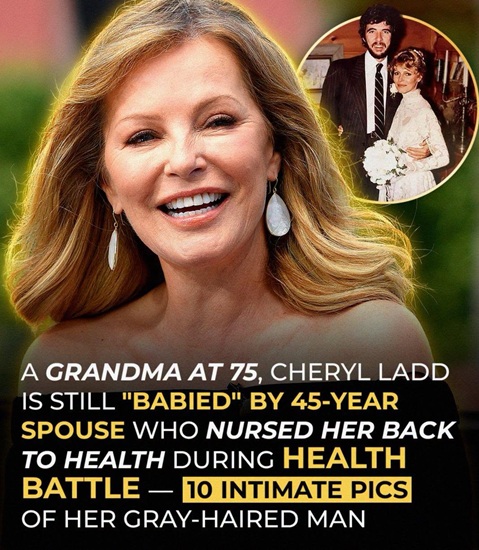
Cheryl Ladd became a household name through Charlie’s Angels, but the story of her life away from television has been shaped just as strongly by family, marriage, creativity, and resilience. Long before audiences knew what would happen in her personal life, Ladd had already experienced the pressure that came with sudden fame. She was a young wife and mother when her career accelerated, and the demands of Hollywood placed considerable strain on her first marriage.
Over the decades that followed, she built a very different kind of life with her second husband, music producer Brian Russell. Their relationship has now lasted more than four decades. Ladd was born Cheryl Jean Stoppelmoor in Huron, South Dakota, and moved west as a young woman to pursue opportunities in entertainment. She worked as a singer and performer before receiving the television role that changed her career. I
n 1977, she joined Charlie’s Angels during its second season as Kris Munroe, the younger sister of Farrah Fawcett’s character Jill Munroe. Replacing one of the biggest stars on television could have been intimidating, but Ladd developed her own identity within the series. She remained on the show until it ended in 1981.
The series turned Ladd into an international celebrity almost immediately. She later acknowledged that becoming a 1970s sex symbol was not something she had expected or felt completely comfortable with. At the time, she was also trying to balance professional demands with her responsibilities as a wife and mother. The success was enormous, but the schedule could be exhausting. Long production days left relatively little time for an ordinary family routine.
Before Brian Russell entered her life as a husband, Ladd had been married to actor and producer David Ladd. They married in 1973 and welcomed their daughter, Jordan Ladd, in 1975. Jordan would later become an actress herself, continuing a family connection to the entertainment industry. Cheryl and David eventually separated and divorced in 1980. The breakup meant that Ladd had to adjust not only personally but also as a mother raising a young daughter during an intensely public stage of her career.

Brian Russell was already connected to the couple socially before he and Cheryl became romantically involved. He had known David Ladd, which contributed to public attention when Cheryl and Brian’s relationship became known. Their romance developed during a complicated period, and the circumstances generated criticism in entertainment coverage. The couple later recalled that the negative attention was difficult. Rather than separating them, however, they said it made them rely more heavily on each other.
Ladd and Russell married in 1981. That marriage began a partnership that would ultimately last far longer than the controversy surrounding its beginning. By the late 2010s, Ladd was publicly describing Russell not only as her husband but as one of her closest friends. She said their friendship remained the foundation of the relationship even after decades together. In a 2018 interview, she explained that they had started as friends and remained friends through the good and difficult parts of life.
The importance of friendship became one of the recurring themes whenever Ladd discussed her marriage. She did not describe their relationship as successful because they avoided disagreements or challenges. Instead, she emphasized the ability to remain connected through changing circumstances. By the time she spoke to Fox News about the marriage, the couple had already celebrated approximately 38 years together. Ladd joked that the secret was simply marrying the right person before explaining that their friendship had survived the ups and downs.

Their relationship was also professional at various points. Russell worked as a music producer, and he became involved in projects connected with Ladd’s singing and television work. After Charlie’s Angels, Ladd was determined not to become permanently defined by Kris Munroe. She pursued acting projects that allowed audiences to see her in roles very different from the glamorous detective character that had made her famous. Russell supported that transition both personally and professionally.
During the early 1980s, Ladd appeared in dramatic television movies and other projects designed to expand her acting range. Among the better-known productions was Grace Kelly, a television movie in which she portrayed the actress who became Princess of Monaco. She also appeared in Kentucky Woman, taking on a more dramatic working-class role. These projects were important because they demonstrated that Ladd wanted a career extending beyond the image associated with Charlie’s Angels.
Russell worked behind the scenes on some of those projects. Their collaboration showed that their marriage could function alongside a professional partnership. For some couples, working together can create extra tension, but Ladd spoke positively about spending professional time with her husband. She suggested that sharing long workdays with the person she loved could make demanding projects more enjoyable rather than more difficult.
Music also remained an important part of Ladd’s career. Long before Charlie’s Angels, she had pursued singing, and she later released albums alongside her acting work. Russell’s background as a producer allowed the two to collaborate creatively in that area as well. Their professional relationship therefore extended across several parts of the entertainment industry rather than being limited to one production.

The marriage also created a blended family. Ladd brought Jordan into the household, while Russell had a daughter, Lindsay, from his previous marriage to singer Brenda Russell. Ladd has spoken openly about the reality that blended families can require patience. Bringing children from different previous relationships together does not automatically create instant harmony. Family members have to develop new routines, relationships, and boundaries over time.
In the early years of the marriage, the girls spent substantial time together and became close. Ladd described them as sisters rather than emphasizing the technical distinction between biological and step relationships. That relationship remained part of the family as they grew older. Decades later, both Jordan and Lindsay would become important sources of support when Ladd faced one of the most serious health challenges of her life.
The transition into a blended family also meant learning how to share parenting responsibilities. Ladd had already experienced the difficulty of balancing motherhood with a demanding television schedule. After Charlie’s Angels ended, she spoke about appreciating the additional time available for home life. The slower rhythm allowed her to spend more time as a wife and mother rather than living entirely around production schedules.
That balance became increasingly important to her. Ladd often said that success alone was not enough to create a fulfilling life. She enjoyed professional achievement, but she also valued being available for the people closest to her. After years of intense filming, the ability to create space for family represented a meaningful change. It allowed her career to continue without dominating every part of her identity.

Jordan eventually followed her mother into acting. Ladd did not discourage the decision even though she understood how difficult Hollywood could be. She believed her daughter had grown up with a realistic understanding of the entertainment business. Rather than arriving in Los Angeles completely unfamiliar with the industry, Jordan had watched both parents navigate acting, producing, and public attention.
Jordan built a career that included film and television work independent of her mother. Her credits eventually included horror films, comedies, and television projects. Although people naturally connected her with Cheryl Ladd, Jordan developed her own professional identity. That independence appears to have strengthened rather than weakened the relationship between mother and daughter.
Their bond became especially visible when they worked together. Ladd and Jordan appeared together in the Lifetime movie The Christmas Contract. Ladd later described the experience warmly, saying it gave them more uninterrupted time together than they had enjoyed since Jordan left home. They stayed close during filming and spent evenings talking and laughing together.
By then, Ladd no longer described their relationship simply through the traditional parent-child dynamic. She said they had become close adult friends who could talk openly and enjoy each other’s company. Jordan’s ability to make her laugh was something Ladd particularly appreciated. Their shared experience in entertainment also gave them a professional language that both understood.
Family continued expanding as Ladd became a grandmother. By 2018, she was publicly speaking about having three grandchildren. That role added another generation to a family that had started with the challenges of combining two households. Ladd described family as one of the most important parts of her life. Her comments frequently returned to the value of strong relationships rather than focusing only on career achievements.
As the daughters became adults and eventually moved away from home, Ladd experienced another adjustment. She has spoken humorously about the conflicting emotions that came with an empty nest. Part of her missed the daily presence of the girls, while another part enjoyed the freedom that came with having the house to herself with Russell. That honesty made her description of family life feel less idealized.
The couple did not stop building a shared life after the children left home. They continued pursuing creative interests, travel, building projects, and other activities. Ladd often described Russell as someone who understood her need for creativity and personal space. The same respect apparently worked in both directions. They could work together while also maintaining individual interests.
This ability to give each other room became another part of Ladd’s explanation for the marriage’s longevity. A lasting relationship did not require constant togetherness. It required understanding when the other person needed time for individual work or reflection. Ladd repeatedly connected friendship, respect, and creativity when talking about why the marriage endured.
Russell’s creative interests extended beyond music as well. Ladd has spoken proudly about his writing, including his novel The Marble Sea. Her comments reflected the mutual encouragement that had existed between them for decades. Just as he supported her career, she publicly celebrated his work. That reciprocity appears to have been part of what she meant when describing them as partners.
The couple’s relationship was eventually tested by something far more serious than professional pressure or tabloid criticism. Around 2023, Ladd discovered a lump in her left breast. She later explained that she noticed it while showering. She did not immediately know what it meant, but when she told Russell, he urged her to contact a doctor without delay.
Ladd later credited Russell’s reaction with helping her move quickly. According to her account, he insisted that they deal with the situation immediately rather than wait. She underwent a biopsy, which confirmed that she had an aggressive form of breast cancer. Doctors told her that treatment needed to begin quickly.
Treatment began with oral chemotherapy, and Ladd also underwent radiation. The process became physically difficult. She lost her hair and eyelashes during treatment and later described the experience as deeply humbling. Her comments made clear that the illness challenged her physically and emotionally in ways few professional difficulties ever had.
Throughout that period, Russell remained directly involved in her care. Ladd said he cooked for her when she lost her appetite and encouraged her to eat enough to maintain her strength. Sometimes that meant offering something as simple as tomato soup or a piece of fruit. These were small acts, but they mattered when treatment made normal eating difficult.
Ladd later said Russell helped prevent her from losing too much weight. He prepared food, encouraged her, stayed close, and offered physical affection when she needed reassurance. Looking back on the experience, she said his care confirmed once again that she had chosen the right partner.
Her daughters also became part of the support system. Jordan Ladd and Lindsay Walker visited, encouraged her, and remained emotionally involved throughout treatment. Ladd described both women as caring and supportive. The blended family that had required adjustment decades earlier was now functioning as a united support network during a major health crisis.
The experience also connected Ladd more deeply with two women who understood exactly what she was facing: her former Charlie’s Angels co-stars Jaclyn Smith and Kate Jackson. Both had previously survived breast cancer. Smith had been diagnosed in 2002, while Jackson had faced breast cancer in the late 1980s. Their previous experiences meant they could offer something beyond ordinary sympathy.
Smith helped in practical ways as well. During the period when Ladd was losing her hair, Smith sent her wigs. She offered different lengths that could be worn as Ladd’s natural hair eventually began growing again. The gesture reflected a friendship that had survived decades beyond their television work.
Jackson also understood the fear and uncertainty associated with the diagnosis. The three women had shared an unusual professional experience during the height of Charlie’s Angels, when the show became a cultural phenomenon. Decades later, they discovered another bond through their experiences with breast cancer. Ladd referred to that connection as a sisterhood.
Ladd kept her own diagnosis largely private while she was undergoing treatment. The public did not learn about it immediately. Instead, she concentrated on treatment and recovery with support from her family and close friends. That changed in April 2026 when she reunited with Jackson and Smith for the 50th anniversary celebration of Charlie’s Angels at PaleyFest in Los Angeles.
The PaleyFest event was held on April 6, 2026, bringing the three actresses together to reflect on the show’s cultural impact and their lives after it ended. The Paley Center had announced the reunion as one of the major anniversary events of the festival. The appearance carried special significance because the surviving actresses had not often appeared together publicly in recent years.
During the discussion, Ladd publicly revealed her breast cancer experience for the first time. She explained that her cancer had been aggressive and described treatment as difficult and humbling. She also spoke about losing her hair before eventually seeing it begin to grow back. The audience was hearing a story she had been living privately for approximately three years.
By the time she shared the diagnosis publicly, Ladd said she was cancer-free. She had begun feeling more like herself approximately six months before her April 2026 interview with PEOPLE. She still needed ongoing medical monitoring, including regular mammograms, but she was able to talk about the experience from the perspective of someone who had completed active treatment and was recovering.
Her message about early detection was straightforward. She encouraged people not to ignore unusual changes in their breasts and emphasized contacting a doctor rather than waiting. Her own experience had begun with noticing a lump and acting quickly after Russell encouraged her to seek care. She did not present her treatment as a universal model for every cancer patient, since treatment differs depending on diagnosis and medical circumstances. Instead, she emphasized awareness and timely professional evaluation.
The fact that all three surviving actresses on the PaleyFest stage had experienced breast cancer made the moment especially emotional. Smith, Jackson, and Ladd had originally been connected through a television program about three glamorous crime fighters. Decades later, their friendship had become something much more personal. The women could understand one another’s fears in a way people without the same diagnosis often cannot.
Ladd also continued to acknowledge the role of her faith during difficult periods. She has publicly described herself as a longtime Christian and an active churchgoer. In an earlier interview, she said her relationship with God had deepened as she grew older. That faith remained part of how she personally understood hardship and recovery.
Her religious beliefs should be understood as her personal perspective rather than as a medical explanation for recovery. Ladd has been clear that she received medical treatment from doctors and underwent chemotherapy and radiation. She has also spoken about faith as an emotional source of strength. Those two parts of her experience can coexist without suggesting that spiritual belief replaces medical care.
The cancer experience added another chapter to a marriage that had already survived more than four decades. Russell had supported Ladd through career changes, family transitions, and the normal challenges of long-term partnership. During treatment, that support became much more practical and immediate. Cooking a small meal or insisting on a medical appointment suddenly mattered more than any professional collaboration they had shared.
Ladd’s comment that she had “married the right guy” gained additional meaning in that context. Early in their marriage, she had described Russell as a stabilizing presence. Decades later, she was saying essentially the same thing after facing a serious illness. The circumstances were different, but the underlying description of their partnership remained consistent.
This continuity is notable because their relationship began during a period of intense criticism. In the early 1980s, celebrity reporting focused on how quickly the romance developed after the end of Ladd’s first marriage and on Russell’s connection with David Ladd. At the time, those circumstances seemed capable of overshadowing the relationship. More than four decades later, the controversy became a very small part of a much longer story.
Their marriage also demonstrates why the beginning of a relationship does not necessarily predict its entire future. Public opinion in 1981 could not know how the couple would handle children, work, aging, illness, or decades of daily life. Those things are learned only over time. In Ladd and Russell’s case, the relationship endured well beyond the original headlines.
That does not mean the marriage should be idealized as effortless. Ladd herself has referred to ups and downs. Every long relationship passes through changing circumstances. The important point in her public comments has been that friendship remained intact through those changes.
The same realistic perspective appears in the way she discusses blended family life. Ladd has never suggested that combining households was automatically easy. Step relationships and shared custody involve practical and emotional adjustments. Yet the family ultimately became close enough that decades later both daughters were present when Ladd needed support most.
That long-term outcome is perhaps more meaningful than an image of instant perfection would have been. Families often develop gradually. Relationships deepen through repeated experiences, conflict resolution, celebrations, illness, holidays, and ordinary daily routines. A blended family can become deeply connected without pretending there were never difficulties.
Jordan’s relationship with her mother reflects that evolution. Divorce was difficult for her when she was young, and becoming the daughter of a famous actress came with its own complications. As an adult, however, she and Cheryl developed the kind of friendship both have discussed publicly. Their professional collaboration on The Christmas Contract gave audiences a glimpse of that closeness.
Ladd has said that working alongside Jordan allowed them to share long conversations and laughter. She no longer needed to offer constant career advice because Jordan had established herself independently. Their relationship could exist on equal adult terms rather than being defined only by the traditional mother-daughter hierarchy.
The same shift occurred within Ladd’s broader family as grandchildren arrived. She has spoken enthusiastically about becoming a grandmother and about how family priorities increased with age. Her career remained important, but her public comments increasingly emphasized relationships, home, and gratitude.
At the same time, Ladd has become more comfortable reflecting on what Charlie’s Angels meant historically. The show was often dismissed in its own era as lightweight entertainment, yet it placed women at the center of an action-oriented television series during a period when that was less common. Ladd and her co-stars have spoken about being proud that young women saw capable female characters solving problems and taking action.
The PaleyFest reunion gave them an opportunity to revisit that history together. The official event description celebrated the 50th anniversary of the series and brought Ladd together with Jackson and Smith. Their comments emphasized both the cultural phenomenon surrounding the show and the friendship that survived after production ended.
For Ladd, that reunion connected several stages of her life at once. There was the young actress who joined the series in 1977, the mature performer reflecting on a decades-long career, the wife celebrating a long marriage, and the cancer survivor deciding to share something she had previously kept private. Few public appearances could have combined so many parts of her story.
Her disclosure was also a reminder that celebrities can experience major private struggles without audiences knowing. While Ladd was undergoing treatment, most people simply saw whatever public appearances or projects were available. The medical reality was happening away from cameras. She chose to reveal it only after she felt ready.
That boundary matters. Public figures do not owe audiences immediate access to private diagnoses. Ladd’s choice to wait allowed her to focus on treatment and family support. When she eventually spoke, it was on her own terms and in a setting connected to people who understood part of what she had experienced.
The support she received from Russell remained central to the story she chose to tell. He was not described merely as someone present in the house. He actively encouraged medical action, prepared food, helped her maintain weight, offered emotional comfort, and remained involved throughout treatment.
These actions are ordinary in one sense. Millions of spouses care for partners during illness every year without public recognition. Their importance comes precisely from that ordinariness. Long-term relationships are often defined less by dramatic declarations than by who makes soup when the other person cannot eat, who goes to appointments, and who remains patient during frightening periods.
Ladd’s description of Russell suggests she understood that clearly. Their marriage began with excitement and controversy, but its durability depended on what happened after the headlines disappeared. Decades of partnership cannot be sustained by the intensity of an early romance alone.
Friendship, according to Ladd, was the connecting thread. That statement appeared repeatedly across interviews separated by years. She described Russell as someone she loved deeply but also someone she simply liked spending time with. The distinction is important in a relationship lasting more than forty years.
The couple also understood each other’s need for creative independence. Russell could pursue music and writing, while Ladd continued acting, singing, and other projects. They did not require every project to be shared. Ladd has specifically noted that she has worked both with Russell and without him.
That combination of togetherness and independence may help explain why they were able to collaborate without feeling professionally trapped. Working together was an option, not an obligation. When a project benefited from their shared talents, they collaborated. When it did not, each could pursue separate work.
Their family followed a similar pattern as the daughters became adults. Jordan and Lindsay developed their own lives while remaining connected to their parents. The household no longer looked like it did in the early 1980s, but the relationships continued. The family structure evolved rather than disappearing.
By the time Ladd faced cancer, those long-developed connections became practical sources of strength. Russell was beside her daily. Jordan and Lindsay visited and encouraged her. Smith and Jackson offered understanding based on their own cancer histories. Her doctors and medical team handled treatment. Her faith offered another personal source of emotional support.
None of those elements worked entirely alone. Ladd’s recovery story included medicine, family, friendship, and personal belief. Presenting the experience accurately means acknowledging each without exaggerating any one factor.
By April 2026, she could say she was cancer-free. That was an important milestone, but she continued regular medical monitoring. Being cancer-free does not mean future follow-up becomes unnecessary. Ladd said she was undergoing routine mammograms at six-month intervals at that stage.
Her message to other women therefore centered on paying attention to changes and seeking professional evaluation. She did not claim that everyone’s cancer journey would resemble hers. Breast cancer includes different subtypes, stages, treatments, and outcomes. The practical lesson she offered came directly from her own experience: she noticed something unusual and sought medical care.
That advice also carried additional weight because Smith and Jackson had lived through their own diagnoses. The three women were able to speak not as doctors but as survivors describing what they had personally experienced. Their role was to encourage awareness, not to replace medical guidance.
The reunion also highlighted how much time had passed since Charlie’s Angels. The actresses who once represented youthful glamour were now discussing aging, illness, survival, and decades of friendship. That transformation was not a contradiction of their earlier images. It was simply the reality of living long enough to accumulate more complicated experiences.
Ladd has often spoken positively about aging and the perspective that comes with it. Her career began when she was very young, and the intensity of early fame left her feeling overwhelmed at times. With age came greater confidence about who she was beyond public labels.
The “sex symbol” description attached to her in the 1970s was one example. She acknowledged that the label made her uncomfortable because she saw herself simultaneously as a wife, mother, singer, and actress. The public image captured only one part of her life.
Her later career allowed those other parts to become more visible. Dramatic acting roles demonstrated range. Family interviews revealed the importance of motherhood and marriage. Her faith became something she discussed openly. Cancer added another experience she never expected to become part of her public story.
Through all of it, she continued describing difficult periods as opportunities for growth. That philosophy does not mean hardships are desirable or easy. It reflects her belief that difficult circumstances often reveal qualities that comfortable periods do not require.
Her marriage with Russell provides one of the clearest examples. The relationship survived early criticism, a blended family, demanding careers, children leaving home, aging, and cancer treatment. There is no single moment that explains more than forty years together. The durability came from the accumulation of many smaller choices.
Russell’s support during cancer treatment may be the most dramatic recent example, but Ladd’s comments suggest the same basic partnership had existed long before the diagnosis. She had described him as stabilizing and strong decades earlier. The cancer experience simply placed those qualities under far greater pressure.
Today, Ladd and Russell live in Texas, according to recent reporting. Their lives are geographically and professionally different from the intense Hollywood years when their marriage began. The relationship that once existed under constant paparazzi attention has become a much quieter long-term partnership.
That transition also illustrates how celebrity relationships change over time. Early coverage tends to focus on beginnings, scandals, weddings, and dramatic moments. The much larger part of a marriage occurs afterward, in routines that attract far less attention. Those quiet decades ultimately tell more about a relationship than the initial headlines.
Ladd’s family life has followed the same pattern. The difficulties of blending households generated uncertainty early on. Decades later, Jordan and Lindsay were both caring for her during cancer treatment. What began as a complicated family arrangement matured into a lasting support system.
Her relationship with Jordan also demonstrates how parent-child connections can change after difficult periods. Divorce and fame complicated Jordan’s childhood, but adulthood created room for a different kind of closeness. The two women eventually became colleagues as well as family.
Their work on The Christmas Contract offered a particularly visible example. Ladd described their time together as joyful because they could interact not merely as mother and daughter but as two adult women. Professional collaboration gave them an excuse to spend extended time together after years of living separate lives.
Ladd’s pride in Jordan has consistently focused on more than the fact that her daughter became an actress. She has spoken about Jordan’s instincts, humor, and independence. The entertainment connection may run through the family, but personal relationships remain more important than career comparisons.
The arrival of grandchildren expanded that perspective further. Ladd has described family as increasingly central as she aged. A career that once required fourteen-hour production days eventually became one part of a much larger life.
That broader identity may also explain why the cancer experience was so disruptive. The diagnosis threatened not merely her ability to work but her continued time with Russell, her daughters, grandchildren, friends, and the life she had built over decades. Recovery therefore carried meaning far beyond returning to acting.
When she appeared at PaleyFest in 2026, she looked back at Charlie’s Angels from the position of someone who had recently faced a very different kind of challenge. The television show had given her fame, but family and friendship had supported her when fame itself could do very little.
Her co-stars understood this distinction too. Smith and Jackson had each confronted serious illness long after their most famous television years. The shared history that once centered on filming schedules and publicity had become a much more personal form of solidarity.
The Paley Center described the reunion as a celebration of the show’s 50th anniversary, but for the women themselves it also became an opportunity to acknowledge what had happened during the decades afterward. Their lives had continued through marriage, motherhood, loss, health challenges, and aging.
That is ultimately what makes Ladd’s story more interesting than a simple celebrity romance. Her marriage to Russell began under scrutiny, but controversy was not the defining feature. The defining feature became endurance.
More than forty years after marrying, Ladd still describes her husband with affection and gratitude. She credits friendship as the foundation of their relationship and practical care as one of its strongest expressions. Their story does not prove that every marriage beginning under difficult circumstances will succeed. It simply shows what happened in theirs.
Similarly, her cancer recovery should not be turned into a universal formula. She benefited from rapid medical attention, professional treatment, family support, and ongoing monitoring. Other patients may face very different medical circumstances. Her experience can encourage awareness without becoming a promise about outcomes.
What can be said confidently is that Ladd publicly revealed an aggressive breast cancer diagnosis in April 2026, approximately three years after first discovering the lump. She underwent oral chemotherapy and radiation, lost her hair and eyelashes during treatment, and later said she was cancer-free.
She also credited Russell with recognizing that the situation should be addressed quickly. His insistence that she contact a doctor became the beginning of a treatment process neither of them had expected. His role continued long after that initial appointment.
For Ladd, the experience appears to have reinforced lessons she had already learned about partnership. Success is easier to celebrate when someone shares it, and illness is easier to endure when someone refuses to leave you isolated. Her comments about Russell repeatedly return to that basic idea.
The relationship she once described as a friendship became a marriage, professional partnership, blended family, and eventually a caregiving relationship during serious illness. Those stages show how long marriages change function over time. One year may be about raising children. Another may be about building careers. Another may require managing illness.
No couple controls which challenges will arrive.
What matters is how they respond when those challenges appear.
According to Ladd’s own account, Russell responded by staying close.
Her daughters did the same.
Her former co-stars did the same.
That circle of support became one of the strongest themes in the way she later told the story.
Her faith remained another source of comfort. Ladd has said she prays and maintains a personal relationship with God. Those beliefs belong to her own interpretation of life and suffering. They can be discussed accurately as part of her personal experience without suggesting that everyone must share them.
The same balanced approach applies to her professional legacy. Charlie’s Angels will always be the role most strongly associated with her name, but her career includes decades of work afterward. Movies, television dramas, Christmas films, stage performances, singing, and family collaborations all continued after the series ended.
Her life therefore did not peak and stop in 1981.
The decades after Charlie’s Angels contained marriages, children growing up, grandchildren, career reinvention, illness, and recovery.
That longer perspective makes the original television fame feel like one chapter rather than the whole story.
In April 2026, Ladd stood beside Jaclyn Smith and Kate Jackson on a stage celebrating something that began nearly fifty years earlier. The women could look back at the young actresses they had been while also acknowledging the older women they had become. Their lives had changed, but the connection survived.
For Ladd, Brian Russell had survived that entire transformation beside her.
He was there when the marriage was criticized.
He was there while they raised a blended family.
He participated in parts of her career.
He remained as the children became adults.
And when cancer arrived, he was there in a very different capacity.
That continuity is the simplest explanation for why Ladd continues speaking about him with such gratitude.
Their story is not valuable because it represents a perfect marriage.
It is valuable because it represents a long one that changed with the people inside it.
Friendship survived romance.
Partnership survived criticism.
Family survived adjustment.
And caregiving became part of love when circumstances demanded it.
Today, Cheryl Ladd’s public story contains more than the glamorous image audiences remember from Charlie’s Angels. She is an actress with a career spanning decades, a mother and grandmother, a wife of more than forty years, and a breast cancer survivor who chose to share her experience after recovery.
Brian Russell remains one of the most consistent figures across those chapters.
When Ladd says she feels fortunate that they found each other, that statement carries decades of history behind it.
The marriage that once generated difficult headlines became one of the most stable relationships in her life.
And when her health was threatened, the person she had chosen as a partner in 1981 was still beside her more than forty years later.
That is the part of the story that has lasted longest.
