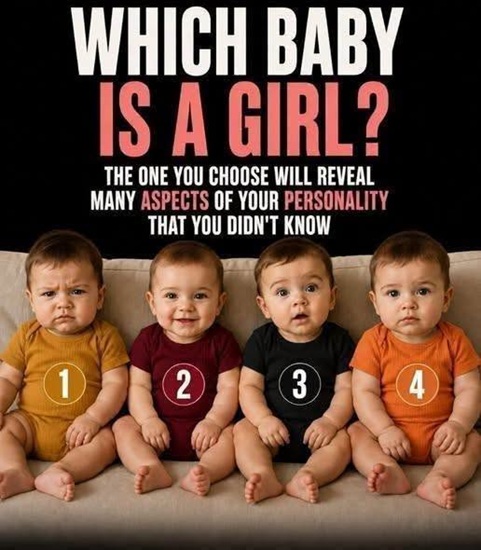
Personality quizzes are everywhere online because they offer a quick and entertaining way to think about ourselves. One especially popular format asks viewers to look at several faces or figures and choose the one that immediately attracts their attention. The idea is simple: make a fast choice without overthinking it, then read a personality description connected to that option. These quizzes can feel surprisingly accurate, but they should be treated as entertainment rather than as scientific psychological assessments.
A single visual preference cannot reliably reveal someone’s complete personality, hidden motives, or emotional history. What makes these quizzes interesting is the way attention works. Human beings do not look at every part of an image equally. Our eyes tend to notice contrast, facial expressions, familiar patterns, unusual shapes, and other details that stand out to us personally. Previous experiences can also influence what catches our attention.
Two people can therefore look at the same picture and focus on completely different features. That difference can make a simple visual test feel highly personal even when the image is identical for everyone. The challenge in this particular quiz is to look at a group of babies and choose the one that immediately stands out. Some versions of the puzzle ask viewers to guess which baby is a girl, while others simply ask which face they notice first.
Appearance alone, however, cannot reliably determine a child’s sex or gender. Clothing colors, hairstyles, facial expressions, and accessories are social choices rather than dependable biological indicators. That is why the quiz works best as a playful exercise in attention rather than a factual identification test.

Before looking at the interpretations, it can be more enjoyable to make your choice quickly. Try not to analyze every face for several minutes. Notice which baby your eyes return to first. Your selection may be influenced by expression, positioning, contrast, or simple chance. None of those possibilities makes the choice scientifically diagnostic. The value of the exercise comes from seeing whether the description gives you something interesting to reflect on.
If the first baby attracted your attention, the playful interpretation describes someone who values structure and reliability. You may prefer knowing what to expect rather than moving through life without a plan. When decisions are important, you might take time to think through consequences before acting. Friends and relatives may appreciate your consistency because they know you usually follow through on commitments. These qualities can make you a calming presence when other people feel overwhelmed.
People who identify with this description may also prefer stability over unnecessary risk. That does not mean they never enjoy surprises or adventures. It simply suggests that preparation often makes them feel more comfortable. A person can be spontaneous in some areas of life while still wanting strong foundations in others. Human personalities are much more complicated than one category.
A structured personality can be especially useful in situations involving responsibility. Planning ahead can reduce confusion, help people manage time, and prevent avoidable mistakes. Someone who enjoys organization may naturally become the person others call when schedules, details, or practical decisions need attention. That can be a strength. At the same time, flexibility remains valuable when plans unexpectedly change.
The first interpretation should therefore be read as a collection of possible traits rather than a fixed identity. Someone may recognize the reliability but not the seriousness. Another person may relate to careful planning while still being highly adventurous. Personality is rarely all-or-nothing. People change their behavior depending on circumstances, relationships, and responsibilities.
If the second baby caught your eye, the entertainment-style description emphasizes warmth and sociability. You may enjoy conversations, meeting new people, and creating positive experiences with others. Social situations can feel energizing rather than exhausting when they involve people you trust. You might also be quick to notice opportunities for humor or connection. That kind of openness can help others feel comfortable around you.
Optimism is another quality commonly attached to this choice. When difficulties appear, you may naturally search for possible solutions rather than focusing only on what went wrong. That does not mean optimistic people ignore serious problems. Healthy optimism is better understood as the belief that effort and adaptation can sometimes improve difficult situations. It can coexist with realism.
People who relate to the second description may also enjoy collaborative environments. Sharing ideas, celebrating accomplishments, and helping others feel included can be rewarding. Some socially oriented people are comfortable being the center of attention, while others prefer creating connections quietly. Being friendly does not automatically mean being loud or extroverted in every situation.
The description can also apply differently depending on context. Someone may be highly sociable around close friends but reserved with strangers. Another person may enjoy groups at work while needing significant time alone afterward. Personality traits exist on spectrums, not rigid categories. A short quiz cannot capture every variation.
If the third baby stood out first, the playful interpretation focuses on curiosity. You may enjoy asking questions, investigating unfamiliar topics, and learning how things work. New ideas can hold your attention for long periods, especially when they challenge assumptions. Curiosity can appear through reading, travel, hobbies, conversation, research, or experimentation. There is no single correct way to express it.
People who identify with curiosity often enjoy exploring several perspectives before forming conclusions. They may prefer to gather information rather than immediately deciding what is true. This can be useful in complicated situations because it encourages patience and careful thinking. At the same time, endless analysis can sometimes make decisions harder. Balance is still important.
Curiosity can also create a willingness to try new experiences. A person might become interested in unfamiliar food, technology, languages, art, or places. Another may focus deeply on one specialized subject rather than exploring many. Both approaches involve a desire to understand more. The specific direction of that curiosity depends on the individual.
The third description sometimes includes thoughtfulness because curious people frequently ask why something happens rather than accepting the first explanation. That habit can make conversations interesting and can help people notice details others miss. Still, curiosity alone does not automatically make someone wise. Knowledge grows through learning, experience, and careful evaluation.
If the fourth baby was the first one you noticed, the entertainment interpretation emphasizes compassion and empathy. You may be attentive to other people’s feelings and quick to recognize when someone seems uncomfortable or discouraged. Friends may appreciate your willingness to listen. You might also prefer understanding a person’s circumstances before judging their behavior.
Empathy does not mean always agreeing with everyone. It means trying to understand how another person may be experiencing a situation. Someone can empathize with another person’s emotions while still disagreeing with their decisions. That distinction is important because healthy relationships require both understanding and boundaries.
People who strongly identify with compassionate traits can sometimes become the friend others turn to during difficult moments. Listening patiently and offering encouragement can create strong relationships. However, caring deeply about others can also become emotionally demanding if personal boundaries are ignored. Supporting people does not require taking responsibility for every problem they face.
The fourth description should therefore be interpreted in a balanced way. Compassion can be a major strength when combined with self-respect. People need both the ability to care about others and the ability to recognize their own limits. One does not cancel out the other. A visual quiz cannot measure that balance, but it can provide a starting point for reflection.
Many people are surprised when one of these descriptions feels highly accurate. Psychology offers a useful explanation for part of that experience. The Barnum effect, also called the Forer effect, describes the tendency to accept broad personality descriptions as uniquely personal when they could apply to many people. Statements such as “you care deeply about people close to you” or “you sometimes doubt your decisions” can feel very specific even though they describe common human experiences.
This does not mean everyone who enjoys a personality quiz is being fooled. It simply explains why broad descriptions can feel unusually precise. People naturally connect general statements with memories and experiences from their own lives. When a description matches something familiar, that match becomes especially memorable. Parts that do not fit may receive less attention.
The Barnum effect is one reason entertainment quizzes should not be confused with validated personality assessments. Psychological research uses carefully designed methods, standardized measures, large samples, and statistical analysis when evaluating personality traits. An online image with four choices does not meet those standards. Its purpose is much more casual. It invites reflection rather than diagnosis.
There is another important factor: confirmation bias. People often notice information that supports what they already believe about themselves. If someone sees themselves as compassionate and receives a description about empathy, they may immediately remember examples that confirm it. Contradictory examples may be less noticeable. Again, this is a common feature of human thinking rather than a personal flaw.
First impressions can also be influenced by visual salience. Brightness, contrast, facial orientation, position, and expression can all affect where the eyes move first. If one baby is positioned differently or has a stronger expression, that may partly explain why people notice it. The choice does not necessarily originate from a hidden personality trait. Visual design itself can strongly influence attention.
Cultural expectations can influence interpretation as well. People grow up learning associations between certain clothing styles, colors, expressions, and roles. Those associations can affect what seems familiar or noticeable. They are not universal truths. Someone raised in a different cultural environment may interpret the same image differently.
This is particularly important when a puzzle asks viewers to identify which child is a girl. There is no reliable way to determine that from a simple photograph based only on hairstyle, clothing, or facial expression. Assigning gender based on appearance can reflect stereotypes rather than factual information. The safer approach is to treat the question as a visual guessing game rather than a meaningful judgment about children.
The same caution applies to personality descriptions attached to children in photographs. A smile does not prove that a child is naturally outgoing. A serious expression does not prove that someone is shy or thoughtful. Photographs capture brief moments. They cannot reveal a complete personality.
The most enjoyable way to use this quiz is therefore as a conversation starter. Compare your choice with a friend or family member and ask what detail caught their attention. One person may have noticed a smile. Another may have focused on eye direction or posture. The differences themselves can be more interesting than the personality label.
People often discover that their choices change when they look at the same image again. The first time, one face stands out. After learning about the puzzle, another becomes more noticeable. This demonstrates that attention is flexible. It responds to expectations and goals.
If someone tells you in advance to search for the happiest face, your eyes may move differently than if you are told to find the most serious one. The picture does not change, but the task does. This shows why visual choices should not be treated as fixed indicators of personality. Attention is shaped partly by what we are looking for.
Mood can influence perception too. Someone feeling cheerful may notice positive expressions more readily. A person who is tired or stressed may focus on different details. Researchers study complex relationships between mood, attention, and memory, but a simple online quiz cannot measure them reliably. It can only provide a playful example of how variable perception can be.
Memory is another influence. A face may remind someone of a relative, childhood friend, or familiar photograph without the person consciously realizing it. That familiarity can pull attention toward the image. The choice might therefore reflect a personal association rather than a stable personality trait.
Even screen size can change the experience. A face that appears prominent on a large monitor may look different on a small phone. Cropping, image quality, and brightness can influence which details are easiest to notice. Two people viewing different versions of the same puzzle may therefore receive slightly different visual information.
This is why claims that one choice “exposes your deepest secret” should be treated as playful exaggeration rather than fact. Personality is influenced by genetics, development, social experiences, relationships, environment, and countless other factors. No single glance can reveal everything. Human behavior is far too complex for that.
A better way to phrase the experience is that the quiz may encourage self-reflection. If a description about reliability feels meaningful, ask yourself why. Perhaps you value stability because of past experiences. If the curiosity description resonates, think about the kinds of subjects that hold your attention. Reflection can be useful even when the original test is not scientifically diagnostic.
It can also be useful to notice which descriptions do not fit. Maybe you chose the second baby but do not consider yourself particularly social. That mismatch is not evidence that you answered incorrectly. It simply shows the limits of the quiz. Entertainment tests are designed to be broad enough for many people to recognize something familiar.
Most people also contain traits from all four descriptions. A person can be organized, sociable, curious, and compassionate at the same time. One quality may become more visible in certain situations than another. At work, someone may be structured. With friends, they may be playful. When learning, they may become deeply curious.
This flexibility is normal. Personality does show patterns over time, but behavior also adapts to context. A reliable friend may occasionally be spontaneous. An outgoing person may need solitude. An empathetic individual can still become impatient. No one is represented perfectly by one category.
That is another reason these quizzes should remain lighthearted. They become less helpful when people use them to place themselves or others into rigid boxes. “You chose number three, therefore you are this kind of person” oversimplifies human behavior. A more useful response is, “Does any part of this description sound familiar to you?”
The quiz can also encourage discussion about what qualities people admire. Someone may choose a face because it appears cheerful and then enjoy reading a description about optimism. Another may prefer a calm expression and connect with the idea of stability. The exercise can reveal preferences without proving personality.
Preferences can themselves change over time. A person who once valued excitement may later prioritize security. Someone previously focused on career goals may begin valuing relationships more strongly. Life experiences influence what feels important. A personality description that resonates today may feel less accurate several years from now.
This does not mean personality changes completely every few months. Research suggests that many traits show substantial stability while also allowing gradual change. People develop as they age and encounter new experiences. A playful quiz cannot capture that long-term complexity, but it can remind us that identity is not frozen.
Another positive feature of these quizzes is their accessibility. They require no special equipment or knowledge. Anyone can look at an image, make a choice, and join a conversation. That simplicity explains why visual personality tests spread so quickly across social media.
Their popularity also comes from curiosity about ourselves. Humans have always created systems for describing personality, from ancient character types to modern psychological models. People naturally want language that helps explain why they behave differently from others. Online quizzes offer an easy version of that much larger interest.
Scientific personality research uses more rigorous approaches. Models such as the Big Five examine broad traits including openness, conscientiousness, extraversion, agreeableness, and neuroticism. Even validated questionnaires do not reveal every part of a person. They provide statistical descriptions of tendencies rather than complete biographies.
An image-based quiz is far less precise than those tools. That is not necessarily a problem as long as readers understand what it is. Entertainment can still be enjoyable without pretending to be clinical science. Problems arise when casual quizzes are marketed as guaranteed psychological truth.
Language therefore matters. Saying a choice “may reflect” or “playfully suggests” certain traits is more accurate than saying it “proves” them. The difference protects readers from being misled. It also allows the quiz to remain fun.
The same approach helps avoid unnecessary anxiety. Someone should not worry because a quiz gives them a description they dislike. Choosing one image does not expose a dangerous secret or predict future behavior. There is no hidden psychological diagnosis inside the result.
If a person is genuinely concerned about personality, mood, anxiety, relationships, or mental health, a professional assessment is more appropriate. Qualified mental-health professionals use history, interviews, validated tools, and clinical judgment rather than a single visual preference. Online quizzes cannot replace that process.
For everyone else, the exercise can simply provide a few minutes of entertainment. Choose the baby that catches your attention. Read the corresponding description. Keep the parts that inspire useful reflection and leave the rest. There is no requirement to make the result fit.
The first choice emphasizes reliability and structure.
The second emphasizes warmth and optimism.
The third emphasizes curiosity and learning.
The fourth emphasizes compassion and emotional awareness.
Most people probably recognize themselves in more than one.
That overlap is expected.
These traits are common human qualities rather than exclusive categories.
The descriptions can also be used as prompts. Ask yourself whether you prefer planning or improvisation. Think about whether social situations energize you. Consider how often you seek new knowledge. Reflect on how easily you notice other people’s emotions.
Those questions are more valuable than simply accepting a label.
Self-reflection becomes useful when it leads to greater understanding.
Perhaps you realize you need more flexibility.
Maybe you notice that you rarely give yourself enough quiet time.
You might recognize that helping others sometimes leaves you exhausted.
A casual quiz can spark those thoughts even though it did not scientifically discover them.
That is an important distinction.
The quiz opens a door.
You decide whether anything meaningful lies behind it.
There is also no need to compare results competitively. Choosing one baby is not better than choosing another. Reliability is not superior to curiosity. Sociability is not superior to compassion. Different situations benefit from different strengths.
Healthy communities generally need all of them.
They need organized people who create structure.
They need optimistic people who energize others.
They need curious people who ask questions.
They need compassionate people who notice emotional needs.
Most successful groups contain a mixture of these tendencies.
That diversity is far more realistic than dividing everyone into four fixed types.
It is also important not to attach these descriptions to the babies themselves. The photograph does not tell us whether any particular child will grow into a reliable, social, curious, or empathetic adult. The traits belong only to the entertainment interpretation assigned to the viewer’s choice. The children in the image should not be analyzed based on appearance.
Likewise, clothing and hair should not become evidence about a child’s gender, personality, or future. Those assumptions often reflect adult expectations more than information about the child. The respectful approach is to keep the focus on the viewer’s reaction.
This is one reason the quiz can actually become more interesting when stripped of exaggerated claims. Instead of pretending that a photograph reveals hidden destiny, it becomes an experiment in noticing what attracts attention. That question is genuinely interesting.
Why did one face stand out?
Was it expression?
Position?
Color?
Familiarity?
You may never know exactly.
And that is fine.
Human attention is influenced by many processes working together.
Not every split-second choice needs a dramatic explanation.
Sometimes a face simply catches your eye.
The enjoyment comes from noticing what happens next.
A description appears.
Your mind searches your memories.
Some statements feel accurate.
Others do not.
That entire process tells us something about how humans interpret information, even if it does not reveal a secret personality code.
The Barnum effect is especially useful here because it reminds readers to stay curious about why descriptions feel personal. If a statement seems astonishingly precise, ask whether it could also describe many people you know. Often the answer is yes. That realization does not ruin the quiz. It makes the psychology behind it more interesting.
For example, many people value close relationships.
Many sometimes worry about decisions.
Many enjoy learning.
Many want stability.
Descriptions using those ideas will naturally resonate with large audiences.
A well-written personality quiz combines common traits in ways that feel individualized.
Readers then supply their own personal examples.
That interaction creates the feeling of accuracy.
Understanding the process allows people to enjoy quizzes without confusing them with evidence.
There is also a positive side to broad descriptions. They can remind people of strengths they rarely acknowledge. Someone reading about compassion may realize they really do spend a lot of energy supporting friends. Another reading about curiosity may recognize how much they enjoy learning.
That kind of reflection can be encouraging.
It simply should not be treated as proof that the picture caused the insight.
The insight comes from the reader.
The image is only the prompt.
That may be the most accurate way to think about the entire exercise.
The picture asks a question.
The description offers possibilities.
The reader provides meaning.
Seen this way, personality quizzes become closer to journaling prompts than psychological examinations.
They invite people to consider themselves from another angle.
Sometimes that is enough.
In a busy day, even a few minutes of reflection can be enjoyable.
The quiz can also create easy conversations between friends, partners, or family members. Ask everyone to choose before revealing the descriptions. Compare results and discuss which traits actually fit. People may learn something through the conversation rather than through the quiz itself.
Someone might say, “I chose number one, but I think you are much more organized than I am.”
Another person may respond, “I chose number four because the expression reminded me of someone.”
Those explanations reveal more than the original labels.
They show how people think about themselves and each other.
That social aspect is one reason these quizzes remain popular.
They give people a low-pressure way to talk about personality.
No one needs to take the result too seriously.
The conversation is the reward.
Ultimately, the first baby you notice cannot scientifically expose your deepest hidden secrets. There is no reliable evidence that a single visual choice can reveal a complete personality. What the exercise can do is draw attention to your preferences and encourage reflection. That is a much more reasonable claim.
If baby one caught your attention, enjoy considering whether reliability and structure matter strongly to you.
If baby two stood out, think about how social connection and optimism shape your life.
If baby three drew your gaze, reflect on curiosity and your desire to understand things.
If baby four attracted you, consider how empathy influences your relationships.
Then remember that none of these descriptions has to define you.
You may identify with several.
You may identify with none.
Either response is completely acceptable.
The most useful lesson is that human personality is richer than a four-picture quiz.
People contain contradictions.
They grow.
They adapt.
They behave differently across situations.
And they cannot be reduced to a single glance.
That complexity is far more interesting than any dramatic online claim.
So make your choice, enjoy the result, and share it if it starts a good conversation.
Just keep the purpose in perspective.
It is a playful personality exercise, not a diagnosis.
The real value comes from what you choose to think about afterward.
