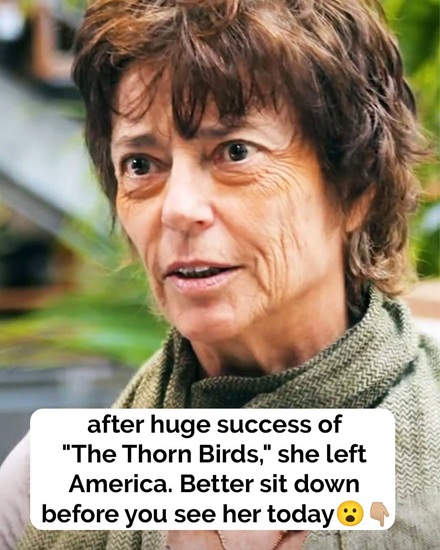
For many television viewers, Rachel Ward will always be remembered as Meggie Cleary, the central female character in the sweeping 1983 television miniseries The Thorn Birds. Her performance opposite Richard Chamberlain helped create one of the best-known television dramas of its era. The production was adapted from Colleen McCullough’s bestselling 1977 novel and followed decades in the lives of the Cleary family. At the heart of the story was Meggie’s complicated relationship with ambitious Catholic priest Father Ralph de Bricassart.
Millions of viewers became invested in their story when the miniseries aired in the United States. More than four decades later, The Thorn Birds remains the production most strongly associated with Ward’s early career. The scale of the program’s original success is difficult to understand without remembering how television operated in the early 1980s. Audiences did not have streaming platforms, hundreds of specialized channels or on-demand viewing options.
A major network miniseries could become a shared cultural event watched by enormous numbers of people at approximately the same time. According to Australia’s National Film and Sound Archive, more than 35 million viewers in the United States watched the approximately ten-hour production when it aired in March 1983. The NFSA even notes that an American airline reportedly screened episodes during flights so passengers would not miss the television event. That extraordinary level of attention quickly transformed the actors involved into internationally recognizable figures.

The success was especially significant for Ward because she had not entered acting through the same route as many formally trained performers. Before she became Meggie Cleary, she was already well known in fashion and modeling circles. Her striking appearance had helped her build a successful modeling career, but acting presented a completely different challenge. A model could communicate through expression and image, while a dramatic television role required dialogue, emotional continuity and the ability to sustain a character over many hours. The Thorn Birds demanded even more because Meggie had to age substantially during the story. The character could not remain emotionally or physically the same woman audiences first encountered.
Rachel Claire Ward was born on September 12, 1957, at Cornwell Manor in Oxfordshire, England. As of August 2026, she is 68 years old and will turn 69 in September. Her early life was very different from the Australian environment that would later become central to both her professional and personal identity. She grew up in England and attended Hatherop Castle School before studying at the Byam Shaw School of Art in London. She left formal education relatively young and pursued modeling. Years later, after marriage and motherhood had reshaped her life, she returned to education and studied writing and communications in Australia. (imdb.com)
Ward’s modeling career developed rapidly. She worked in fashion and appeared in prominent magazines, building a recognizable image before establishing herself as an actress. Modeling provided travel and professional independence, but it did not necessarily prepare her for the emotional demands of a major dramatic performance. Ward gradually moved toward acting through commercials and screen work. By the beginning of the 1980s, she had started receiving increasingly substantial opportunities. One of her important early movie appearances came in Sharky’s Machine, the 1981 crime drama directed by and starring Burt Reynolds.

Her work in Sharky’s Machine attracted attention from the Golden Globes. Ward received a 1982 nomination in the New Star of the Year category. That recognition arrived before The Thorn Birds turned her into an internationally known television performer. It also illustrates why describing her as completely unknown before playing Meggie would be inaccurate. She was already building momentum professionally, although she had not yet reached the level of recognition that the miniseries would create. The Thorn Birds became the project that dramatically expanded her audience.
Casting Meggie Cleary proved to be one of the production’s major challenges. The character required an actress capable of portraying a woman across several stages of adulthood. Producer Stan Margulies explained that Meggie had to progress from a romantic young woman into someone transformed by disappointment, experience and age. The actress therefore needed to communicate significant emotional changes while remaining recognizably the same character. According to the National Film and Sound Archive, more than 200 women were considered for the role. More than 40 actresses eventually auditioned.
Ward ultimately won the part, although she later spoke openly about her insecurities regarding her acting ability at the time. In retrospect, she remembered receiving strong marks for her appearance but considerably less confidence regarding her acting. Rather than hiding those concerns, Ward has discussed them with humor and unusual openness. Producers sent her to work with an acting coach as preparation continued. The decision helped her approach an unusually demanding role at a relatively early point in her acting career. It also became part of the complicated way she later remembered her sudden rise to fame.

Meggie’s transformation required more than changes in performance. Costumes, makeup and physical presentation helped audiences follow the passage of time. Ward recalled the process of being aged for the later sections of the story, including changes to her face and body silhouette. Costume designer William Travilla created clothing representing different phases in Meggie’s development. The NFSA collection still preserves several of his original costume sketches for the character. Designs range from clothing for the younger Meggie to more structured outfits representing her later adulthood.
One costume became especially famous among fans of the production. The pale pink gown associated with the “Ashes of Roses” sequence developed an almost legendary reputation among viewers. In the story, Meggie descends a staircase wearing the gown as Father Ralph watches her. Costume designer Travilla created the dress in silk and also produced duplicates that could withstand more demanding filming conditions. The visual image became closely linked with Ward’s portrayal of Meggie. Decades later, discussions of The Thorn Birds still regularly return to the dress.
The relationship between Meggie and Father Ralph provided the emotional foundation of the story. Ralph was played by Richard Chamberlain, already an established television star by the time production began. Their characters were drawn toward one another while confronting Ralph’s commitment to the Catholic Church and his ambitions within it. That conflict gave the miniseries much of its melodramatic power. Viewers watched affection, frustration, sacrifice and regret accumulate across years of fictional time. The story was deliberately sweeping rather than understated, which was part of its appeal.
Chamberlain’s experience gave the production a recognizable leading man, while Ward brought a different quality to Meggie. Her performance was comparatively naturalistic in moments where the surrounding material could become highly dramatic. That contrast contributed to the character’s vulnerability. Meggie was not presented as someone completely in control of her circumstances. She made choices, experienced consequences and gradually developed greater understanding of both herself and the people around her. Ward had to carry those changes across a story covering decades.

The production also benefited from a major supporting cast. Barbara Stanwyck played the formidable Mary Carson, while Jean Simmons appeared as Fiona Cleary. Christopher Plummer, Richard Kiley, Piper Laurie, Bryan Brown and several other respected performers contributed to the large ensemble. The combination of established stars and emerging talent gave the production considerable prestige. It was not simply built around a single romantic pairing. The broader Cleary family story contained conflict involving land, marriage, religion, ambition and generational change.
Awards recognition quickly followed. The Thorn Birds received eight Golden Globe nominations and won four awards, including Best Miniseries. Ward received a Golden Globe nomination in 1984 for her portrayal of Meggie. The production also collected six Emmy Awards, according to the NFSA. Barbara Stanwyck won an Emmy for her performance, while Jean Simmons and Richard Kiley were also among the acting winners associated with the production. These awards reinforced the miniseries’ position as more than a ratings phenomenon.
Ward’s Golden Globe nomination is sometimes incorrectly dated to 1982, but the official Golden Globes archive lists the nomination for the 1984 awards. Her 1982 Golden Globe nomination was actually for New Star of the Year following Sharky’s Machine. That distinction matters because the two nominations represented different stages of her developing career. The first acknowledged her emergence as a promising performer. The second recognized the role that had transformed her public profile.
Despite the program’s success, Ward’s own response to her performance was complicated. She received criticism in some reviews and later said that negative reactions stayed with her for years. Sudden international exposure can magnify both praise and criticism, and Ward was experiencing that attention while still developing as an actress. Rather than remembering The Thorn Birds only as a professional triumph, she has described insecurity about whether she had delivered what people expected. That vulnerability became an important part of her later reflections on the series.
Her perspective changed somewhat as time passed. Distance from the production allowed Ward to reconsider both her performance and the style of television in which she had participated. Acting conventions evolve, and performances that were judged within one era can look different decades later. Ward has described her own acting instincts as relatively naturalistic and suggested that aspects of the production pushed her toward a style that was not always instinctive for her. Instead of completely rejecting her early work, she gradually found a more forgiving way to understand it.
There was also an extraordinary personal reason The Thorn Birds would remain important to her. Ward met Australian actor Bryan Brown during production. Brown played Luke O’Neill, the man Meggie marries while attempting to build a life away from Father Ralph. Their fictional marriage was deeply troubled. Away from the cameras, however, Ward and Brown began developing a relationship that would continue for decades. The contrast between the unhappy fictional relationship and the successful real-life partnership later became one of the most frequently discussed stories surrounding the production.
According to the NFSA, Ward and Brown fell in love during the making of the miniseries and married within months of filming being completed. Their relationship did not become a short-lived romance associated with a famous production. They have remained together for more than four decades. Ward and Brown married on April 16, 1983, and subsequently built their family life primarily in Australia. They eventually had three children: Rosie, Matilda and Joe.
Their relationship gave Ward another reason to view The Thorn Birds differently from an ordinary acting credit. The production simultaneously represented the role that made her famous and the place where she met the person with whom she would build her family. Professional memories could therefore never be completely separated from personal ones. Even if Ward sometimes felt uncertain about her acting, the project changed the direction of her entire life. That is one reason discussions of the miniseries frequently move beyond ratings and awards into the Ward-Brown relationship.
Brown already had an established career in Australian cinema and television. His presence eventually helped connect Ward more closely with Australia, a country that became her permanent home. Moving from Britain and international modeling into Australian family life represented another major transformation. Ward continued acting, but her career gradually expanded into other creative areas. She was no longer simply the model who had become a television star. Over time, writing, directing and producing became increasingly important.
After The Thorn Birds, Ward remained active in film. She starred opposite Jeff Bridges and James Woods in the 1984 romantic thriller Against All Odds. The film gave her another prominent Hollywood role at a moment when her international profile was still extremely high. She subsequently appeared in other productions while increasingly spending her personal life in Australia. Her career did not follow a simple straight line toward permanent Hollywood stardom. Instead, Ward’s priorities evolved alongside marriage and motherhood.
The adjustment to family life was not always simple. Ward later described periods when she felt isolated while raising young children far from the family network she had known in England. Bryan Brown’s acting work could also take him away for professional commitments. Those years eventually encouraged Ward to reconsider what kind of creative work she wanted to pursue. She returned to study and began developing skills behind the camera. The transition became one of several reinventions that would characterize her adulthood.
Ward studied writing and communications at the University of Technology Sydney. Returning to formal education after already establishing a public career required a different kind of confidence from the one demanded by modeling or acting. It also gave her the opportunity to explore storytelling from the creator’s perspective. Instead of waiting for someone else to cast her in a role, she could begin developing projects herself. Writing eventually led toward directing. The change opened a new professional chapter that would become increasingly important.
Ward directed short films before moving toward larger productions. One notable early directing project was Martha’s New Coat, which earned recognition in Australia. Working behind the camera allowed her to focus on character, atmosphere and storytelling from a completely different position. The performer who once worried about whether she was meeting expectations on The Thorn Birds was now responsible for guiding other actors. That reversal demonstrated how much her relationship with filmmaking had changed.
Her most prominent feature film as a director became Beautiful Kate, released in 2009. The film starred Ben Mendelsohn, Rachel Griffiths, Sophie Lowe and Bryan Brown. Ward directed the picture and adapted its screenplay from Newton Thornburg’s novel. The drama explored family secrets, memory and difficult relationships. It was a considerably different kind of project from the lavish romantic melodrama that had made Ward internationally famous decades earlier.
Beautiful Kate was also a family-connected production. Bryan Brown appeared in the film, and members of Ward’s family became involved in different ways with her creative life. Her evolution toward directing allowed the couple’s relationship to extend into professional collaboration. Instead of The Thorn Birds remaining the only major production linking their careers, they continued working within the same industry while developing separate creative identities.
Ward’s acting career also continued alongside directing. One notable later performance came in the 2000 television adaptation of On the Beach, which also featured Bryan Brown and Armand Assante. The production was based on Nevil Shute’s novel about the aftermath of nuclear war. Ward’s performance earned another Golden Globe nomination in 2001 for Best Actress in a television limited series or movie. The production itself also received a Golden Globe nomination.
That nomination arrived nearly two decades after her breakthrough as Meggie Cleary. It demonstrated that The Thorn Birds had not represented her only major critical recognition as an actress. The later nomination also came after her personal and professional life had changed considerably. By then, Ward was no longer the relatively inexperienced actress suddenly facing enormous international attention. She was a mature performer, mother and developing filmmaker with years of industry experience behind her.
Ward appeared in additional Australian television productions during later stages of her career. Her credits included work connected with series such as Rake, The Straits and Devil’s Playground. Her relationship with acting became more selective as writing, directing and family responsibilities competed for her attention. Rather than maintaining the pace expected of someone pursuing continuous international celebrity, she built a career that moved between different forms of storytelling.
Her daughter Matilda Brown eventually entered the entertainment industry as well. Matilda has worked as an actress and filmmaker, although Ward reportedly encouraged her to develop skills behind the camera rather than relying entirely on acting. That advice reflected Ward’s own experience. She understood both the opportunities available to actors and the uncertainty created by depending on other people for roles. Learning writing and filmmaking could provide greater creative control.
Mother and daughter eventually shared the screen in The Death and Life of Otto Bloom. Rachel and Matilda portrayed the same character at different stages of her life, allowing their physical resemblance to become part of the casting. The collaboration created an unusual connection between generations. Instead of Matilda simply following her mother into acting, they were able to work together in a project that deliberately used their similarities.
Ward and Brown’s family expanded again when they became grandparents. Their children entered adulthood and began building families of their own. For Ward, grandparenthood added another stage to a life that had already moved through dramatically different identities. The young model who left England, the actress suddenly recognized as Meggie Cleary, the mother adjusting to Australia and the filmmaker developing her own projects eventually became a grandmother surrounded by another generation.
Her public life also included recognition outside entertainment. Ward was appointed a Member of the Order of Australia, commonly abbreviated AM. The honor reflected contributions extending beyond film and television, including work connected with social justice and advocacy. This side of her public life reinforced the fact that her interests had broadened considerably since the period when magazines primarily discussed her appearance and acting roles.
Ward’s relationship with appearance itself became another subject of public discussion decades later. As a young model and actress, her physical beauty had been repeatedly emphasized by magazines and entertainment coverage. Aging therefore placed her in a cultural environment that can sometimes treat women differently once they no longer resemble the images associated with their youth. Ward increasingly resisted the expectation that maintaining a polished celebrity appearance should define her later life.
In 2026, Australia’s ABC profiled Ward through Australian Story, focusing not on Hollywood or The Thorn Birds but on another major transformation: regenerative farming. The program showed Ward living and working on her family’s cattle property in northern New South Wales. She described farming as a source of purpose and connection. Her children also discussed how comfortable she appeared within the rural environment.
The farm had become much more than a celebrity retreat. Ward was actively involved in its operation and increasingly interested in regenerative agricultural practices. According to the ABC profile, Bryan Brown described her as deeply involved with managing the property. Ward spoke about developing a new connection with the Australian landscape after spending many years emotionally attached to the England of her childhood. The transformation offered a striking contrast with the glamorous modeling photographs through which the public had first known her.
Her children noticed the same change. Matilda Brown described her mother as especially free and comfortable on the farm. Rosie Brown discussed the way the farming experience had grounded her. Grandchildren now visit the property, allowing the land to become part of another generation’s family memories. Ward’s current life therefore connects family, environment and personal purpose in a way that would have been nearly impossible to predict during her years as a young international model.
Ward herself has described taking a long time to feel that she truly belonged in Australia. That admission adds nuance to the familiar story of a British actress meeting an Australian actor and simply settling happily in his country. Migration can involve complicated feelings even when someone builds a successful family and career in a new place. Ward retained strong emotional connections to the English landscape in which she grew up. Over time, her attachment to Australia became deeper. Farming appears to have played an important part in that process.
That sense of belonging provides an interesting contrast with the role that first connected Ward with an Australian story. The Thorn Birds was based on an Australian novel and centered on a family whose lives became tied to a vast fictional property. Yet much of the miniseries was filmed outside Australia. Ward herself was British and had not yet built the Australian life she would eventually have. Decades later, she became an Australian citizen, filmmaker and farmer whose connection with the country extended far beyond a television role.
The longevity of The Thorn Birds has also given Ward opportunities to reconsider the production as an older woman. When the miniseries first appeared, audiences were focused on whether Meggie and Father Ralph would find happiness. Later discussions increasingly explored production history, costumes, casting and the careers of the actors involved. Institutions such as the National Film and Sound Archive preserve materials from the miniseries because of its continuing place in television history.
The series’ success can be explained partly by the scale of its emotional storytelling. It covered love, ambition, family expectations, religion, death, marriage and regret across decades. Rather than limiting itself to one period in the characters’ lives, it allowed audiences to watch decisions echo through later generations. That structure gave viewers time to develop strong attachments to the fictional family. When tragedy occurred, the impact came partly from the hours already spent with the characters.
Television miniseries were particularly well suited to that kind of storytelling. They offered more room than a conventional movie while avoiding the need to sustain an open-ended series for many seasons. Viewers knew there would eventually be a conclusion. This created a concentrated viewing experience in which each episode carried the story closer to a predetermined ending. The Thorn Birds used that format effectively and became one of the era’s defining examples.
Its romantic conflict also had an inherently difficult structure. Father Ralph’s religious commitment prevented the central romance from following the straightforward path audiences might expect from a conventional love story. His ambitions and obligations repeatedly competed with his feelings for Meggie. Meggie, meanwhile, attempted to create another life. The choices each character made carried consequences over many years.
Bryan Brown’s Luke O’Neill became part of that conflict. Meggie’s marriage to Luke represented an attempt to move forward, but their relationship did not provide the emotional fulfillment she had hoped to find. The fact that Ward was falling in love with Brown while portraying a deeply unhappy marriage added an unusual behind-the-scenes irony. Audiences could not have known during production how significant their real-life relationship would become.
Ward and Brown have now been married for more than four decades. In an industry where personal relationships often receive intense public scrutiny, their long marriage has become one of the more enduring partnerships associated with Australian entertainment. Their relationship has also developed beyond romance into creative collaboration, parenthood and grandparenthood. That longevity gives the story of their meeting on The Thorn Birds a significance that could not have been apparent in 1983.
Richard Chamberlain remained central to Ward’s memories of the production as well. His portrayal of Father Ralph became one of the defining performances of his career. Although their fictional relationship was passionate and tragic, Ward’s real-life relationship with Brown unfolded alongside the production. The three actors therefore became connected through one of television’s more unusual mixtures of fictional and real-life romantic narratives.
The awards history of the miniseries demonstrates the strength of its ensemble. Richard Kiley won an Emmy for supporting actor, while Jean Simmons received the supporting actress award and Barbara Stanwyck won in the lead actress category. Bryan Brown was also nominated for his work. Richard Chamberlain received an Emmy nomination for his portrayal of Ralph. The production additionally won recognition in technical categories such as editing.
Ward’s own Golden Globe nomination was particularly significant because of the uncertainty that had surrounded her casting. More than 200 women had been considered, dozens had auditioned and Ward herself later admitted that she did not feel completely confident about her acting ability. Yet the final performance became inseparable from the miniseries. Even viewers who have never followed her later directing career may immediately recognize her as Meggie.
The role also demonstrates how careers can be changed by decisions that initially appear uncertain. Producers could easily have chosen another actress. Ward might have remained primarily associated with modeling and smaller acting roles. She might never have met Bryan Brown. Her connection with Australia could have developed completely differently. One casting decision therefore affected both her professional reputation and private life.
Ward’s later career shows that she refused to remain permanently frozen in the image created by that role. She continued acting, returned to education, learned to write and moved into directing. Eventually, she developed a completely different relationship with the land through farming. Each stage required abandoning at least some expectations surrounding the previous one.
This pattern of reinvention was highlighted directly in the ABC’s 2026 profile. People close to Ward described her as someone who had repeatedly changed direction: model, actor, writer, director and farmer. Rather than treating those stages as disconnected identities, they can be understood as parts of a long search for meaningful work. Ward herself discussed the importance of having purpose, particularly later in life.
Her current farming work also challenges the image many people retain from her early modeling career. Celebrity culture often preserves performers at the age when they first became famous. Audiences can watch The Thorn Birds today and see Ward exactly as she appeared in the early 1980s. Real life, of course, continues. People age, priorities change and careers develop in directions that younger versions of themselves could not predict.
Ward has publicly embraced that reality rather than trying to maintain the appearance associated with Meggie Cleary. Her 2026 ABC profile discussed online criticism directed at her appearance and the way she responded by emphasizing what mattered to her in her current life. Instead of making appearance the center of the conversation, she directed attention toward farming, purpose and the environment.
That response reflects a larger change in her relationship with public attention. At the beginning of her career, appearance was central to her professional success as a model. During The Thorn Birds, even Ward joked about the enormous importance producers placed on her looks during casting. Decades later, she has far greater control over the standards by which she evaluates herself. Farming does not require maintaining a movie-star image.
Her family has also become part of that later-life perspective. Ward now spends time with grandchildren on the farm, continuing a family story that began unexpectedly during production of The Thorn Birds. Bryan Brown remains beside her decades after playing the fictional husband Meggie could not love in the way she wanted. Their children have developed careers and families of their own. That continuity gives Ward’s biography an unusual symmetry.
There is therefore much more to Rachel Ward’s story than a single successful miniseries. The Thorn Birds remains an essential part of her legacy because it introduced her to a huge international audience and led directly to her relationship with Bryan Brown. But it did not represent the conclusion of her story. It became the beginning of several other chapters.
As an actress, Ward continued receiving significant roles and eventually earned another Golden Globe nomination through On the Beach. As a filmmaker, she developed her own stories and directed Beautiful Kate. As a mother, she raised three children and later worked with members of her family professionally. As a farmer, she discovered another form of purpose in her late 60s.
Her life also demonstrates how success can look different at different ages. At 25, success might have meant appearing on magazine covers or being cast in one of the biggest television productions in the world. Later, it could mean raising children while building a life in another country. At another stage, it meant directing films. Today, it may involve restoring land, managing a farm and spending time with grandchildren.
That evolution makes it misleading to discuss Ward only through nostalgia. She certainly remains part of television history, but she is not simply a former actress remembered for what happened in 1983. In 2026 she remains active in a life that has moved far beyond the entertainment industry that originally made her famous. Her farming work and interest in regenerative agriculture represent current priorities rather than simply retirement from acting.
At the same time, there is no need to minimize what The Thorn Birds achieved. More than 35 million American viewers watched the production, it earned major awards and it turned a complicated multigenerational novel into a television event remembered decades later. Ward’s Meggie was central to that success.
The story required viewers to believe in Meggie through youth, disappointment, motherhood and maturity. Ward was relatively inexperienced when she accepted that responsibility. She later criticized aspects of her own performance, but audience attachment to the character remained strong. The continuing interest in her decades later suggests that whatever uncertainty she felt did not prevent viewers from connecting with Meggie.
Perhaps that is why Ward’s later reflections on the role are so interesting. The public can remember a performance as iconic while the performer remembers insecurity, criticism and fear. Both experiences can be true at the same time. Fame does not automatically create confidence. Sometimes the people most closely associated with a successful production are the least able to experience it in the uncomplicated way audiences do.
Ward eventually received one of the most personally meaningful reassurances from within her own family when her daughter watched the miniseries and responded positively to her mother’s performance. For Ward, family approval carried a different weight from professional reviews written decades earlier. That moment symbolized how much her life had changed since she first played Meggie.
She was no longer a young actress waiting for critics to decide whether she belonged in a major television production. She had become a mother whose adult child could look back at that younger version of her. The professional anxiety of 1983 had become family history. Time had changed the meaning of the work.
The same is true of her relationship with Bryan Brown. During production they were two actors working on a high-profile television project. By the time audiences watched the miniseries, their real-life relationship was already developing rapidly. More than forty years later, what began on a set has become a marriage encompassing children, grandchildren, movies, career changes and farming.
That may ultimately be one of the most remarkable elements of Ward’s story. The project remembered for one of television’s great fictional romances also created a lasting real-world partnership away from the cameras. Meggie and Father Ralph were written as a tragic love story. Rachel Ward and Bryan Brown built something entirely different.
Today, Ward’s life appears considerably removed from the glamorous image that first introduced her to audiences. She works on a cattle property, speaks enthusiastically about regenerative farming and spends time with her growing family. Yet none of those later chapters erase the earlier ones. The model, Meggie Cleary, filmmaker, wife, mother and farmer are all parts of the same biography.
At 68, Rachel Ward has lived long enough to see The Thorn Birds move from current television phenomenon to established cultural history. New viewers can discover it without remembering the excitement surrounding its original broadcast. Longtime viewers can revisit the performances with decades of knowledge about what happened to the actors afterward. For Ward, the production remains connected with both professional uncertainty and one of the most important relationships of her life.
Her story is therefore not simply about what happened after a successful television role. It is about how a person can repeatedly redefine success. International attention did not prevent uncertainty. Marriage did not end creative ambition. Motherhood did not prevent her from returning to education. Leaving acting as her primary focus did not end her relationship with storytelling.
And moving toward farming did not erase the filmmaker who came before it. Instead, each stage appears to have provided something different. Modeling introduced independence and travel. Acting created international recognition. The Thorn Birds brought Bryan Brown into her life. Family reshaped her priorities. Writing and directing provided greater creative control. Farming eventually created another kind of belonging.
That is why Rachel Ward’s life remains interesting long after the final scene of The Thorn Birds. The miniseries gave audiences a character they remembered, but Ward continued changing after the cameras stopped. The actress once uncertain whether she deserved the role eventually became a director capable of guiding other performers. The young British woman who initially struggled to feel completely at home in Australia eventually developed a deep attachment to its landscape.
Television history will continue associating Rachel Ward with Meggie Cleary, and understandably so. The role became one of the most important television performances of her generation and helped make The Thorn Birds an international phenomenon. But the decades that followed reveal a fuller story.
Rachel Ward did not simply remain the young woman audiences remember descending a staircase in the famous “Ashes of Roses” dress. She built a marriage lasting more than four decades, raised three children, became a grandmother, returned to study, wrote, directed and continued acting selectively. She eventually found another passion in caring for land in Australia.
The contrast makes her biography far richer than a conventional story of former television fame. One of her greatest professional opportunities arrived when producers were not entirely certain about her acting experience. She accepted the challenge, became globally recognizable and met the man who would become her husband. Everything afterward grew from choices and circumstances that could never have been completely predicted.
More than forty years after The Thorn Birds first appeared, Rachel Ward’s life offers a reminder that an iconic role can be only one chapter in a much larger story. Meggie Cleary may remain preserved on screen exactly as audiences remember her. Rachel Ward continued growing, changing and finding new forms of purpose.
For fans of the miniseries, that continuing story may be just as compelling as the production that first made her famous. The Thorn Birds gave Rachel Ward worldwide recognition. What came afterward gave her a family, a filmmaking career, a home in Australia and, eventually, another sense of purpose on the land she now calls home.
