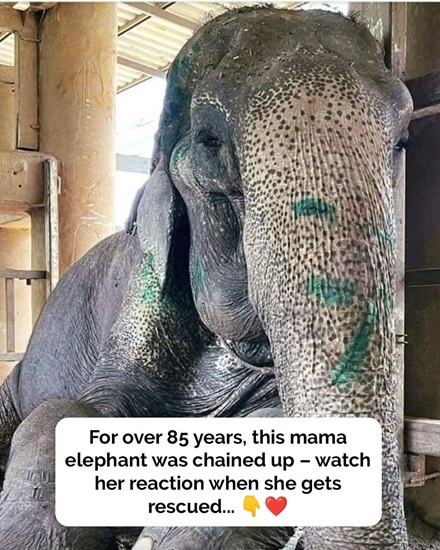
For most of her extraordinarily long life, an elderly Asian elephant named Somboon knew very little of the kind of retirement people normally associate with old age. By the time rescuers reached her in Thailand in January 2024, she was estimated to be about 87 years old and had spent decades working in industries that used captive elephants for logging, transportation and tourism. Accounts connected to her rescue describe a life shaped by long periods of labor and restricted rest.
Somboon eventually became known internationally after Save Elephant Foundation arranged for her transfer to Elephant Nature Park in northern Thailand. Her arrival there marked the beginning of a very different stage of life, focused on food, veterinary attention, rest and freedom from regular work. Somboon’s story attracted widespread attention partly because of her advanced age. Reports published around the time of her rescue described her as approximately 87, making her an exceptionally old Asian elephant.
Her history was reconstructed largely through information shared by people familiar with her earlier life and by the rescue organization caring for her. Those accounts say she had spent much of her life performing physically demanding work. When she was younger, she was reportedly used in logging, a type of labor in which elephants historically moved heavy timber through difficult terrain. Later, as Thailand’s elephant economy changed, Somboon was used in tourism-related work.
Reports based on information shared by her former keeper said that Somboon had worked in several different settings during her lifetime. At different periods she was reportedly involved in carrying logs, giving rides, participating in ceremonial activities and being taken through streets where money was collected from members of the public. In later decades, tourism became a major part of her routine. One account stated that she spent more than 30 years giving rides and could work for many hours in a day. Because much of her early history occurred many decades ago, not every detail can be independently documented, so the most careful description is that these are the histories reported by people connected with her care and rescue.

What was much easier to observe by the time of her rescue was Somboon’s physical condition. Photographs and updates showed an elderly elephant who was very thin and visibly affected by age. Reports described missing teeth, dry or unhealthy-looking skin and reduced physical strength. Like many elderly elephants, she also had difficulty with mobility, particularly when attempting to rise after lying down. These conditions required close monitoring after her arrival at the sanctuary. Her age alone made recovery very different from what rescuers might expect from a younger animal.
Save Elephant Foundation became involved after learning about Somboon’s circumstances. The Thai nonprofit works with captive elephants through rescue, rehabilitation and sanctuary programs and is closely associated with Elephant Nature Park near Chiang Mai. The foundation describes its mission as providing elephants in need with long-term care while also supporting rehabilitation and environments where rescued animals can live without returning to demanding work. Somboon became one of the elderly elephants brought into that system of care.

Her transfer took place at the end of January 2024. Updates shared during the rescue indicated that Somboon was leaving the location where she had worked and traveling to Elephant Nature Park, where the intention was for her to spend the remainder of her life without the responsibilities that had shaped her earlier decades. Posts documenting the journey appeared on January 29 and January 30, showing that the operation was carefully followed by the people involved. The transfer itself was significant because moving an elderly elephant requires special attention to physical stress, hydration and the animal’s ability to remain stable during transport.
Once Somboon arrived at Elephant Nature Park, caregivers prepared an area suited to her age and physical condition. One particularly important feature was a soft sand bed. Sand is used in sanctuary settings because it can provide a gentler resting surface for elephants with weakened joints or other mobility problems. For an elderly animal, getting down and standing again can be physically demanding, so the condition of the ground matters considerably. Somboon’s response to the new resting area soon became the part of her story that received the most attention online.

Newly rescued elephants do not always lie down immediately after entering an unfamiliar environment. Rescue organizations have explained that some remain cautious for days or weeks while becoming accustomed to new surroundings. Somboon behaved differently. According to accounts based on Save Elephant Foundation’s updates, she approached the prepared sand area and lay down soon after arriving. She then slept deeply despite activity around her. The moment was interpreted by caregivers as a sign of just how exhausted she was after her journey and advanced age.
The image of Somboon sleeping became widely shared because it looked so simple. There was no complicated rescue equipment visible in the central moment and no dramatic performance. There was simply an elderly elephant resting on soft ground. Yet the context made that ordinary behavior meaningful to many viewers. After a life reportedly dominated by human-directed work, the sanctuary was allowing her to choose when to rest rather than requiring her to follow a work schedule.
It is important, however, not to exaggerate the moment into claims that cannot be proved. Some online versions of Somboon’s story have said that it was literally the first time she had lain down in 80 years. There is no reliable way to establish such an absolute claim about every night of an elephant’s life. What the rescue accounts clearly support is that Somboon had experienced years of demanding conditions and that she lay down almost immediately after reaching her prepared sand bed at Elephant Nature Park. That fact is powerful enough without adding certainty that the available evidence cannot provide.
Her long sleep created another challenge. When Somboon eventually needed to stand again, she could not easily rise on her own. Elderly elephants can struggle to stand after lying down because of weakened muscles, joint problems or poor overall condition. The sanctuary team therefore had to assist her. Later updates from Elephant Nature Park explained that Somboon was among several older elephants requiring help to get back onto their feet. Caregivers hoped that improved nutrition, regular monitoring and time would strengthen her enough to make movement easier.

This difficulty should not be interpreted as evidence that allowing her to lie down had been a mistake. Rest remains important for animals, especially those dealing with age and physical exhaustion. The challenge was simply that Somboon required additional support because her body no longer had the strength of a younger elephant. Sanctuary staff monitored her closely and provided assistance when necessary. Similar support is sometimes required for other elderly elephants living at Elephant Nature Park.
Somboon’s diet also became an important part of her care. Missing teeth can make feeding more difficult for elderly elephants because they may not be able to chew the same foods as younger animals. Caregivers must take age, dental condition and digestive needs into account when providing meals. Save Elephant Foundation describes nutrition and medical care as central parts of its elephant program. In Somboon’s case, reports noted that the sanctuary provided nutritious food while monitoring her strength and general health.
Over the weeks following her arrival, the updates became increasingly encouraging. Somboon began moving around her surroundings and was seen walking more steadily. Images and videos also showed her enjoying mud and spending time near the river. These behaviors were positive not because they proved that every health problem had disappeared, but because they showed an elderly animal engaging with her environment after a major transition. Her advanced age meant that she would continue needing care regardless of improvements.
Two months after her rescue, a video update described improvements in Somboon’s condition and showed the relationship she had developed with people caring for her. The update emphasized the gradual nature of the process rather than suggesting an instant recovery. For an elephant in her late 80s, rehabilitation is not about returning to youthful physical condition. It is about maintaining comfort, supporting mobility and providing a safe environment where the animal no longer needs to perform demanding labor.
Somboon’s case also brought renewed attention to the lives of captive Asian elephants used in tourism. Thailand has a long and complex relationship with elephants, which have played roles in culture, labor and tourism for generations. Changes in the logging industry pushed many captive elephants and their handlers toward tourism-related work. Activities historically offered to visitors have included rides, performances and opportunities for close physical interaction.
Debates about elephant tourism have changed substantially in recent years. Animal-welfare organizations increasingly encourage travelers to consider how animals are managed rather than assuming that every venue calling itself a sanctuary follows the same standards. Practices involving repeated riding, forced performances or long periods of restraint have faced growing criticism from welfare groups. Some facilities have responded by moving toward observation-based experiences in which elephants are allowed more control over their activities.
Save Elephant Foundation states that its approach centers on rescue, rehabilitation, natural behavior and long-term sanctuary care. Its work includes animals that previously lived in trekking camps, logging operations, street-begging situations and entertainment venues. The organization also supports local communities and educational programs, recognizing that captive elephant welfare is connected with the livelihoods of people who have traditionally worked with elephants.
That broader context matters because the history cannot fairly be described as a simple conflict between individual tourists and individual elephant owners. Economic conditions, traditions, employment opportunities, changes in forestry policy and the growth of international tourism all contributed to the system in which captive elephants were used. Visitors can influence demand through the activities they choose, but the issue also involves people whose livelihoods depend on the animals and who may have limited economic alternatives.
Somboon’s story illustrates what can happen when an elderly working elephant moves from that system into long-term sanctuary care. At Elephant Nature Park, her value no longer depended on giving rides, participating in performances or generating income through physical labor. Her daily routine became centered around basic needs such as food, water, movement, rest and veterinary attention. For an animal of her age, those ordinary elements represented a major change.
One of the most striking things about Somboon’s rescue was how little dramatic action was required for the story to affect people emotionally. The image that traveled around the world was not of her performing a remarkable trick or making a spectacular recovery. It was simply an old elephant sleeping. The significance came from understanding what had happened before that moment.
For decades, Somboon’s movements had largely been organized around human activities. After her transfer, caregivers were attempting to create an environment in which she could make more choices for herself. That might mean deciding when to walk, when to eat, when to enter mud or water, and when to rest. Choice is a basic component of animal welfare because it allows an animal greater control over its surroundings.
The concept of retirement for an elephant is obviously different from retirement for a person, but the comparison helps explain what changed. Somboon no longer had a work schedule. She did not need to carry visitors. She was not expected to move heavy material. She could spend her remaining years receiving care appropriate to her age.
Because she was so old when she arrived, caregivers also had to accept that some medical problems could not simply be reversed. Missing teeth do not grow back. Age-related joint weakness can remain. Changes in vision or skin condition may require continued management. The objective was therefore not to transform Somboon into a perfectly healthy young elephant but to improve her comfort and quality of life.
This is an important distinction in rescue stories. Social media sometimes presents rehabilitation as a dramatic before-and-after transformation in which an animal quickly becomes completely healthy. Real veterinary care is usually more complicated. Older animals may improve in some areas while continuing to experience chronic conditions. Progress can mean eating better, walking more comfortably or sleeping safely rather than achieving a complete cure.
Somboon’s difficulty standing after sleep provides a good example. The problem did not disappear simply because she had reached a sanctuary. Staff members sometimes needed to help her rise. Updates described mahouts and veterinary personnel working carefully with elderly elephants that required this assistance. That ongoing work is part of sanctuary care even when it is less visually dramatic than the rescue itself.
Her case also highlighted the specialized needs of aging elephants. Large body size places considerable pressure on legs and joints. Dental wear can affect nutrition. Reduced strength can make it harder to move between standing and lying positions. Older elephants therefore require environments designed with those limitations in mind.
Soft resting areas are one example. Accessible food and water are another. Veterinary observation becomes particularly important because small changes in movement or appetite can signal significant health problems. Experienced caregivers learn individual routines so that unusual behavior can be recognized quickly.
Somboon was not the only elderly elephant receiving this kind of assistance at Elephant Nature Park. Updates from the sanctuary have said that a large percentage of its population consists of older elephants with histories of work. Some struggle with walking, eating or sleeping and occasionally require physical assistance from caregivers. Somboon therefore became a visible example of a much broader challenge faced by elephant sanctuaries.
The sanctuary environment also allows rescued elephants to live near others of their species. Social relationships are important for elephants, although every rescued animal adjusts differently. Some elephants quickly form bonds, while others need substantial time because of age, previous isolation or stressful experiences. Caregivers generally allow relationships to develop gradually rather than forcing immediate interaction.
For an animal as old as Somboon, simply having the opportunity to observe and interact within a protected environment can be significant. There is no guarantee that every rescued elephant will become part of a large social group. Personality and history matter. Sanctuary care therefore needs to be individualized.
The same principle applies to human interaction. Caregivers cannot assume that every rescued animal immediately trusts people simply because those people intend to help. Elephants with long histories of human control may initially respond cautiously. Building trust requires consistency and patience.
Somboon’s willingness to lie down shortly after arrival was unusual enough that the organization specifically commented on it. Other rescued elephants may remain standing for long periods in unfamiliar surroundings because lying down can leave such a large animal vulnerable. Her decision to rest so quickly therefore stood out to the people observing her.
It is tempting to say that Somboon somehow understood immediately that she had been rescued. That idea makes a powerful story, but it is impossible to know exactly what an elephant is thinking. A more accurate interpretation is that she encountered an environment with soft bedding and no immediate work demands and chose to lie down. Her behavior indicated that she was able to rest there, even if humans cannot know the precise thoughts behind the decision.
Keeping that distinction between observation and interpretation is important when telling animal stories accurately. We can describe what Somboon did. We can document her physical condition and the care she received. We can report what rescuers observed. What we should avoid is presenting imagined thoughts as facts.
The same caution applies to claims about her emotional recovery. Videos showing Somboon walking, eating or taking mud baths are encouraging. They demonstrate behavior consistent with increased comfort and engagement. They do not allow anyone to measure every aspect of her psychological state. Animal welfare is best evaluated through repeated observation, health indicators and behavior over time.
By early April 2024, updates showed that Somboon had spent roughly two months at the sanctuary. A video published by ElephantNews described visible improvement and showed her interacting with her rescuer. Her condition continued to require attention, but the contrast with her arrival was noticeable.
Her story also became part of a broader international conversation about Asian elephants. The Asian elephant is an endangered species, and populations face pressures from habitat loss, conflict with humans and other threats. Captive elephants present a separate set of welfare questions because their lives depend heavily on the conditions in which they are kept and the work expected of them.
Conservation and captive-animal welfare overlap but are not identical issues. Protecting wild elephant populations requires habitat conservation and reducing human-elephant conflict. Improving conditions for captive elephants involves standards for care, handling, breeding, transportation and tourism. Somboon’s story belongs primarily to that second category.
Save Elephant Foundation works across several of these areas. In addition to caring for rescued captive elephants, it supports environmental projects, educational initiatives and community programs. Its stated goal is not only to remove individual elephants from difficult situations but also to change how elephants are viewed and managed over time.
Tourists can play a role by researching facilities before visiting. The word “sanctuary” by itself does not guarantee particular welfare standards, so travelers can look at what activities are offered, whether animals are required to perform and how much choice elephants have in interacting with visitors. Responsible travel decisions can reward businesses that move away from highly intrusive entertainment.
At the same time, changes in tourism need to consider the people caring for elephants. Mahouts and their families may have generations of experience working with the animals and may depend on tourism income. Sustainable reform is more likely when animal welfare improvements are combined with economic opportunities for local communities.
This is one reason the story should not be framed as outsiders simply telling people in Thailand what to do. Somboon was rescued by a Thai organization led by Thai conservationist Saengduean “Lek” Chailert. The foundation works directly within Thailand and with local elephant owners and communities. The effort is rooted in local animal-welfare work rather than an attempt to present foreign observers as the sole voices on the issue.
Lek Chailert has spent decades advocating for changes in elephant welfare. Through Save Elephant Foundation and Elephant Nature Park, she and her colleagues have participated in numerous rescues involving elephants with histories in logging, tourism and entertainment. Somboon’s rescue became especially visible because of her age and the memorable footage of her sleeping after arrival.
Yet every rescue presents different challenges. Some elephants arrive with physical injuries. Others have vision problems, disabilities or behavioral difficulties. Younger animals may require decades of care. Elderly animals may need intensive support almost immediately.
The financial responsibility continues long after the dramatic transport to the sanctuary is finished. Elephants consume large quantities of food and require land, staff, veterinary services and infrastructure. Long-term rescue therefore means committing to years of care rather than simply moving an animal once.
Somboon’s advanced age makes that commitment particularly poignant. Nobody could know exactly how long she would live after reaching the park. The rescue was not based on the possibility of decades of future rehabilitation. It was based on the belief that whatever time remained could be spent under different conditions.
That is perhaps the simplest way to understand the significance of her story. Her past could not be changed. Decades of labor could not be erased. Physical effects of age could not be reversed completely. What rescuers could change was what happened next.
Instead of continuing to carry visitors, she could walk without that responsibility. Instead of working according to a commercial schedule, she could rest. Instead of receiving care primarily to keep her working, she could receive care simply because her health mattered.
The distinction may sound obvious, but it represents a very different relationship between humans and captive animals. In one model, care exists largely to maintain an animal’s ability to perform a task. In a sanctuary model, the animal itself becomes the reason for the care.
Somboon’s famous first sleep at Elephant Nature Park captured that transition in a way that statistics could not. Viewers could see an elderly elephant lying on the sand while people moved around nearby. Nothing spectacular happened, and that was exactly the point.
For perhaps the first time in many years, nothing was being asked of her in that moment.
Caregivers did not need her to carry someone. They did not need her to perform. They simply allowed her to sleep.
After she woke, the reality of her age returned immediately. She struggled to stand and required assistance. The sanctuary could offer safety, but it could not remove every consequence of an extremely long life.
That combination of relief and continuing difficulty makes Somboon’s story more truthful than a simple happy ending. Rescue was the beginning of another stage, not the solution to every problem.
Her daily routine still required veterinary observation. Staff still needed to watch her movement. She still needed help when her strength was insufficient. Her physical condition remained fragile.
At the same time, reports showed improvements. She could walk around the sanctuary, enjoy food and interact with the environment. Later footage showed her participating in behaviors such as mud bathing, which is natural and useful for elephants because mud can help protect their skin from sun and insects.
These ordinary behaviors became markers of progress. A dramatic trick was not necessary. Walking comfortably, eating well or choosing to enter the mud could represent meaningful improvements in daily life.
For people following the rescue online, Somboon also became a recognizable individual rather than an anonymous example of elephant tourism. Her age, appearance and distinctive story gave audiences someone specific to follow.
Individual stories can be powerful because large welfare issues are often difficult to visualize. Hearing that many captive elephants have worked in tourism is abstract. Seeing one old elephant struggling to stand makes the practical consequences easier to understand.
There is still a responsibility to avoid turning that individual into another form of entertainment. Rescue stories should focus on the animal’s welfare rather than using suffering simply to generate shock or engagement.
The most respectful way to tell Somboon’s story is therefore to acknowledge both what is known and what remains uncertain. She was an elderly elephant with a long history of work. She was transferred to Elephant Nature Park in late January 2024. She arrived thin and with age-related health concerns. She lay down on a prepared sand bed soon after arrival, slept deeply and later needed assistance getting back up. Those facts are supported by rescue updates and subsequent reporting.
Reports also support that she had been involved in logging and tourism during her long life. Some accounts say she had been taken from the wild when very young, but details from such an early period of her life are necessarily harder to document independently. For that reason, those claims are best presented as part of her reported history rather than as details confirmed by modern records.
There is likewise no need to claim that Somboon was literally unable to rest for every one of her previous 80 years. The central point remains clear without that exaggeration. She had spent decades in demanding work and arrived at the sanctuary at an extremely advanced age in poor physical condition.
The response from the sanctuary showed what different priorities can look like. Soft bedding was prepared. Food was adjusted to her needs. Her ability to walk and stand was monitored. Assistance was provided when she could not rise by herself.
Those things are not dramatic, but good animal care often consists precisely of such details.
Somboon’s story also demonstrates why older animals require special consideration when rescue decisions are made. Transport itself can be stressful. Sudden environmental changes can be difficult. Veterinary teams must balance the potential benefits of relocation against the risks.
In Somboon’s case, the transfer was completed successfully, and the sanctuary became her new home. The updates that followed suggested that she adjusted well enough to begin exploring and resting there.
As time passed, followers saw a different version of the elephant who had arrived at the end of January. Her age did not change, but her surroundings did. Her workload disappeared. Her days became structured around care instead of labor.
That transformation is what makes her rescue meaningful.
It is not that every problem vanished when the sanctuary gates opened.
It is that for the remainder of her life, the purpose of the people around her had changed.
They were no longer asking what Somboon could do for them.
They were asking what they could do to make Somboon comfortable.
That difference is at the heart of responsible sanctuary care.
For people who encounter elephants while traveling, her story can also encourage thoughtful questions without assigning blame to an entire country, culture or community. Travelers can ask whether animals are allowed to choose when to interact, whether riding or performances are required and how older or injured animals are treated.
Those questions are more useful than assuming every elephant tourism activity is identical.
They also allow change to be supported in practical ways.
Facilities that reduce forced interaction and prioritize elephant welfare can benefit when tourists choose them over more exploitative models.
At the same time, lasting improvements require solutions that work for local people as well as animals.
Somboon’s rescue was possible because individuals and organizations inside Thailand were willing to coordinate a different future for her.
Her story therefore belongs not only to international animal-welfare conversations but also to the work of Thai rescuers, veterinarians, mahouts and supporters who participated directly.
By focusing on those verified facts, the story becomes stronger rather than weaker.
There is already enough emotion in the image of an 87-year-old elephant finally reaching a place where she no longer needs to work.
No invented thoughts or exaggerated numbers are necessary.
The quiet details tell the story.
An elderly elephant arrives.
A sand bed is waiting.
She walks toward it.
She lies down.
She sleeps.
When she struggles to stand, people help her.
When she needs food, it is prepared.
When she needs monitoring, staff remain nearby.
In the following weeks she begins walking more comfortably.
She explores.
She eats.
She takes mud baths.
She continues receiving care.
Those moments may appear ordinary, but for Somboon they represented an entirely different daily life.
Her story also reminds us that rescue does not need to happen only for young animals with decades ahead of them.
An elderly animal can still benefit enormously from comfort, safety and freedom from work.
Even if the remaining time is uncertain, the quality of that time matters.
Somboon could not regain the decades already spent laboring.
But the end of her story did not have to look exactly like the beginning.
At Elephant Nature Park, she was given the opportunity to live as an elderly elephant receiving care rather than as an attraction required to continue earning her keep.
That may be the most important fact of all.
Her rescue in January 2024 did not rewrite her past.
It changed her present.
And for an animal that had already lived an extraordinarily long life, that change mattered.
Somboon’s journey remains one of the most widely shared examples of how differently an elephant can behave when work is replaced by rest and individualized care.
Her first deep sleep attracted attention around the world, but her quieter days afterward are equally important.
Recovery is not one dramatic moment.
It is food arriving every day.
It is veterinary checks.
It is a soft place to rest.
It is assistance when weak legs cannot lift an aging body.
It is the freedom to walk without carrying passengers.
It is being allowed to move slowly.
It is being allowed to stop.
For Grandma Somboon, that became the new rhythm of life at Elephant Nature Park.
After decades of reported work in logging and tourism, she finally entered a stage where her needs came first.
Her age and health meant that care would never be simple.
But the aim was no longer productivity.
It was comfort, dignity and the chance to spend the remainder of her life without returning to the work that had defined so much of her past.
That is why Somboon’s story continues to resonate.
Not because it provides a perfect ending.
But because it shows the practical difference that can be made when an elderly animal is finally given the opportunity to rest.
