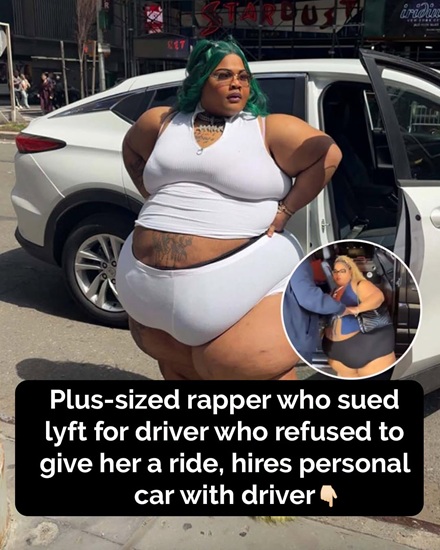
More than a year after Detroit rapper Dank DeMoss became the center of a nationwide online debate, her name returned to social media for an unexpected reason.
This time, it was not because another driver had refused her a ride. It was because of the vehicle she was riding in.
Videos and photographs circulated showing DeMoss traveling in a large van with a driver.
The vehicle offered significantly more space than the sedan involved in the incident that originally made her famous outside music circles.
For some people online, that seemed ironic.
For others, it changed nothing.
And almost immediately, an old argument started again.
But to understand why one van could restart such a heated discussion, it is necessary to go back to January 2025.
Dank DeMoss is the stage name of Dajua Blanding, a Detroit rapper and social-media personality.
At the time, she was trying to attend a football watch party.
She requested a ride through Lyft.
A driver arrived in a Mercedes-Benz sedan.
Then the trip stopped before it really began.
According to Blanding and video of the encounter, the driver did not allow her into the vehicle.
The disagreement centered on her size.
Blanding recorded part of the interaction.
In the footage, she insisted that she could fit in the car.
The driver disagreed.
He told her he believed she would not fit comfortably and expressed concern about whether the car and its tires could safely accommodate her.
He suggested that she request a larger vehicle.

He also indicated that he would cancel the trip so she would not be charged.
For Blanding, however, the issue was not simply getting another ride.
She believed she had been denied service because of her weight.
And in Michigan, that distinction matters legally.
Michigan’s Elliott-Larsen Civil Rights Act includes weight among protected characteristics.
The law recognizes protections against discrimination in areas including public accommodations.
That made the dispute more than an argument about whether one passenger would fit into one particular car.
It raised a legal question about when a driver’s concern about a vehicle becomes discriminatory treatment of a passenger.
Blanding later told FOX 2 Detroit that she had ridden in smaller vehicles before.
She also said the encounter had hurt her feelings.
Soon afterward, she retained attorneys and filed a lawsuit involving Lyft and the unidentified driver.
Her lawyer Jonathan Marko argued that refusing transportation because of her weight violated Michigan civil-rights protections.
Lyft responded publicly by saying it opposed discrimination.
The company said its community guidelines and terms prohibit harassment and discriminatory treatment.
But the internet quickly divided.
Some people defended Blanding.
They argued that customers should not be denied service solely because of body size.
Others defended the driver.
They argued that drivers use personal vehicles and may have legitimate concerns about seating capacity, passenger comfort, suspension, tires, or manufacturer weight limits.
Then came a third group.
They were less interested in law or vehicle engineering.
They simply turned the incident into jokes.
And that may have been the most predictable part of the entire story.
Once Blanding’s video spread online, her appearance became the focus of thousands of comments.
Some users discussed civil rights.
Others discussed vehicle specifications.
But a large amount of the attention was directed toward her body.
The debate increasingly became personal.
That made it difficult to separate a genuine legal question from the ridicule surrounding the woman who had raised it.
Blanding continued defending her position.
Her argument was straightforward.
She believed she could physically enter the vehicle.
The driver had decided otherwise before giving her that opportunity.
From her perspective, that was discrimination.
From the driver’s perspective, according to what could be heard in the interaction, the issue involved whether the sedan could accommodate her.
Those positions were never going to be easily reconciled online.
And vehicle capacity is not determined by appearance alone.
Every vehicle has a manufacturer-specified load capacity.
That total generally includes passengers and cargo.
It varies by make, model, equipment, and configuration.
The relevant figure is not simply how large a car looks from outside.
Nor can a social-media commenter reliably determine the exact safe payload of a specific car from a short video.
That technical reality is worth remembering.
But the lawsuit focused on another question.
Was Blanding denied service because of a legally protected characteristic?
Her attorneys said yes.
The matter proceeded through the legal system.
Then, several months later, the case quietly reached an end.
In September 2025, FOX 2 Detroit reported that court records showed the lawsuit had been resolved earlier that summer.
Blanding’s attorney Zach Runyan confirmed that the case had been resolved.
He did not provide details about the settlement.
No publicly confirmed financial figure was released.
That absence matters.
Online posts later made numerous claims about what Blanding supposedly received.
Some suggested large payouts.
Others claimed specific consequences for the driver.
But without court documentation or reliable confirmation, those claims should not be presented as established facts.
What can responsibly be said is much simpler.
The lawsuit was resolved.
The specific terms remained private.
And the original disagreement did not disappear from the internet.
In fact, the next development gave it new life.
Videos began circulating showing Blanding traveling in a large van with a driver.
Some reports described it as a chauffeur-driven luxury or Sprinter-style vehicle.
Compared with an ordinary sedan, it clearly offered more interior room.
That visual contrast was enough.
Critics immediately connected the van to the original Lyft incident.
One popular argument went something like this:
If she now prefers a much larger vehicle, perhaps the Lyft driver had been right to question whether the sedan was appropriate.
Others saw that argument as missing the point completely.
The lawsuit had not asked whether a larger vehicle might be more comfortable.
The legal dispute concerned the reason she said she was denied a ride.
Those are different questions.
A person can prefer a spacious van today and still argue that a service provider discriminated against them previously.
One does not logically prove or disprove the other.
But social media rarely rewards that kind of nuance.
The van became a symbol.
To critics, it appeared to validate the driver’s concerns.
To supporters, it represented someone choosing transportation that worked well for her after a humiliating experience.
The exact same image produced opposite conclusions.
That is often how viral controversies survive.
The facts become secondary.
The symbol becomes more important.
Blanding herself has consistently presented her public image around confidence and body acceptance.
Her stage persona embraces being a larger woman rather than hiding it.
But that does not mean she has claimed that health or weight management is easy.
Quite the opposite.
She has publicly discussed struggling with her weight since childhood.
In interviews, she has mentioned thyroid issues.
She has also spoken about genetic influences on her weight.
Those are statements Blanding has made about her own health experience.
They should not be expanded into diagnoses that she has not publicly documented in detail.
Thyroid disorders can affect metabolism and body weight.
But weight is complex.
Genetics, food intake, medications, endocrine conditions, physical activity, sleep, environment, and many other factors can contribute.
No outside observer can look at someone’s body and determine the complete cause of their weight.
That has not stopped people from trying.
Blanding’s size has repeatedly become the central subject in discussions about her.
Yet she has also publicly shared efforts to change her weight.
In 2025, she posted a progress update and said she had lost well over 100 pounds.
She described the process as imperfect.
She said she exercises but sometimes gets busy.
She acknowledged that she still eats foods she enjoys.
And she described weight management as a long-term battle rather than a short transformation.
That framing is significantly different from many viral narratives.
Online discussions often prefer extremes.
Either someone is presented as completely rejecting weight loss.
Or they are portrayed as undergoing a dramatic transformation.
Real life usually sits somewhere in between.
A person can support body confidence while also pursuing weight loss.
They can dislike discrimination without claiming every health concern about obesity is false.
They can work out and still struggle.
They can make progress without becoming thin.
Those ideas do not contradict one another.
Blanding’s public comments have reflected that complexity.
She has talked about wanting to feel accepted as she is.
She has also discussed trying to lose weight.
That makes the response to the van especially revealing.
Some commenters treated the vehicle as evidence in a case that had already been legally resolved.
But buying or using a larger vehicle is not a court ruling.
It does not retrospectively establish what the driver knew.
It does not determine the motive behind the refusal.
And it does not reveal the settlement terms.
It simply shows Blanding traveling in a more spacious vehicle.
Anything beyond that requires interpretation.
Still, the visual was almost designed for internet debate.
A woman who had sued after allegedly being told she would not fit in a sedan was now being driven in a large van.
The comparison practically wrote its own jokes.
And the jokes arrived quickly.
Some comments argued that she had accidentally proved the driver’s point.
Others accused those commenters of mocking a person over her weight instead of addressing the legal issue.
Then another question emerged.
Could the driver have had a legitimate safety concern?
In principle, vehicle load capacity is a legitimate issue.
Drivers should not exceed manufacturer limits.
Passenger safety matters.
Tire ratings matter.
Seat-belt fit matters.
Vehicle payload matters.
But a general statement about vehicle safety does not automatically resolve this specific incident.
To know whether the Mercedes in question exceeded a manufacturer limit, someone would need details such as the exact model, configuration, existing passengers or cargo, and its rated payload.
The viral video alone does not establish all of those facts.
That is precisely why confident internet conclusions can exceed the evidence.
It is possible to believe both things at once.
Drivers should operate vehicles safely within their technical limits.
And customers should not face discriminatory treatment based on assumptions about protected characteristics.
The difficulty lies in determining which principle controlled a specific encounter.
That is a legal and factual question.
Not a meme.
Michigan’s civil-rights framework is part of what made Blanding’s case unusual nationally.
Weight discrimination is not protected in exactly the same way everywhere in the United States.
Michigan has long included height and weight within its civil-rights protections.
That legal context gave her attorneys a basis for bringing the claim.
It did not automatically guarantee she would win at trial.
And because the case was resolved rather than publicly litigated to a final judgment on the merits, there was no public trial verdict declaring every disputed issue one way or another.
That distinction is important.
A private settlement can end a dispute without producing a definitive judicial finding on every allegation.
So saying “Blanding proved the driver discriminated against her in court” would go beyond the publicly reported outcome.
Saying “the lawsuit was dismissed because the driver was right” would also be wrong.
The accurate statement is narrower.
The lawsuit was resolved privately.
The terms were not publicly disclosed.
That leaves social media doing what it usually does.
Filling the gaps.
But facts do not become stronger because they are repeated more often.
The same applies to claims that the driver was fired.
Those claims circulated online.
Reliable reporting available about the settlement does not establish that detail clearly enough to state it as fact.
The same caution applies to claims about exactly how much money Blanding received.
Without public confirmation, numbers attached to the settlement are speculation.
And the van itself has been surrounded by similar exaggeration.
Reports and viral posts have described it as custom, luxury, chauffeur-driven, or purchased specifically because of the Lyft case.
Some of those descriptions come from social-media interpretation.
The safest conclusion is simply that widely circulated videos show Blanding traveling in a large van with a driver.
Whether the vehicle was purchased solely because of the lawsuit is a separate claim.
That may sound overly cautious.
But caution is exactly what viral stories usually lose first.
There is another part of Blanding’s story that rarely gets the same attention.
Music.
Before the Lyft controversy, Dank DeMoss was already pursuing a rap career.
She has released independent music and built a social-media presence around her personality and songs.
Her public persona strongly embraces larger women and self-confidence.
She has also spoken about her father’s influence on her music.
In interviews, Blanding has said her father died young and that music became part of how she dealt with that loss.
Her broader ambitions include music and entertainment.
Yet millions of people who encountered her name in 2025 knew none of that.
They knew only one thing.
She was the woman who sued Lyft.
That is one of the strange effects of going viral.
A person can spend years building a career.
Then one 30-second confrontation defines them to an audience far larger than the one following their actual work.
For Blanding, the rideshare dispute became that moment.
It created visibility she did not receive from music alone.
But it also meant people who knew almost nothing about her felt entitled to judge nearly every aspect of her life.
Her health.
Her food.
Her mobility.
Her clothes.
Her relationships.
Her career.
And eventually, her choice of vehicle.
That is where the story begins to become larger than one driver and one passenger.
The original encounter raised a legitimate question about discrimination.
The response raised another question about how the internet treats people whose bodies fall far outside conventional norms.
Criticism of a lawsuit is fair.
Legal arguments can be debated.
Vehicle capacity can be discussed.
Settlement terms can be analyzed when they are public.
But ridicule about someone’s body is not evidence.
And insults do not settle engineering questions.
The controversy repeatedly blurred those categories.
A technical debate became a body-shaming debate.
A legal argument became entertainment.
Then a van became the latest prop.
Blanding, meanwhile, continued speaking about her own health journey.
She has said she goes to the gym.
She has discussed taking steps toward weight loss.
And in 2025, she said she had lost more than 100 pounds.
That progress did not make the criticism disappear.
If anything, it demonstrated another contradiction in online culture.
People often demand that larger individuals lose weight.
Then when they publicly discuss losing weight, strangers scrutinize the pace.
If they embrace body positivity, they are accused of glorifying obesity.
If they pursue weight loss, people accuse them of contradicting body positivity.
There is often no version that satisfies everyone.
Blanding’s approach has been to continue presenting confidence publicly while acknowledging that weight management remains difficult for her.
That can coexist.
Body positivity does not logically require someone to promise that their body will never change.
At its most basic, it means arguing that dignity should not depend on reaching a certain body size.
Health goals are a separate question.
That distinction is easy to lose in arguments where every image becomes ammunition.
The van is a perfect example.
One person sees practical transportation.
Another sees hypocrisy.
Another sees success.
Another sees proof that the sedan was unsuitable.
Yet the van itself cannot answer the original legal dispute.
It cannot tell us exactly what the driver’s vehicle was rated to carry.
It cannot tell us whether the driver made an individualized safety assessment or acted on an assumption.
It cannot tell us why Lyft ultimately agreed to resolve the lawsuit.
And it cannot tell us what either side agreed to privately.
It is simply a vehicle.
The meanings were added afterward.
That is where the delayed payoff of the story becomes clearer.
At first, the controversy appears to be about whether Dank DeMoss could fit into a Mercedes.
Then it appears to be about Michigan discrimination law.
Then the internet turns it into a fight about obesity.
Then a settlement ends the formal dispute.
And finally, a larger van appears and starts everything again.
But the real unresolved question is not about the dimensions of either vehicle.
It is about how society handles the point where accessibility, safety, individual dignity, and practical limitations meet.
Those issues do not always produce easy answers.
A transportation company has obligations to customers.
A driver has obligations to operate safely.
A passenger has a right to be treated with dignity.
Vehicles have physical limits.
Civil-rights laws impose legal limits too.
Sometimes those boundaries collide.
That is exactly what makes the original incident worth discussing without turning either person into a cartoon.
The driver did not need to become a villain for legitimate questions about discrimination to be raised.
Blanding did not need to become a symbol of every debate about obesity for her treatment to be examined legally.
A civil lawsuit offered one mechanism for resolving that disagreement.
And ultimately, the case was resolved privately.
That is where the legal story ended.
The internet story did not.
Months later, one video of a spacious van was enough to revive the entire argument.
Critics saw vindication.
Supporters saw independence.
Blanding continued living her life while strangers debated what her transportation supposedly proved.
Perhaps the simplest interpretation is also the least dramatic.
She now has access to a vehicle that gives her more room.
That may be more comfortable.
It may be more convenient.
It may suit her lifestyle.
None of those possibilities requires rewriting what happened in January 2025.
And none proves what a court would have decided if the civil case had gone all the way to trial.
That uncertainty may frustrate people looking for a clear winner.
There may not be one.
What is documented is enough.
In January 2025, a Lyft driver declined to transport Dajua Blanding after saying she would not fit in his Mercedes sedan and raising concerns about the vehicle.
Blanding disagreed.
She said she had traveled in smaller cars and that the refusal hurt her.
She filed a discrimination lawsuit.
Michigan law includes weight among protected characteristics.
Lyft publicly said it prohibits discrimination.
The lawsuit was later resolved privately.
Specific settlement terms were not disclosed.
Blanding later appeared in videos traveling in a larger van.
Social media turned that vehicle into a fresh round of argument.
And alongside all of that, she has publicly described a long struggle with weight and reported losing more than 100 pounds.
Those facts create a complicated story without needing extra exaggeration.
There is no requirement to declare the driver evil.
There is no requirement to declare Blanding dishonest.
And there is certainly no need to invent settlement figures, medical explanations, or secret motives.
The documented events already contain enough tension.
A passenger believed she was discriminated against.
A driver believed his vehicle was not appropriate.
The disagreement became public.
The law became involved.
The dispute ended privately.
Then the internet continued trying to decide who had been right.
More than a year later, it was still doing exactly that.
All because of one new vehicle.
And perhaps that is the final irony.
The legal case was resolved.
The argument never was.
