Ten days after catastrophic flooding tore through parts of Nepal, rescuers received the kind of result that becomes harder to imagine with every passing hour.
A man was found alive underground. The survivor was a Chinese national working at a hydropower project in the disaster zone.
His name was Lu Haitao. For more than a week, rescue teams had been searching through a landscape transformed by water, mud, rocks and destroyed infrastructure.
Entire communities had been hit.
Roads and bridges were damaged or swept away.
Hydropower facilities along river valleys were among the sites facing some of the most difficult rescue operations.
Many workers were still missing.
Some were believed to be inside tunnels.
Then, after 10 days, one of them emerged alive.
The rescue took place on September 5, 2026.
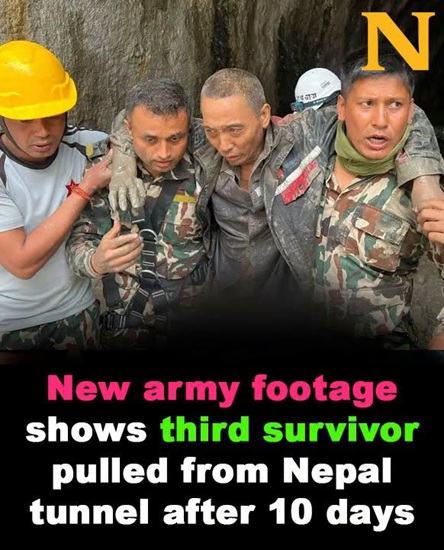
Lu was located inside a tunnel at the Upper Trishuli-1 Hydropower Project.
Reports placed him about 225 meters, or approximately 738 feet, inside the tunnel.
Getting him out was only the first challenge.
Images released after the rescue showed soldiers supporting and carrying him.
He appeared exhausted.
After so many days underground, walking normally was difficult.
A helicopter was waiting.
An army medical worker began assessing him during the evacuation.
Initial reports said he had mild hypothermia but no obvious serious external injuries.

He was later taken for medical treatment.
The scene was remarkable on its own.
But its importance became clearer when viewed alongside what had happened only a day earlier.
Two other hydropower workers had also been found alive.
Their names were Sanjay Sah, also reported in some coverage as Sanjay Shah, and Kabir Maharjan.
They had been trapped at the Upper Trishuli 3A Hydropower Station.
They had spent nine days underground.
Then rescuers reached them.
The operation had been extremely difficult.
The entrance area had been buried by enormous quantities of mud and debris.
Rescuers first had to determine where access could safely be created.
Old engineering information, maps and knowledge of the facility became important.
But knowing approximately where trapped workers might be was only the beginning.
Huge rocks blocked progress.
Floodwater created another danger.
And every attempt to open a route brought a new risk.
If rescuers broke through the wrong section and released trapped water, the people inside could be endangered.
The rescue team itself could also be trapped.
That meant speed mattered.
But caution mattered just as much.
At certain points, controlled explosives were used to move obstacles that could not easily be removed by hand or machinery.
Water also had to be managed.
The underground environment was unstable and largely hidden from view.
Nobody could simply look through the tunnel and see what remained beyond the next obstruction.
Then rescuers heard something.
A voice.
It was faint.
But it was enough.
The team called toward the trapped workers.
A reply came back.
After days of uncertainty, there was finally confirmation that someone remained alive.
Rescuers continued forward.
Eventually, Sah and Maharjan were brought out.
Images of the men emerging covered in mud quickly circulated internationally.
The moment gave exhausted teams something they desperately needed.
Evidence.
People could survive underground for far longer than many observers had assumed.
Australian tunnelling specialist Arnold Dix had been helping advise the rescue effort.
Dix had experience with complex underground emergencies, including the 2023 Silkyara tunnel collapse in India, where 41 workers were eventually rescued.
Nepal presented a different challenge.
This was not one isolated tunnel accident.
Flooding had affected numerous hydropower facilities across a much larger area.
Rescue teams were trying to understand conditions at multiple sites at the same time.
The scale was extraordinary.
And information was incomplete.
Some tunnel entrances had disappeared beneath mud and debris.
Road access had been destroyed.
Communication systems had failed in places.
Workers’ exact locations were often unknown.
Some tunnels could contain air pockets.
Others could be flooded.
Some might have been partly protected because of their underground design.
Others could have filled rapidly with water and sediment.
No two locations could simply be treated as identical.
That uncertainty made every successful rescue important.
After Sah and Maharjan were found alive, Dix said the discovery gave teams renewed hope.
It showed that survival after more than a week underground was possible.
That did not prove everyone missing was alive.
But it changed what rescuers knew.
Then Lu Haitao was found.
A third worker had survived.
And this time it had been 10 days.
His rescue did not occur at exactly the same hydropower facility as the first two men.
That distinction matters.
Sah and Maharjan were rescued at Upper Trishuli 3A.
Lu was rescued from the Upper Trishuli-1 project.
But all three cases formed part of the much wider struggle to reach workers trapped or missing around Nepal’s damaged hydropower infrastructure.
The disaster itself had begun on August 26.
A massive flash flood struck areas along the Bhote Koshi and connected river systems.
News reports linked the event to a glacial collapse in the Himalayan region, while Nepalese authorities confirmed the enormous flood and the widespread destruction that followed.
Water mixed with mud, rocks and debris moved through river valleys with devastating force.
Homes were destroyed.
Infrastructure disappeared.
Roads became impassable.
Bridges were damaged.
Hydropower projects built close to rivers were hit particularly hard.
Workers had little warning.
Some escaped.
Others could not.
In the days that followed, the numbers became increasingly grim.
By September 5, Reuters reported at least 1,344 people dead in Nepal.
Another 4,887 people were listed as missing.
Hundreds of foreign nationals were among those unaccounted for.
The disaster also affected the Tibetan side of the border.
Chinese reporting cited 31 confirmed deaths and 531 people missing there by September 5.
Those figures were still subject to change as search operations continued.
The scale of the tragedy made the individual rescues feel almost impossible to separate from the wider loss.
One person surviving did not erase thousands of families waiting for news.
But each survivor changed the emotional landscape of the rescue effort.
For families of missing workers, the message was unavoidable.
Ten days did not necessarily mean hope was over.
That realization carried enormous weight.
Earlier reports suggested roughly 900 workers were missing from about a dozen hydropower projects.
Around 500 were believed potentially to be inside tunnels.
Those estimates were difficult to verify precisely while the disaster response was still underway.
Conditions were changing.
People initially reported missing could later be found elsewhere.
Some workers may have escaped without immediately being able to contact their families or employers.
Others could still be trapped underground.
Rescuers therefore faced two challenges at once.
They had to locate people.
And they had to determine where searching could be done without causing another disaster.
Tunnels are unusual rescue environments.
Above ground, drones and aircraft can survey large areas relatively quickly.
Thermal cameras may detect people in accessible locations.
Rescuers can often visually inspect debris.
Underground, almost all of those advantages disappear.
A tunnel curves.
Walls block radio signals.
Mud can stop drones.
Floodwater can hide entire sections.
Collapsed rock can create barriers that are dangerous to disturb.
And the absence of communication does not necessarily mean nobody is alive.
That last point became increasingly important.
An underground worker may have no working phone.
Power could be gone.
Radio communication might be impossible.
Yet an air pocket, a dry platform or a higher section of a tunnel could remain survivable.
Temperature underground may also be more stable than conditions outside.
But survival depends on several variables.
Air.
Water.
Temperature.
Injuries.
Access to food.
Exposure.
The condition of the tunnel.
There is no guaranteed survival timeline.
That is why rescuers could not simply assume that silence meant death.
And the three survivors proved why.
For Lu, surviving 10 days underground required enduring conditions that were still being reconstructed after his rescue.
His medical condition needed professional evaluation.
It would be irresponsible to invent details about exactly what he ate, drank or thought during every hour unless he personally provided those details.
What was confirmed was extraordinary enough.
He had survived.
He had been reached.
And he was being treated.
The same caution applies to the other missing workers.
Hope is justified.
Certainty is not.
Rescue teams cannot promise families that everyone will be found alive.
But after three workers were pulled from tunnels after nine and 10 days, neither can they assume that late rescue efforts are pointless.
That created a difficult balance.
Every additional hour raises concern.
Yet rushing blindly underground could kill rescuers and survivors alike.
Arnold Dix repeatedly emphasized the dangers teams were facing.
Water was one of the greatest threats.
A team digging below flood-plain level could be inundated from behind.
Breaking through an obstacle could release water trapped ahead.
Rock movement could destabilize an already damaged structure.
The people attempting the rescue therefore became part of the risk equation.
Saving one worker could not justify unnecessarily sacrificing another.
That reality made the operations slow.
From outside, people may see rescuers digging and wonder why they cannot simply move faster.
Inside a damaged tunnel, “faster” can mean “more dangerous.”
Every rock can be structural.
Every cavity can contain water.
Every new opening can change pressure and drainage.
That is why engineers, soldiers, tunnelling specialists and other rescue personnel had to work together.
The problem was not merely digging.
It was understanding what they were digging into.
Maps became valuable.
Engineering drawings became valuable.
People who knew the hydropower facilities became valuable.
Even information shared among engineers could help teams reconstruct structures that were no longer visible from the surface.
Technology helped too.
Drones had been used extensively in the wider flood zone.
Some carried thermal equipment.
Others helped inspect areas that rescuers could not safely reach immediately.
But drones also had limits underground.
Narrow passages restricted movement.
Mud blocked routes.
Signal loss was a constant issue.
A drone cannot fly through solid rock.
Sometimes the final meters still required human beings.
And those meters could be the most dangerous of all.
That is why the moment a faint human voice answered from the Trishuli 3A tunnel mattered so much.
The rescuers were no longer working only from probability.
They knew someone was there.
That knowledge can transform an operation.
It creates a target.
It creates urgency.
But it also creates pressure.
The rescuers know every delay matters.
They also know a mistake could destroy the very refuge keeping the trapped people alive.
There are few clearer examples of why disaster rescue requires patience as well as courage.
The successful operations also revealed something about infrastructure.
Hydropower projects in mountainous regions often rely on tunnels, underground chambers and structures close to rivers.
Those features are essential to electricity generation.
During an extreme flood, however, access can become extraordinarily difficult.
A worker may be physically protected underground while simultaneously being cut off from rescue.
That paradox became central to the Nepal operations.
The tunnels were dangerous.
But in some cases, they may also have created spaces where people could survive the destruction occurring above them.
That possibility helped explain why specialists refused to treat underground silence as definitive.
The rescues also came during a larger humanitarian emergency.
Thousands of people needed assistance.
Survivors had lost homes.
Communities had lost roads.
Families were searching for relatives.
Medical services faced pressure.
Damaged infrastructure complicated the movement of aid.
The hydropower tunnel operations were therefore only one part of a huge national and international response.
Nepal’s military and emergency services were involved.
Foreign specialists also contributed.
Teams and experts from several countries assisted different aspects of the effort.
The operation became a mixture of local knowledge, engineering experience and international disaster-response capability.
But machinery and expertise alone could not remove the emotional burden.
Rescuers were exhausted.
Families were exhausted.
Officials were under pressure to provide information even while that information was changing.
Then came the survivors.
First Sah and Maharjan.
Then Lu.
Each rescue offered a reason to continue searching carefully.
Not because survival everywhere was guaranteed.
But because survival somewhere had been proven.
That distinction is crucial.
Hope based on evidence is different from false reassurance.
A responsible account of the disaster should not promise miraculous outcomes.
It should also not declare people dead before rescuers have enough evidence.
The three tunnel rescues demonstrated why both extremes are dangerous.
At nine days, two men were alive.
At 10 days, another man was alive.
The numbers mattered.
But eventually, something else mattered more.
The rescues changed the question.
Early in a disaster, teams ask where survivors are likely to be.
As days pass, a darker question begins to appear.
Can anyone still be alive?
After the Nepal tunnel rescues, the answer was no longer theoretical.
Yes.
Some people could.
That did not reduce the scale of the catastrophe.
It did not change the number of families grieving.
It did not guarantee the safety of the hundreds still missing around hydropower projects.
But it gave rescue teams something powerful.
Proof.
Proof that underground pockets could remain survivable.
Proof that a faint signal days after a flood still deserved investigation.
Proof that difficult tunnel operations could produce living survivors even after conventional expectations had begun to fade.
And that became the delayed payoff of the entire operation.
The most important thing Lu Haitao brought out of the tunnel was not only his own survival.
His rescue strengthened the case for continuing carefully wherever engineering conditions suggested survival remained possible.
The same was true of Sah and Maharjan.
Their rescues became information.
Engineers could study where they survived.
Teams could examine the tunnel conditions.
Rescuers could ask what protected them from water.
They could investigate how breathable air remained available.
They could use those lessons when approaching other damaged facilities.
One rescue could therefore influence the next.
That is why Arnold Dix described the earlier Trishuli 3A success as something that gave rescuers greater focus.
The operation was no longer only about celebrating two men.
It was about learning from the space that had kept them alive.
Every tunnel would still be different.
But the questions could become sharper.
Where are the highest points?
Where might air remain?
Which chambers were above water level?
Which access routes could be opened without flooding the refuge?
Where were workers most likely to have moved when the flood arrived?
These are technical questions.
But behind every one of them is a human being.
Someone’s brother.
Someone’s father.
Someone’s son.
Someone’s colleague.
That is why rescuers kept digging.
By the time Lu was flown to medical care, 10 days had passed since the August 26 flood.
Much of Nepal’s affected region was still dealing with enormous destruction.
Thousands remained missing.
The disaster was far from over.
But three workers who might easily have been counted among the dead were alive.
For the families still waiting, that fact did not offer certainty.
It offered something smaller.
And perhaps more valuable.
A reason not to abandon hope before the evidence demands it.
The Nepal tunnel rescues were never evidence that every missing worker would return home.
They were evidence that after nine days, rescue was still possible.
After 10 days, rescue was still possible.
And somewhere beneath mud, rock and destroyed infrastructure, another person might still be waiting for someone above ground to keep searching.
That possibility was enough to keep the work going.
