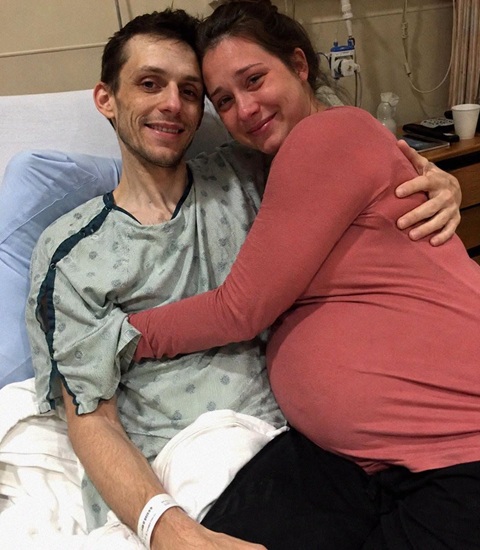
I thought the most painful thing I would ever have to do was carry out my husband’s final wish after his death. Mark had known for weeks that he probably would not live long enough to meet our daughter, and he had been remarkably clear about what he wanted to happen when the time came. He wanted anything medically suitable to be donated. He said that if he could not stay long enough to watch our child grow, perhaps some part of him could help another family have more time together.
I hated hearing him talk about his own death, but I promised him I would respect that decision. What I never imagined was that he had prepared for a second battle—one I would have to fight after he was gone. The first hint came while I was leaving the hospital. I was eight months pregnant, exhausted, emotionally numb, and desperate to get away from every sympathetic expression in the hallway. People kept saying Mark’s name and touching my arm as though physical contact could somehow make the loss easier.
I was almost at the exit when I heard Dr. Rivers calling after me. I kept walking for several seconds before finally turning around. He was holding a plain envelope, and the look on his face told me immediately that it was not hospital paperwork. He explained that Mark had given him the envelope three weeks earlier. My name was written across the front in the messy handwriting I had seen on grocery lists, birthday cards and notes left beside the coffee machine for years. Dr. Rivers said Mark had made him promise not to give it to me until after everything was over.
I asked why, but he could only tell me that Mark believed I would understand when I needed it. That vague answer sounded exactly like my husband and somehow made me both angry and heartsick at the same time. Two months earlier, our life had looked very different. We were sitting on the porch debating baby names and pretending that the future was still ordinary.
Mark suggested Clementine with a completely straight face, and I told him it was a perfectly good name for an orange. Eventually he mentioned Cecelia, explaining that his grandmother used to sing a song with the name in it even though, according to him, she had never been particularly good at singing. When I repeated the name aloud, the baby kicked beneath his hand, and Mark immediately announced that she had voted.
That was the night Cecelia became real to us in a different way. We had wanted a child for years, and reaching the third trimester had felt like something we had worked toward together for an eternity. Then, only months into the pregnancy, Mark became seriously ill. His doctors gave us devastating news and told us his time was probably limited. There was a very real possibility that he would never hold the daughter whose movements he could already feel through my stomach. We stopped talking about distant plans because suddenly everything felt measured in weeks.
One evening, while Cecelia kicked hard enough to move my shirt, Mark told me he wanted to be an organ and tissue donor if doctors believed anything could be used. I begged him not to talk about dying while our daughter was moving beneath his hand. He told me that was exactly why he needed to discuss it. If he could not watch her grow up, he wanted the possibility that someone else might receive more time with the people they loved. I told him not to make death sound noble because I was already furious that it was happening at all.
Mark admitted he was frightened too. That mattered because everyone around us kept talking about bravery, strength and making memories, as though we were supposed to turn dying into something beautiful. Mark never pretended it was beautiful. He was afraid of leaving, afraid of what would happen to me, and devastated that he might never meet Cecelia. At the same time, he was determined not to let fear make every decision for him.
As his health declined, ordinary moments became strangely important. One morning, I found him standing in front of the bedroom mirror struggling with his shirt buttons because his hands had begun shaking. He insisted he could manage, even though he had put one button into the wrong hole and made the shirt hang crooked. I stepped forward and fixed it for him while making a joke about his new approach to fashion. He laughed, but then caught me staring.
He asked why I was looking at him as though I were trying to memorize him. I denied it at first, but he knew me too well. The truth was that I was memorizing everything I could. I wanted to remember the exact shape of his smile, the way he tilted his head when he was amused, the scar near his chin, and the way he always pushed his sleeves up when he was concentrating. I wanted enough memories to someday tell Cecelia what kind of man her father had been instead of reducing him to a collection of photographs.
That same morning, Mark told me his mother, Violet, had asked him about the donation again. Violet and I had always been close. During the worst weeks of morning sickness, she arrived at our house with groceries, soup and tiny yellow baby socks because she insisted our daughter should own at least one thing that was not pink. She loved Mark fiercely and had welcomed me into her family long before our wedding. That history made what came later even more painful.
Mark explained that Violet did not want him to donate. She could not tolerate the idea of parts of her son helping people she would never know. I tried to defend her by reminding Mark that she was preparing to lose her child. He agreed, but he also warned me that grief sometimes needed somewhere to place its anger. He asked me not to make Violet’s grief my responsibility and, more importantly, not to allow her grief to make me question the choices we had made together.
A few weeks later, Mark began asking to speak with Dr. Rivers privately. The first time, I made a joke about secret medical meetings. The second time, I stood in the doorway and asked what exactly he was arranging without me. He told me there was something he needed to handle himself but that it was ultimately for me. I told him that explanation somehow made the secrecy worse. He only asked me to trust him.
I did trust him. That was why I walked into the hallway and allowed the door to close. I hated not knowing what was happening inside that room, but our marriage had never required complete access to every thought or conversation. If Mark believed he needed to take care of something alone, I decided I could give him that dignity. At the time, I assumed he was discussing medical paperwork or final arrangements.
Mark died on a rainy Tuesday with my hand wrapped around his. Afterward, the hospital staff explained which donations would depend on medical suitability and what would happen next. I answered the questions I could answer and repeated the same sentence whenever someone asked whether Mark had been certain about his decision. Yes. This was what he wanted. I knew that because we had discussed it more than once.
Then Dr. Rivers placed the envelope in my hand.
I did not open it until I was home. Inside was a folded note and a small flash drive. The note told me not to watch the recording simply because I missed him. Mark had written that I should watch it if anyone made me doubt him or, more importantly, if anyone made me doubt myself. I read those words twice and became irritated with him all over again. Even dead, he had somehow found a way to leave instructions.
I put the flash drive away. At that point, I did not think I needed it.
Two days later, Violet came to the house. I found her standing in Cecelia’s nursery, folding and refolding a blanket that had already been folded perfectly. She asked whether the doctors had taken everything they could from Mark. I told her that they would only use what was medically appropriate. Her face tightened, and she asked how I could possibly be comfortable with that.
I told her I was not comfortable. Comfort had never been part of the decision. I was grieving my husband and trying to prepare for childbirth at the same time. Respecting Mark’s wishes did not mean I felt peaceful about losing him. It simply meant that his decision still belonged to him even though he was gone.
Violet began listing parts of him that might now help strangers. She spoke about his heart, his skin and his eyes with a kind of horror that told me she was imagining her son being taken apart rather than imagining people receiving medical help. I tried to explain some of the terminology, but it quickly became clear that better words were not going to make the situation easier for her.
Then she looked at my stomach and said I still had part of Mark.
My hand immediately moved over Cecelia.
I told her not to bring my daughter into the argument. Violet did not answer. She simply left the nursery and went home.
At Mark’s memorial, the tension became public. One of his relatives hugged me near the flowers and said Mark had continued helping people right until the end. Another family member said I must be proud of him. Before I could answer, Violet appeared behind us and said I did not have the right to be proud of the donation.
The room went silent.
She argued that Mark had been extremely sick and questioned whether anyone should believe he had been capable of making such an important decision clearly. I told her he had known exactly what he wanted. Violet responded that I had agreed to everything. I said yes because carrying out my husband’s wish was exactly what I had promised to do.
I could have argued with her in front of everyone. Instead, I told her we were not going to do this during Mark’s memorial and walked away. I believed silence was the kindest option.
By the end of the evening, I understood what that silence had created.
One of Mark’s aunts approached me quietly and asked whether he had been taking medication that might have affected his judgment. I immediately understood where the question had come from. Violet had begun suggesting that Mark might not have been thinking clearly when he chose to donate.
Suddenly, the issue was no longer simply about a grieving mother struggling with a decision she hated. People were beginning to question whether I had influenced a dying man into making a choice he did not fully understand.
That night, I went into Cecelia’s nursery, opened my laptop and plugged in the flash drive.
Mark appeared on the screen.
He looked thinner than I remembered, although I knew the recording was only a few weeks old. His face was tired, his shoulders seemed smaller, and for several seconds I simply stared at him without listening. Then he began speaking.
The first thing he said was that if I had opened the video only because I missed him, I should turn it off. I nearly laughed through my tears. Even in a recording made near the end of his life, he was still trying to organize me.
Then he explained why he had made the video.
Violet had already confronted him several times about the donation. She had even asked whether the decision had really been his or whether I had pushed him toward it. Mark said he had told her clearly that the decision belonged to him. He understood why his mother hated the idea, but he also knew there was a possibility that after his death she would direct that anger toward me.
Then he said something that made me stop the recording.
Grief did not give anyone the right to turn me into the villain.
I sat staring at the frozen image of my husband on the screen.
He had known.
He had anticipated exactly what was happening, and instead of telling me, he had quietly created evidence that I could use if I ever needed it.
For the first time since Mark died, I became genuinely angry with him.
I stood in Cecelia’s nursery with both hands over my stomach and told a dead man that he should have trusted me enough to face the problem together. I had been his wife. He did not need to protect me from every conflict simply because he knew his time was short.
Being angry at him felt horrible.
It also felt real.
Grief had made me treat Mark as though death had transformed him into someone perfect. The video reminded me that he was still my husband—the same frustrating man who kept secrets because he believed he was protecting people, made jokes at inappropriate times and sometimes decided what was best for me before asking what I actually wanted.
Two days later, Violet returned carrying a small embroidered blanket. She said she had been thinking about Cecelia’s name and believed the baby should carry Mark’s name somehow. I reminded her that Mark and I had chosen the name together months earlier.
Violet insisted that Mark had supposedly told her he had changed his mind.
I knew immediately that was not true.
When I challenged her, she told me I had not been part of every conversation Mark had ever had. I pointed out that neither had she. The words hurt both of us, but I was no longer willing to remain quiet just because confrontation felt cruel.
I told Violet to go home.
She stared at me in disbelief and reminded me that she had just lost her son. I told her I knew. I would never understand exactly what it felt like to lose a child. But she would also never know exactly what it felt like to lose a husband while carrying the daughter he would never meet.
We could grieve differently without destroying each other.
Violet left.
Two weeks later, Cecelia was born.
The delivery was uncomplicated and quiet compared with the months that preceded it. When the nurse placed her against my chest, she immediately tucked one thumb against her fist in exactly the same way Mark used to sleep. I laughed and cried at the same time.
For several minutes, I allowed myself to see him in her.
When Violet came to the hospital, she did something I had not expected.
She asked before reaching for the baby.
That small question mattered.
I handed Cecelia to her, and Violet looked down at her granddaughter with tears in her eyes. She told the baby she had known her father before he had teeth. Cecelia yawned, and Violet laughed.
For a little while, grief stopped being a competition.
I wanted to believe we were beginning to understand each other.
A few weeks later, I realized we were not there yet.
Violet was visiting my house when I overheard her speaking with Mark’s aunt in the living room. She said Mark had not been himself near the end. She suggested again that I had managed the donation decisions and that he would never have chosen them if he had been thinking clearly.
This time, Cecelia was in her arms.
I walked into the room and asked Violet to give me my daughter.
She immediately tried to explain, but I repeated the request.
When Cecelia was against my chest, I told Violet she would never say those things in front of her again.
Violet argued that Cecelia was only a baby and could not understand.
I reminded her that she would not always be a baby.
One day my daughter would understand language. One day she would ask who her father had been. One day she would hear stories about the choices he made during the final months of his life.
I would not allow her grandmother to teach her that Mark had been too weak or confused to make his own decisions.
Violet began crying.
Then she said the sentence that finally showed me what was underneath everything else.
I still had something of Mark.
She looked at Cecelia and asked what she had left.
I told her she had me.
Violet froze.
I reminded her that before Mark died, we had loved each other too. We had shared holidays, birthdays, family dinners and years of ordinary life. I had never intended to take her son away from her memory.
But during the weeks after his death, she had turned me into an enemy because blaming me was easier than accepting that Mark had made a decision she could not control.
Violet shook her head and insisted again that he had not been himself.
That was when I told her about the recording.
Her face went pale.
I opened the laptop and pressed play.
Mark’s voice filled the room.
He said plainly that donation had been his decision.
Then he addressed his mother directly.
He told Violet that she had loved him before anyone else had, but loving him did not give her the right to decide which of his choices were legitimate. He told her not to make Sally prove her love by agreeing with everything Violet wanted.
Then he spoke about Cecelia.
He said our daughter was not something he had left behind for the adults to divide emotionally.
She was not proof that he still existed.
She was our daughter, and she deserved to grow into her own person without carrying responsibility for anyone else’s grief.
Violet covered her mouth and asked me to stop the recording.
I did.
For a long time, neither of us spoke.
Then I told her I wanted Cecelia to know her grandmother.
I wanted Violet to tell her stories about Mark as a child, about the ridiculous haircuts he had as a teenager and the terrible songs he used to sing in the car. I wanted my daughter to know the people who had loved her father before I ever met him.
But there would be boundaries.
Violet could never tell Cecelia that I had forced Mark into the donation decision.
She could never rewrite his final wishes simply because accepting them hurt.
And she could never make a child responsible for comforting adults who missed someone she had never been able to meet.
Violet cried and admitted she did not know who she was without her son.
I told her I did not know who I was without my husband either.
For months, everyone had expected us to behave as though grief came with instructions.
It did not.
Mark had been right about one thing.
We were making it up as we went.
Six months later, Violet was sitting on my living-room rug while Cecelia fought determinedly with a wooden block.
Our relationship was not magically repaired.
It was simply better.
Violet called before visiting.
She asked before picking Cecelia up.
When she missed Mark, she said she missed Mark instead of turning that feeling into an accusation against me.
Those changes were small, but they mattered.
That afternoon, Cecelia grabbed the block so tightly that her tiny knuckles turned pale.
Violet smiled and said the grip looked exactly like Mark’s.
For a second, I saw the old instinct return to her face.
The instinct to find her son in every movement Cecelia made.
Then she looked at the baby again and shook her head.
“No,” she said quietly.
She touched Cecelia’s hand.
“That’s hers.”
Cecelia immediately threw the wooden block into Violet’s lap and squealed.
Violet laughed.
So did I.
It was the first time since Mark’s death that neither of us needed Cecelia to prove that he was somehow still in the room.
We could remember him without turning her into a memorial.
We could miss him without asking her to fill the space he left behind.
We could disagree about the choices he made and still accept that those choices belonged to him.
And we could love the child he never got to meet without asking her to become anything other than herself.
That became the real lesson Mark left behind.
Honoring someone’s memory does not mean protecting every comforting version of them.
Sometimes love means allowing the truth to remain complicated.
Sometimes grief creates anger that has nowhere reasonable to go.
Sometimes the people who love the same person most deeply can hurt one another because each believes their pain should be understood first.
And sometimes healing begins only when nobody is required to prove who loved the person more.
Mark’s final wish was never simply about donation.
It was about choice.
He wanted the decisions he made while he was alive to remain his after he was gone.
I had promised to protect that.
Eventually, Violet learned that protecting his memory did not require controlling it.
And I learned something too.
I did not have to make Mark perfect simply because he had died.
I could be grateful for what he left me.
I could be angry that he had tried to protect me through secrecy.
I could miss him desperately and still admit that sometimes he drove me crazy.
Those truths could exist together.
Cecelia would grow up hearing stories about her father.
But she would not grow up carrying his unfinished grief.
She would know that he loved her before he ever saw her face.
She would know why he chose her name with me.
She would know he made a decision near the end of his life that he believed might help other people.
And she would know that none of those things required her to become a replacement for him.
She could simply become Cecelia.
Entirely herself.
