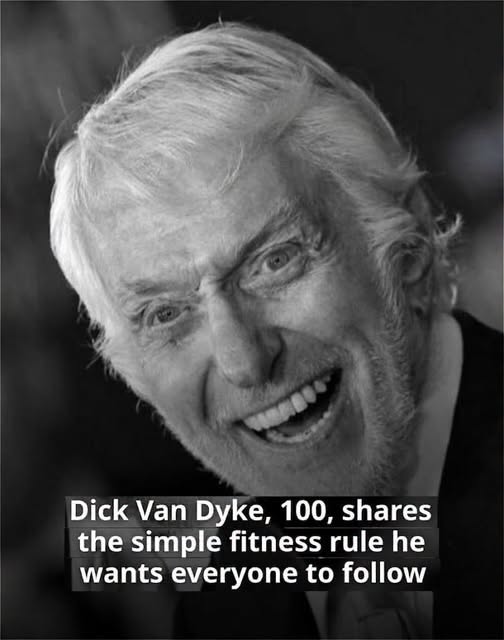
At an age when simply reaching another birthday represents an extraordinary milestone, Dick Van Dyke continues to attract attention for something that has defined much of his public life: movement. The legendary actor, comedian, singer and dancer turned 100 on December 13, 2025, meaning that in 2026 he is living through his 101st year. Rather than treating his centenary as a reason to withdraw completely from physical activity, Van Dyke has continued talking about the importance of exercise, optimism and maintaining an active interest in life.
His longevity cannot scientifically be attributed to one simple habit, but Van Dyke has repeatedly identified movement as an important part of the way he lives. For generations of viewers, that emphasis on movement feels particularly appropriate. Van Dyke built much of his career around physical comedy, dancing and an unusually energetic performance style. His famous television work, Broadway performances and appearances in movies such as Mary Poppins and Chitty Chitty Bang Bang required timing, coordination and a willingness to use his entire body as part of a performance.
Even many decades later, the physical enthusiasm that helped make him famous has remained recognizable. What has changed is that audiences are now watching that same personality continue moving at an age very few people reach. One of the clearest examples comes from Van Dyke’s continuing exercise routine. Before his 100th birthday, AARP reported that he was still going to the gym about three times every week. That was not described as an occasional publicity stunt undertaken shortly before reaching a major birthday.
Instead, Van Dyke presented exercise as something he had incorporated into his life over the long term. He explained that when he missed too many gym sessions, he could notice stiffness beginning to develop, giving him another reason to maintain the habit. His workouts are also more substantial than someone might assume from his age. Van Dyke described completing a circuit in the gym, moving through different machines rather than remaining focused on only one exercise.
He mentioned beginning with a sit-up machine, working his legs and then moving on to exercises for his upper body. His wife, Arlene Silver, has also been associated with his continuing active lifestyle, and Van Dyke has repeatedly shown that movement remains something he genuinely enjoys rather than merely tolerates.
That consistency is arguably more important to understanding his routine than any single exercise. Van Dyke does not describe longevity as the result of discovering an unusual workout at age 99. Physical activity has been part of his identity for decades. Dancing was embedded in his professional career, and he continued finding ways to remain physically engaged long after the demanding musical performances of his younger years were behind him.
A recent video provided an especially striking example. At 100, Van Dyke appeared using an inversion table, equipment designed to support the body while it tilts backward into an inverted position. The sight of a centenarian confidently incorporating the equipment into his routine naturally caught people’s attention. Van Dyke accompanied the moment with a simple message encouraging continued movement. People reported the video as another illustration of the fitness philosophy he has followed for years.
The inversion-table video should not, however, be interpreted as medical advice for every older adult. An exercise or piece of equipment appropriate for one person may not be appropriate for another, particularly when underlying health conditions, balance, blood pressure, medications or mobility limitations are involved. Van Dyke’s example documents what he personally does. It does not establish an exercise prescription for people of the same or any other age.
That distinction is especially important because stories about extraordinary longevity can easily become exaggerated. A person reaching 100 naturally encourages people to search for a secret: a particular food, workout, supplement or daily ritual that supposedly explains everything. Van Dyke’s own reflections are considerably more nuanced.
He certainly places major importance on exercise. But he has also talked about optimism, relationships, humor and emotional outlook. His message is therefore less about identifying one miraculous technique and more about continuing habits that keep him engaged physically and emotionally.
AARP reported that Van Dyke views his optimistic personality as an important part of how he has approached aging. In reflections published around his 100th birthday, he described resisting the temptation to surrender to life’s more difficult experiences, including setbacks, losses, loneliness, bitterness and the physical challenges that come with growing older. His language presented life not primarily as an obligation but as something he had continued to engage with enthusiastically.
Van Dyke has also spoken about refusing to spend his life consumed by anger or hate. That does not mean he claims a positive attitude biologically guarantees a long life. Rather, it reflects the emotional philosophy he personally associates with living well. Reports about his reflections on longevity have repeatedly mentioned his laid-back attitude and his reluctance to hold onto resentment.
That part of his outlook is notable because reaching 100 inevitably means experiencing enormous change. Van Dyke has lived through personal losses, changes in the entertainment industry and countless transitions in his private and professional life. Longevity means experiencing joy for longer, but it can also mean having more opportunities to experience disappointment and grief.
His response has generally been to continue looking for reasons to remain interested in life. That attitude is visible in his professional story as well as in his fitness routine. He has never completely defined growing older as a process of gradually surrendering everything that once gave him pleasure.
Van Dyke’s career itself stretches across an extraordinary period of entertainment history. Before television transformed American popular culture, he had already begun developing his abilities in radio and live performance. His breakthrough Broadway role in Bye Bye Birdie brought major recognition, and The Dick Van Dyke Show, which began in 1961, established him as one of television comedy’s defining performers.
His film work widened that audience further. In Mary Poppins, his dancing, comedy and musical performance helped create a character remembered more than six decades later. Chitty Chitty Bang Bang became another family favorite, while later generations encountered him through projects including Diagnosis: Murder and numerous guest appearances.
That career history makes Van Dyke’s present-day physical activity particularly interesting. For him, movement was never simply exercise performed in a gym. It was also part of how he communicated with an audience.
A stumble could become a joke.
A dance step could define a scene.
A facial expression combined with a carefully timed physical movement could generate laughter without requiring an elaborate explanation.
As a result, watching him continue exercising at 100 feels less like seeing an elderly celebrity suddenly discover fitness and more like seeing a lifelong performer continue one of the behaviors most closely connected with his identity.
Other people who have encountered him in gyms have noticed the same quality. AARP highlighted musician Rick Springfield’s account of seeing Van Dyke working through different machines and then performing a small dance movement afterward. The observation attracted attention partly because Springfield himself was in his 70s and considered Van Dyke’s activity remarkable.
That does not mean Van Dyke is attempting to train like a much younger professional athlete. His approach is better understood as continued engagement with his body. Staying active does not require pretending age has no effects. Instead, it means continuing to use the abilities that remain available rather than abandoning activity solely because a particular birthday has been reached.
Van Dyke has also been unusually willing to joke about his own age. In the months leading up to his 100th birthday, he joked publicly about whether he would actually make it to the milestone and acknowledged that if he had known he would live so long, he might have taken better care of himself earlier in life. The humor was characteristic of a performer who has spent decades finding comedy in ordinary human limitations.
His comments also provide a useful corrective to any attempt to present his lifestyle as a flawless health plan followed from childhood onward. Van Dyke has openly discussed choices he later changed. Reports surrounding his 100th birthday noted that he had given up cigarettes and alcohol, decisions he has reflected on when discussing his long life.
That history makes the story more realistic. Van Dyke did not spend a century following a perfectly optimized routine designed by longevity researchers. He lived a complicated human life, made changes, maintained habits that worked for him and continued adjusting as he grew older.
Another major element is joy. Van Dyke’s reflections on his life consistently return to enjoyment—of performing, dancing, relationships and simply being engaged with the world. His 2025 book, 100 Rules for Living to 100: An Optimist’s Guide to a Happy Life, was released shortly before his centennial birthday and combines reflections on aging with stories from his long career. AARP described the book as emphasizing joy, optimism and staying healthy rather than proposing a single scientific formula for extreme longevity.
The word “optimist” in the title is significant. Van Dyke’s public philosophy has rarely been about grimly fighting aging. Instead, he has often framed longevity around continuing to find things worth doing.
That can include exercising.
It can include performing.
It can include relationships.
And it can include laughter.
Even at 100, Van Dyke’s identity has remained closely connected with entertainment. People noted that he continued appearing publicly in his later years, including involvement in music and television-related projects, while his career has been celebrated through awards and retrospectives. In 2024, he became the oldest performer to win a Daytime Emmy, another unusual milestone in a career already filled with major honors.
His marriage to Arlene Silver has also been part of his reflections on remaining youthful. The couple married in 2012, and Van Dyke has spoken warmly about their relationship. Rather than suggesting marriage itself provides a longevity formula, his comments reflect the broader importance he places on companionship and continuing to enjoy life with other people.
That social side of his life matters because the public conversation around longevity can become overly focused on diet and exercise while ignoring relationships, purpose and emotional well-being. Van Dyke’s own account is broader.
He exercises because he wants to move.
He continues engaging with entertainment because he enjoys it.
He tries not to remain consumed by anger.
And he surrounds himself with people and activities that continue giving him reasons to participate in life.
These choices may help explain his personal approach to aging, but responsible reporting should stop short of claiming that they scientifically explain why he reached 100.
Human longevity is influenced by numerous factors. Genetics, healthcare, environment, socioeconomic conditions, disease history, lifestyle and chance can all play roles. Scientists cannot examine one exceptionally long-lived celebrity and determine that one behavior caused his lifespan.
For that reason, saying “Dick Van Dyke says staying active helps keep him going” is much more accurate than claiming “exercise made Dick Van Dyke live to 100.”
The first statement describes Van Dyke’s own experience.
The second makes a medical causal claim that the available evidence cannot establish.
The same caution applies to his positive outlook. Avoiding anger may be part of how he prefers to live, and psychological well-being is important in its own right. But no responsible article should promise readers that refusing to become angry will cause them to reach 100.
Van Dyke himself does not need such exaggerated claims to make his story impressive.
The documented facts are remarkable enough.
He turned 100 on December 13, 2025.
He continued going to the gym multiple times per week as he approached that birthday.
At 100, he publicly demonstrated himself using an inversion table while reinforcing his message about continuing to move.
He has repeatedly discussed optimism and his unwillingness to remain trapped in bitterness, anger or hate.
And he continues to be remembered not simply for surviving a century but for maintaining some of the enthusiasm that audiences first saw generations ago.
That final point may be one of the most interesting aspects of his story.
Van Dyke’s longevity attracts attention because 100 is an extraordinary number. But numbers alone are not why people continue responding to him.
They respond because the man reaching that age still resembles the performer they remember.
The smile is familiar.
The humor remains.
Movement is still part of his life.
And he continues talking about the future rather than treating his past as the only thing worth discussing.
At 100, naturally, Van Dyke cannot do everything his younger self could do. Aging is real, and even extremely active older adults experience changes in strength, balance, flexibility and recovery.
The remarkable point is not that he somehow defeated aging.
It is that he continued participating in his own life while aging.
That is a much more realistic message than promising a secret to eternal youth.
His exercise routine illustrates the principle clearly. AARP’s reporting showed that he notices when inactivity begins making him feel stiff, so he has an incentive to return to movement.
That is different from exercising because someone believes a particular number of repetitions will guarantee a particular lifespan.
For Van Dyke, movement appears to be connected with how he wants to feel today.
That present-focused attitude is reflected throughout his comments about growing older.
There is no evidence that Van Dyke wakes each morning obsessed with proving he can live to a particular age.
Instead, the public picture is of someone who continues doing activities he values.
His century of life also provides unusual perspective.
Someone born in 1925 has witnessed an extraordinary amount of technological, cultural and social change.
Van Dyke’s entertainment career itself spans eras from radio and Broadway to black-and-white television, major Hollywood musicals, streaming media and social platforms.
Generations who encountered him through completely different formats can therefore recognize the same performer.
Some viewers remember The Dick Van Dyke Show when it originally aired.
Others first knew him as Bert in Mary Poppins.
A younger generation may know him from later television appearances or viral clips celebrating his dancing and longevity.
Reaching 100 has connected those audiences in an unusual way.
Many public figures disappear from regular view long before reaching very old age. Van Dyke remained recognizable because he continued participating.
That persistence helps explain why a simple workout video could attract so much interest.
Seeing a 100-year-old entertainer on an inversion table is visually surprising.
But the larger meaning lies in what it represents.
It is another example of a person who has spent a lifetime moving refusing to decide that movement no longer belongs in his life simply because his age reached three digits.
Van Dyke’s example should therefore be understood as personal inspiration rather than universal medical instruction.
Anyone—particularly an older adult—considering a new or demanding exercise routine should take personal health circumstances into account and seek appropriate professional guidance when necessary.
Van Dyke’s ability to perform a particular movement does not mean every centenarian, or every younger person, should automatically attempt the same thing.
The lesson he communicates is broader.
Keep using your body in ways appropriate for you.
Stay interested in life.
Do not allow every disappointment to become permanent bitterness.
Find reasons to laugh.
And continue participating in the things that give life meaning.
Those ideas do not constitute a guaranteed longevity formula.
Van Dyke’s original material makes essentially the same distinction: his long life cannot be reduced to one habit, although he clearly associates continuing physical activity with the way he feels.
His emotional philosophy is similarly straightforward. The supplied article notes his emphasis on avoiding hatred, refusing to remain trapped in anger and maintaining a more positive outlook.
That combination—movement and optimism—provides a more accurate description of his message than any claim about a single miraculous secret.
As of September 2026, Van Dyke is 100 years old and will turn 101 on December 13 if he reaches that date. His continued activity remains unusual enough to inspire headlines, but perhaps the strongest part of his story is its simplicity.
He did not suddenly decide at 100 that movement mattered.
He kept doing something that had already been part of his life.
He did not discover an elaborate anti-aging formula.
He continued exercising.
He continued enjoying humor and performance.
And by his own account, he tried not to fill the years he had with unnecessary hatred or resentment.
After a century of living and more than seven decades of entertaining audiences, that message may sound surprisingly ordinary.
Yet perhaps that is exactly why people find it compelling.
Dick Van Dyke’s story is not proof that one habit can guarantee 100 years of life.
It is the documented story of a 100-year-old man who still values movement, laughter, optimism and remaining engaged with the world around him.
For someone whose career was built partly on the joy of motion, it is difficult to imagine a more fitting philosophy for the century he has already lived.
