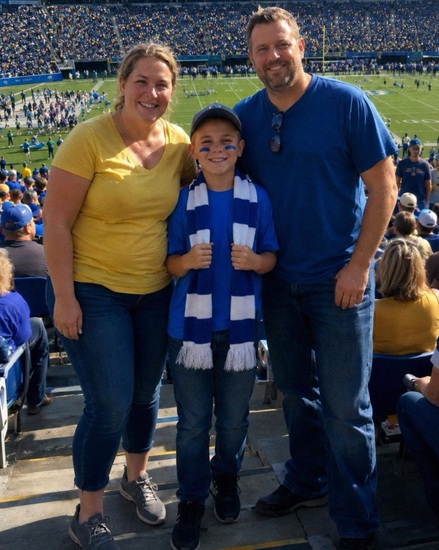
Twelve-year-old Daniel had spent so much time around doctors that he could recognize the sound of a hospital cart before it reached his room. His parents, Laura and Michael, had learned the rhythms of hospital life too: the morning checks, the quiet conversations in hallways, the cups of coffee that went cold before anyone remembered to drink them. Daniel was receiving treatment for a serious fictional illness, and although his family tried to keep their routines familiar, ordinary days had become increasingly difficult to find.
Whenever they were together, Laura found herself watching him carefully, while Michael repeatedly asked whether he was tired, hungry, cold, or uncomfortable. Daniel understood why they behaved that way, but sometimes he missed being treated simply like their son. Before illness changed their routine, Saturday afternoons had been uncomplicated. Daniel and Michael watched football together while Laura pretended she had little interest in the game, even though she frequently shouted at the television whenever a referee made a decision she disliked.
Daniel loved teasing her about it. “You complain more than Dad,” he would say, and Laura would insist that she was merely defending fairness. Michael would laugh, Daniel would throw a cushion at him, and within minutes all three would be arguing about a play none of them could change. Those afternoons had never seemed important at the time. They were simply part of family life, which was precisely why Daniel missed them so much. As Daniel’s fictional treatment became more demanding, those carefree afternoons slowly disappeared.
Football might still be playing on television, but Michael spent more time looking at Daniel than at the screen. If Daniel shifted in his chair, his father immediately asked whether something hurt. If he stopped eating, Laura wanted to know whether he felt sick. She also began taking photographs constantly because she feared forgetting the smallest details of their time together. Daniel eating toast became a photograph. Daniel wearing mismatched socks became another. Even an ordinary afternoon nap could become something Laura wanted to preserve. Her intentions came from love, but Daniel began noticing that his parents were sometimes documenting their lives instead of simply living them.
One afternoon, a hospital support worker named Sarah visited Daniel during a fictional conversation designed solely for this story. She asked what kind of day he would choose if he could plan anything he wanted with his parents. Daniel did not ask to meet a celebrity, travel to an exotic destination, or receive an expensive gift. He answered almost immediately. He wanted to attend a football game with his mother and father. Sarah asked whether there was anything else he wanted included. Daniel thought for a moment before shaking his head. “I just want us to watch the game,” he said. To him, that simple request represented something his family had been missing for months: an afternoon that did not revolve entirely around illness.
In this fictional story, arrangements were made for the family to attend a game with appropriate accommodations for Daniel’s needs. When they entered the stadium, Daniel stopped walking for several seconds. The sound was enormous. Fans moved through the corridors carrying food and drinks, music echoed from speakers, and conversations seemed to come from every direction at once. Michael instinctively asked whether the noise was too much. Daniel smiled and told him it was exactly what he wanted. When they finally reached their seats and Daniel could see the entire field, his expression changed. For a little while, there were no hospital walls around him and no medical equipment nearby. There was simply a game about to begin.
Laura immediately reached for her phone. She photographed Daniel looking toward the field, Daniel laughing at the crowd, Daniel holding his drink, and Daniel arguing with Michael about which player would score first. Every time she captured another picture, she told herself she was preserving an important memory. Daniel did not complain, but he noticed. Meanwhile, Michael could barely concentrate on the game. “Are you comfortable?” he asked several times. “Do you need water? Do you want to rest?” Finally Daniel looked at him and smiled. “Dad, you’re not watching football,” he said. Michael pointed toward the field and insisted that he was. Daniel shook his head. “You’re watching me watch football.”
Michael became quiet because he knew his son was right. For months he had been afraid of missing something important, so he had developed the habit of examining every moment instead of participating in it. Laura had done something similar through her photographs. Neither parent meant to make Daniel uncomfortable. Their behavior came from fear, love, and a desire to protect him. Yet Daniel experienced it differently. He did not want every smile to become evidence of a significant moment or every ordinary action to be treated as something fragile. He wanted his parents to laugh when something was funny, complain when their team played badly, and forget for a few minutes that they were supposed to be creating memories.
During a quieter break in the fictional game, Daniel finally explained what he had been thinking. He told his parents that he knew they worried about him and that he understood why. Then he told them something they had not expected. “Sometimes when you try really hard to make every minute important, it stops feeling normal,” he said. Laura slowly lowered her phone. Michael leaned closer but did not interrupt. Daniel explained that what he missed most was not a spectacular vacation or a dramatic surprise. He missed hearing his parents argue over football statistics. He missed his mother complaining about referees. He missed being told to move because he was blocking the television.
Laura realized that she had been treating ordinary moments as though each one required proof that it had happened. She looked at the hundreds of photographs stored on her phone and understood that Daniel was not asking her to stop caring. He was asking her to participate. Michael understood something similar. He had convinced himself that being a responsible father meant constantly watching for signs that Daniel needed help. Sometimes that was necessary, but Daniel was reminding him that fatherhood also meant laughing at ridiculous plays, sharing snacks, and disagreeing about football. They did not need to stop being attentive parents. They simply needed to leave enough space for their family relationship to exist alongside their concerns.
When play resumed, Michael deliberately turned toward the field instead of checking Daniel’s expression. A few minutes later, their team made a terrible mistake. Michael groaned loudly. Daniel immediately started laughing. “There you are,” he said. Michael laughed too. Then a referee made a controversial call, and Laura reacted before she could stop herself. “That is ridiculous!” she shouted. Daniel looked at her in amusement and asked whether she even understood what the penalty meant. Laura admitted that she probably did not, but she remained convinced the referee was wrong. Daniel laughed harder, and this time Laura did not reach for her phone.
For the next part of the fictional afternoon, nothing extraordinary happened. No celebrity appeared. No announcement was made about Daniel. No camera focused on the family. Nobody asked them to stand or wave. The game simply continued, and that ordinary quality became the most meaningful part of the experience. Daniel ate some of Michael’s snack after insisting that he did not want any. Laura complained about another referee decision. Michael predicted a touchdown and turned out to be completely wrong. Daniel reminded him of the mistake for the rest of the quarter. They were not trying to manufacture a perfect memory. They were behaving like a family watching football together.
Near the end of the fictional game, their team finally scored. The crowd rose almost simultaneously, and Michael jumped from his seat. Laura shouted along with the people around her, while Daniel laughed and grabbed both of his parents by the arms. For several seconds, nobody thought about photographs or whether the moment was significant enough to preserve. They simply reacted. When everyone sat down again, Laura noticed her phone beside her but left it untouched. Daniel noticed too. “No picture?” he asked. Laura smiled. “Not this one,” she replied. Daniel looked puzzled for a second, so she added, “I wanted to actually see it.”
Daniel gave her a small smile and turned back toward the field. Michael began arguing about the next play, and Daniel immediately disagreed with him. Their conversation became another ordinary debate between a father and son who both believed they understood football better than the other. Laura listened for a few moments before joining the argument herself. Daniel laughed and told her she still did not know the rules. She told him that knowledge of the rules had never prevented her from having an opinion. Michael laughed so loudly that several people nearby glanced toward them. For the first time that afternoon, none of them cared whether anyone was watching.
The meaning of this fictional story is not that difficult circumstances can be solved by pretending they do not exist. Daniel’s parents still needed to pay attention to his needs, follow medical guidance within the fictional scenario, and respond when he required help. What changed was their understanding of how they spent the moments between those responsibilities. Love did not always have to look like constant observation. Sometimes it could look like sharing a snack, laughing at a bad prediction, or watching a game without trying to transform the afternoon into something larger than it was.
When the family eventually left the stadium, Laura had fewer photographs than she originally expected to take. She still treasured the pictures she had, but she no longer believed that every meaningful second needed to be captured. Michael had spent several hours without asking Daniel a question every few minutes, and Daniel had finally enjoyed something he had wanted for a long time: not a perfect day, but a recognizable one. Their fictional afternoon did not remove uncertainty from their lives, and it did not promise an unrealistic outcome. Instead, it gave the family a reminder that even during difficult periods, ordinary human connection can still matter.
On the ride home, Daniel rested against the window while Michael quietly discussed the final score. Laura began to reach for her phone when she saw Daniel’s sleepy expression, then stopped herself. There would always be moments worth remembering, she realized, but remembering did not require photographing every one of them. Some memories could simply belong to the people who were there. Daniel opened his eyes for a second and caught her looking at him. “What?” he asked. Laura smiled and shook her head. “Nothing,” she said. “Just enjoying the ride.” Daniel smiled back, closed his eyes, and the family continued home together.
