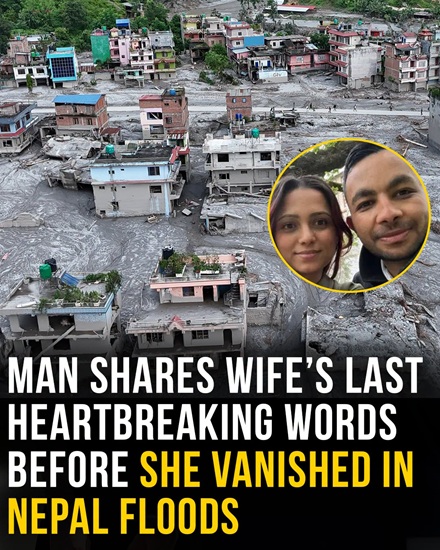
Pramod Poudel could not have known that an ordinary telephone conversation with his newlywed wife would become the last time he heard her voice before disaster struck. Poudel, who lives in Uckfield in East Sussex, had been in contact with his wife Sumitra shortly before catastrophic flooding devastated communities along the Nepal-China border on August 26, 2026. Hours later, a powerful surge of water, sediment, ice and debris swept through mountain valleys, destroying homes, roads and bridges and leaving thousands of families searching for missing relatives.
Poudel soon learned that Sumitra and three other members of his family could no longer be contacted. He left Britain and travelled back to Nepal, hoping to find answers about the people closest to him. His story has since become one of many personal accounts emerging from a disaster whose consequences are still unfolding. The flooding struck Nepal’s Rasuwa district and neighboring areas near the border with China’s Tibet Autonomous Region on the morning of August 26.
ICIMOD reported that a major flash flood sent huge amounts of water, sediment and boulders through the Bhote Koshi and Trishuli river systems. The sudden surge caused extensive destruction to communities and infrastructure along the river corridors, while damaged transportation links made some affected locations extremely difficult to reach. Roads and bridges were destroyed or rendered unusable, and communication systems failed in several areas. Rescue personnel consequently faced both dangerous terrain and major logistical obstacles while trying to locate survivors. Authorities warned from the beginning that the complete scale of the disaster would take time to establish.

Analysis of the disaster later indicated that the destructive wave was connected to a massive glacial collapse high in the Himalayas rather than a conventional earthquake. CNN reported that satellite analysis showed a section of ice roughly 2,000 feet wide breaking away and carrying surrounding mountainside material with it as it descended thousands of feet. The resulting mass of water, pulverized ice and rock travelled more than 14 miles in less than seven minutes. Its extraordinary speed left settlements downstream with very little opportunity to react once the collapse began.
The wave devastated infrastructure around the Gyirong border area and continued into river systems on the Nepalese side. The event demonstrated how rapidly a high-altitude collapse can transform into a destructive downstream flood. The human cost continued to rise during the days following the disaster. Nepal’s Ministry of Foreign Affairs said in an August 31 briefing that 903 bodies had been recovered in Nepal and roughly 4,200 people remained unaccounted for at that point.
The figures continued changing as search teams reached additional areas and authorities collected information about missing residents, workers and travelers. By September 2, Reuters reported that the overall disaster had killed at least 1,050 people, while nearly 4,000 remained missing. Hundreds were also feared trapped or buried around damaged hydroelectric facilities and tunnel systems. Because rescue and identification work remained active, casualty totals were still subject to revision as new information became available.

Among the families waiting for answers is that of Pramod Poudel. ITV News reported that Poudel lives in Sussex and returned to Nepal after losing contact with his wife, mother, brother and uncle following the flood. His missing relatives were identified as his wife Sumitra, his mother Tulasa Poudel, his brother Pradip Poudel and his uncle Madhav Prasad Poudel. Poudel had tried repeatedly to reach family members after hearing about the flooding but was unable to contact them. His father, Purusottam Poudel, who was in a different location, survived and remained reachable. Poudel told reporters that seeing images of the destruction convinced him that he needed to travel back to Nepal himself.
Poudel had particularly painful reasons for worrying about Sumitra because the couple had married only recently. ITV reported on September 1 that they had married approximately two months before the disaster. Poudel had returned to Britain while Sumitra remained in Nepal, and the couple stayed in contact by telephone. According to subsequent reporting, Poudel spoke with her shortly before the flood and remembered her expressing her love for him during their conversation. After the disaster swept through the area, he could no longer reach her. He has continued searching while holding on to hope that information about his missing relatives will eventually emerge.
Getting back to the area where his family lived was itself extraordinarily difficult. Floodwaters had destroyed bridges and badly damaged roads, isolating communities and forcing residents and rescuers to find alternative routes through challenging terrain. Poudel told reporters that communication failures made the uncertainty even harder because families could not simply telephone one another to determine who had survived. Electricity and mobile connections were unavailable or unreliable in several affected places. When ITV News later met Poudel in Nepal, he had returned to the area of his childhood and was confronting the destruction firsthand. His mother, brother, uncle and wife were still missing at the time of that report.

The destruction surrounding Poudel was not an isolated family tragedy. Thousands of people across Nepal and Tibet were waiting for information about missing relatives, and rescue teams were searching collapsed structures, debris fields and damaged hydropower facilities. The disaster severely affected at least a dozen hydropower projects, creating particular concern about workers who may have been caught inside tunnel systems. Rescue operations were complicated by deep mud, unstable debris and damaged access routes. Authorities deployed thousands of security and emergency personnel while international assistance and specialist support were also being coordinated. Even several days after the disaster, rescuers were continuing to locate survivors in extraordinarily difficult conditions.
Identification of those who died also became an increasingly difficult part of the emergency response. Reuters reported that authorities were collecting photographs, DNA samples and other identifying information as families searched for relatives. Hospitals and temporary facilities had to handle large numbers of recovered bodies while search operations continued elsewhere. Some remains were moved away from badly affected areas because local facilities could not cope with the scale of the disaster. At the same time, relatives travelled across Nepal seeking information from authorities and identification centers. The process illustrated how a major disaster continues affecting families long after the floodwaters themselves have moved downstream.
Scientific organizations have also emphasized that the Himalayan region faces significant risks associated with glaciers, unstable mountain terrain and rapidly changing environmental conditions. ICIMOD said the August 26 flood demonstrated the need for stronger regional cooperation on climate risks that cross national borders. Because rivers, glaciers and mountain systems do not stop at political boundaries, monitoring and early-warning systems often require information sharing between countries. Specialists continue studying the precise sequence of events that produced the catastrophic surge. Those investigations are important not only for understanding what happened in August but also for improving preparedness in other vulnerable Himalayan communities.
For Poudel, however, the enormous scientific and logistical dimensions of the disaster remain deeply personal. His immediate concern has been finding his wife and relatives and supporting the family members who survived. ITV reported that he returned from Britain to his childhood area after learning that the flood had destroyed much of what had once been there. By September 1, his wife, mother, brother and uncle were still missing and feared dead, but searches and identification work across the disaster zone were continuing. The absence of confirmed information has left him facing the same painful uncertainty experienced by thousands of other families. Reporting his situation accurately therefore requires distinguishing between people confirmed dead and those who remain officially missing.
The Nepal-Tibet flood remains an evolving disaster, and official totals can change as search teams reach isolated locations, survivors are found and unidentified victims are identified. For that reason, figures that were accurate on August 27 or August 31 may no longer describe the situation several days later. As of September 2, available reporting placed the death toll above one thousand while thousands remained unaccounted for. Rescue personnel continued working in damaged communities and around hydropower facilities despite dangerous conditions. Families such as Poudel’s remained at the center of that effort, waiting for definitive information about their loved ones. Any updates about individual missing people should be treated as provisional until confirmed by relatives or responsible authorities.
This account is based on publicly reported information and does not claim firsthand knowledge of the disaster. It does not speak on behalf of residents of Nepal, the Nepalese government, affected families or rescue organizations, and it does not present the publisher as a local or domestic voice. The purpose is to report verified information about the disaster and about Poudel’s publicly documented search for his relatives.
Because the emergency remains active, readers should rely on official authorities and established news organizations for changing casualty figures and announcements about missing people. Respect for affected families is especially important while searches and identification efforts continue. Their circumstances should not be exaggerated, and people who remain missing should not be described as confirmed dead unless reliable authorities or their families provide that confirmation.
