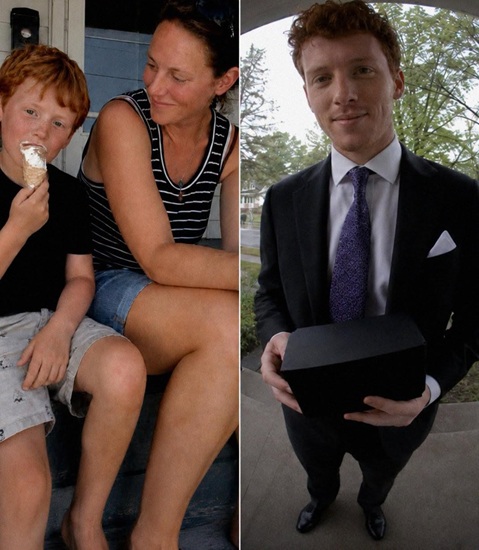
For years, Mrs. Holland believed she knew exactly what had happened. A boy she had loved almost like a son had disappeared. Her jewelry had vanished.
Her husband had pointed toward the obvious suspect. And after that, silence had done the rest.
Twenty years later, a knock on the door forced her to reconsider everything. But the truth did not arrive all at once. It came inside a black box.
And before she opened it, she had to remember how the story began.
It started with a boy sitting alone across the street.
He was eight years old.
Thin.
Quiet.
And far too serious for his age.
It was a cold October afternoon.
The wind had turned sharp enough to make the trees shake.
Mrs. Holland noticed him sitting on the front steps of the house opposite hers with his knees pulled tightly to his chest.
His jacket looked too small.
His sleeves stopped above his wrists.
He was not crying.
That somehow made the sight sadder.
Mrs. Holland watched him for several minutes from her kitchen window.
Then she made tea.
She added milk to one mug.
Carried a plate of cookies in the other hand.
And crossed the street.
The boy looked up when her shadow fell across the pavement.
“Would you like to come inside for a little while?” she asked.
He studied her carefully.
Not rudely.
Cautiously.
As though someone had already taught him that kindness might come with conditions.
“Maybe,” he said.
Then he looked at the plate.
“Are those chocolate chip?”
Mrs. Holland smiled.
“Yes.”
He hesitated.
“My parents don’t really let me eat those.”
“Then perhaps you should only have one.”
That made him smile for the first time.
His name was Dylan.
Over the next few weeks, Mrs. Holland learned more about him.
His parents were strict.
Not violent.
Not openly cruel.
Just rigid in the way they believed a child should live.
Meals were carefully controlled.
Sweets were almost nonexistent.
Pizza was considered junk.
Birthday cake was something other children ate.
Dylan’s mother talked often about discipline.
His father talked about responsibility.
Dylan rarely talked about either of them.
Instead, he talked about school.
Books.
Cartoons.
Dogs.
And food.
Especially food.
The first time Mrs. Holland offered him a full chocolate chip cookie, he turned it over in his hands as if studying something expensive.
“Are you sure?”
“It’s a cookie, Dylan.”
“It smells amazing.”
He took a bite.
Then another.
Slowly.
Carefully.
As though eating too quickly might make it disappear.
Mrs. Holland never forgot that.
After that afternoon, Dylan began stopping by more often.
Sometimes he appeared while she was gardening.
Sometimes while she was carrying groceries.
Sometimes he simply knocked.
“Need help with anything?”
Most of the time, she did not.
She found something anyway.
He carried bags.
Raked leaves.
Swept the porch.
Later, when he grew taller, he changed lightbulbs and reached shelves she could not.
Whenever Mrs. Holland tried to pay him, he refused.
“You already paid me.”
“With what?”
“Pizza.”
The answer never changed.
Neither did the grin that followed it.
Years passed.
The skinny little boy grew taller.
His voice deepened.
His shoulders broadened.
And gradually, without anyone formally saying it, Dylan became part of the Hollands’ routine.
Mrs. Holland never had children of her own.
She never admitted aloud how much that mattered.
But Dylan filled a space she had stopped thinking about years earlier.
Her husband Richard noticed.
He did not dislike Dylan.
But he never trusted the closeness.
“You’re getting too attached,” he said one evening.
Mrs. Holland folded laundry at the kitchen table.
“He needs someone.”
“He has parents.”
“Parents can still fail at listening.”
Richard looked up from the newspaper.
“They feed him.”
“They feed him kale.”
Richard sighed.
“You know what I mean.”
She did.
Richard believed families should handle their own problems.
Mrs. Holland believed communities existed because sometimes families could not.
They never fully agreed.
The subject usually ended there.
Until the garage incident.
One December afternoon, Mrs. Holland was searching for Christmas decorations.
The garage was full of boxes.
Old tools.
Paint cans.
Unused furniture.
And years of things Richard refused to throw away.
Dylan wandered in.
“Need help?”
“Only if you’re willing to risk being buried alive.”
He laughed.
“You keep everything.”
“I call it organization.”
“I call it a museum.”
He climbed onto a small ladder.
Mrs. Holland pointed toward a bin on the top shelf.
“Blue one.”
Dylan reached for it.
That was when Richard appeared.
His expression changed almost instantly.
“Dylan.”
The boy froze.
“Yes, sir?”
“Get down.”
Mrs. Holland looked over.
“He’s helping me.”
“I’ll handle it.”
“We’re almost finished.”
Richard’s voice hardened.
“I said I’ll handle it.”
The garage went quiet.
Dylan climbed down.
“Sorry.”
He left a few minutes later.
Mrs. Holland waited until the front door closed.
“What was that about?”
Richard began moving boxes.
“I don’t like people going through my things.”
“He wasn’t going through anything.”
“That boy sees too much.”
Mrs. Holland laughed.
“He’s curious.”
Richard did not.
“Curiosity can become a problem.”
The sentence stayed with her.
Not because she understood it.
Because she did not.
A week later, Dylan noticed something else.
A small metal lockbox sat behind several old paint cans in the garage.
“What is that?”
Before Mrs. Holland could answer, Richard entered.
His reaction was immediate.
“Nothing that concerns you.”
He grabbed the lockbox.
Carried it inside.
And locked the garage door behind him.
Dylan frowned.
“I was just asking.”
“I know.”
“He’s weird about that box.”
Mrs. Holland shrugged.
“Richard is weird about lots of things.”
At the time, that explanation seemed sufficient.
Years continued moving.
Dylan entered high school.
He got taller.
Then taller again.
He learned to drive.
He became good at mathematics.
Better at writing.
And unexpectedly talented at fixing things.
He helped Mrs. Holland repair a broken fence.
Replaced a bathroom faucet.
And once spent an entire Saturday trying to fix a lawn mower that probably deserved retirement.
He refused payment every time.
Pizza remained the preferred currency.
By senior year, Dylan had become almost unrecognizable from the nervous eight-year-old who once inspected a cookie before eating it.
He earned a scholarship to a university nearly 500 miles away.
Mrs. Holland cried at graduation.
More than she expected.
The night before he left for college, she invited him over.
She did not attempt anything healthy.
Two pizzas.
Pepperoni.
A chocolate cake.
Three bags of chips.
And a tray of cookies.
Dylan stared at the table.
“This is the best dinner I’ve ever had.”
“You’ve said that before.”
“Every time was true.”
They ate until both regretted it.
Then they watched old cartoons.
The same ones Dylan had watched in her living room when he was nine.
For several hours, the years disappeared.
When Dylan finally stood to leave, the mood changed.
“I don’t know when I’ll be back,” he said.
Mrs. Holland forced a smile.
“You’ll always have a place here.”
“I know.”
He hugged her.
Longer than usual.
“Thank you.”
“For what?”
He looked around the kitchen.
“Everything.”
The next morning, the house across the street was quiet.
Dylan’s family’s truck was gone.
Boxes had disappeared.
The driveway was empty.
Mrs. Holland stood at her window longer than she wanted to admit.
It felt as though an entire chapter of her life had driven away.
Then she went upstairs.
And found the bedroom door open.
She stopped.
She was almost certain she had closed it.
Her jewelry box sat on the dresser.
The lid was raised.
Mrs. Holland crossed the room.
Her grandmother’s pearl earrings were missing.
So was her mother’s wedding ring.
Two necklaces.
A bracelet.
Small pieces of gold accumulated across generations.
Then she checked the closet.
Richard’s emergency cash was gone too.
She felt dizzy.
Richard entered behind her.
He looked at the jewelry box.
Then at the drawer.
“He’s gone.”
Mrs. Holland turned.
“What?”
“The boy.”
“No.”
Richard’s expression remained calm.
“I warned you.”
“It wasn’t Dylan.”
“Who else was here yesterday?”
She opened her mouth.
Nothing came out.
The police arrived later.
Photographs were taken.
Drawers were dusted.
Questions were asked.
One officer asked whether anyone outside the household had recently entered the bedroom.
Mrs. Holland hesitated.
Richard did not.
“Our neighbor boy. Dylan.”
The officer wrote the name down.
Something about that moment bothered Mrs. Holland.
Richard had not paused.
Not even for a second.
But fear and confusion were stronger than suspicion.
Days passed.
No jewelry was found.
No cash.
No arrest.
No clear evidence.
And no word from Dylan.
Mrs. Holland considered calling him.
Dozens of times.
She would lift the phone.
Then imagine the conversation.
Did you take them?
Why?
How could you?
The questions felt unbearable.
So she never dialed.
Richard treated the silence as proof.
“If he were innocent, he’d call.”
Maybe.
Or perhaps, Mrs. Holland sometimes thought late at night, he believed there was nothing left to say.
Months became years.
Dylan disappeared from her life completely.
Richard rarely mentioned him.
Mrs. Holland did.
Mostly to herself.
She thought about birthdays.
Graduations.
Weddings.
Possible grandchildren.
She wondered whether Dylan became the person she had always imagined.
Then life continued.
As it always does.
Richard grew older.
So did she.
Eventually, Richard became ill.
The illness moved quickly.
Mrs. Holland cared for him through the final months.
They had disagreed about many things during their marriage.
But she had loved him.
When he died, she mourned him sincerely.
Afterward, the house became unbearably quiet.
Twenty years had passed since Dylan left.
New families lived across the street.
Children came and went.
Cars changed.
Trees grew taller.
Still, every now and then, Mrs. Holland saw someone pushing his hair backward from his forehead and thought of Dylan.
Then came the rainy Thursday.
The doorbell rang.
Mrs. Holland looked at the security camera.
A tall man stood on the porch.
Dark suit.
Wet hair.
A black box held against his chest.
She stared.
Nothing seemed familiar.
Then the man lifted one hand.
He pushed his hair back.
Her heart stopped.
The habit.
Exactly the same.
She pressed the speaker.
“Dylan?”
The man looked toward the camera.
“Yes, Mrs. Holland.”
She opened the door.
For several seconds, neither spoke.
He was older.
So was she.
But the eyes were unmistakable.
Mrs. Holland felt her throat tighten.
“I’m glad you’re alive.”
Dylan gave a small smile.
“So am I.”
She stepped toward him.
“I’ve missed you.”
His expression changed.
“I know.”
Then he lifted the black box.
“I came to return something.”
The box was heavier than it looked.
Mrs. Holland carried it to the dining table.
Her hands shook.
For twenty years, she had imagined the missing jewelry.
The pearls.
The ring.
The bracelet.
She opened the lid.
No jewelry.
Instead, the box was full of folders.
Old envelopes.
Financial statements.
Copies of checks.
Typed reports.
And another object beneath them.
A small metal lockbox.
Mrs. Holland recognized it immediately.
The one from Richard’s garage.
She looked up.
Dylan was watching her.
“I know what you thought,” he said.
Mrs. Holland swallowed.
“That you stole from me.”
“Yes.”
“Didn’t you?”
He looked down.
“No.”
Silence filled the room.
Then he said something she never expected.
“I stole from Richard.”
Mrs. Holland frowned.
“I don’t understand.”
“I know.”
Dylan placed the old metal box on the table.
“The night before I left for college, I saw him take this upstairs.”
Mrs. Holland stared at it.
“He was nervous because you saw it?”
“He was terrified.”
Dylan continued.
“Later that night, after everyone was asleep, I went looking.”
“You broke into our bedroom?”
“I did.”
Mrs. Holland closed her eyes.
“I wanted to know what he was hiding.”
“And?”
“I found the lockbox.”
Inside, Dylan said, were records.
Account numbers.
Cash.
Documents.
Names of companies.
Invoices.
Payments.
Things that did not make sense to an eighteen-year-old.
“But they looked wrong,” Dylan said.
“What did you do?”
“I took the box.”
Mrs. Holland’s voice sharpened.
“And the jewelry?”
Dylan looked ashamed.
“That was an accident.”
She stared at him.
“The lockbox was sitting above your jewelry case. When I pulled it free, several pieces caught on the handle.”
“My mother’s ring?”
“Yes.”
“My grandmother’s pearls?”
“Yes.”
“Why didn’t you put them back?”
“I heard Richard.”
Dylan took a breath.
“He came through the door.”
Mrs. Holland felt the old room around her in memory.
“What happened?”
“He saw the lockbox.”
“And?”
“He changed.”
Dylan’s voice became quieter.
“He wasn’t angry the way I’d seen him angry before.”
“He was scared.”
Richard told him to put everything down.
Dylan refused.
Then Richard threatened him.
At first, Dylan believed it was only panic.
Then Richard began explaining what would happen if Dylan spoke.
The missing jewelry.
The missing cash.
The police.
A respected adult businessman against an eighteen-year-old boy.
Richard said no one would believe Dylan.
Especially after the report had already been filed.
Mrs. Holland felt cold.
“You came back?”
“Three days later.”
She looked up sharply.
“What?”
“I came back from college.”
“Why?”
“To tell you.”
Her breath caught.
“Richard met me before I reached the house.”
Dylan said Richard had been waiting.
He told him Mrs. Holland already believed he was a thief.
That the police had his name.
That returning would make everything worse.
Dylan did not believe him completely.
So he wrote.
The black box contained the evidence.
Dozens of envelopes.
Every one addressed to Mrs. Holland.
Some were opened.
Some had postal marks.
Some were stamped as returned.
“I wrote after I got back to school.”
Mrs. Holland lifted one.
The handwriting belonged to an eighteen-year-old Dylan.
She opened it.
The first sentence was simple.
Mrs. Holland, I didn’t steal from you.
Her hands began shaking.
“I never saw these.”
“I know.”
“Who returned them?”
“Richard.”
Dylan pointed toward a stack of envelopes.
“He intercepted them.”
“How?”
“I don’t know exactly.”
Dylan had eventually received one letter back.
Across the front, someone had written that Mrs. Holland had moved and wanted nothing to do with him.
She had never moved.
“I believed it,” he said.
Mrs. Holland covered her mouth.
“I kept writing anyway.”
“How long?”
“Years.”
He touched several envelopes.
“Birthdays.”
Another stack.
“Christmas.”
Then one smaller bundle.
“And Mother’s Day.”
Mrs. Holland stared.
“Mother’s Day?”
Dylan’s eyes filled.
“You were the closest thing I had to one.”
She began crying.
Not quietly.
Not gracefully.
Twenty years of emotion arrived at once.
Dylan reached across the table.
Mrs. Holland took his hand.
“You should have come back.”
“I wanted to.”
“Why didn’t you?”
“Because I thought you hated me.”
“I never hated you.”
“I know that now.”
She looked at the documents again.
“What was Richard hiding?”
Dylan opened a folder.
The answer had taken twenty years to reach her.
Richard had been involved in financial fraud.
According to the documents Dylan had preserved, he had created false vendors and manipulated payments connected to his employer.
Money had moved through accounts Mrs. Holland never knew existed.
The paperwork covered years.
Some transactions stretched back to before Dylan had entered their lives.
Mrs. Holland shook her head.
“No.”
“I said the same thing.”
Dylan had taken the documents to a lawyer.
The lawyer made copies.
Told Dylan to preserve the originals.
And advised him that accusations would be difficult to prove without additional evidence.
Richard’s position inside the company had protected him for years.
But suspicion already existed.
An internal inquiry had begun.
There simply had not been enough evidence to connect everything.
Dylan’s documents helped.
Not immediately.
Richard’s threats made the situation complicated.
And Dylan feared being accused of stealing the cash and records himself.
So the evidence stayed preserved.
The investigation stalled.
Then years passed.
After Richard died, new information became available.
Accounts were reviewed.
Records were compared.
The old financial trail was reopened.
Eventually, investigators were able to substantiate misconduct connected to Richard.
Mrs. Holland stared at the paperwork.
She had spent twenty years defending a man she loved.
And doubting a boy she had once treated like family.
The realization hurt more than the jewelry ever had.
Then Dylan reached deeper into the black box.
“There is something else.”
He removed a small velvet pouch.
Mrs. Holland stopped breathing.
He placed it on the table.
Then another.
Then another.
She opened the first.
Pearl earrings.
Her grandmother’s.
The second contained her mother’s wedding ring.
The third held the gold bracelet.
More jewelry followed.
Every piece she had believed lost.
Polished.
Wrapped.
Protected.
She touched the ring.
“Why didn’t you sell any of this?”
Dylan looked almost offended.
“They weren’t mine.”
“You could have needed the money.”
“I did.”
Mrs. Holland looked up.
“Then why?”
“Because they belonged to you.”
He paused.
“I thought one day I’d be able to bring them back.”
Mrs. Holland pressed the wedding ring into her palm.
Twenty years earlier, she had believed those objects represented betrayal.
Now they represented something else.
Proof that Dylan had never intended to steal from her.
But he was not finished.
He reached into his jacket.
Pulled out a folded piece of paper.
The edges were worn.
The paper had been opened hundreds of times.
Mrs. Holland recognized her handwriting.
A recipe.
Chocolate chip cookies.
She laughed through her tears.
“You kept this?”
Dylan nodded.
“For years.”
“It isn’t even a very good recipe.”
“It was to me.”
“Why?”
He smiled.
“It tasted like home.”
That sentence broke whatever remained of Mrs. Holland’s composure.
She stood.
Crossed the small distance between them.
And hugged him.
For a moment, Dylan remained still.
Then he wrapped his arms around her.
Exactly as he had before leaving for college.
Only this time, neither let go quickly.
“I’m sorry,” Mrs. Holland whispered.
“You don’t have to be.”
“Yes, I do.”
She stepped back.
“I believed him.”
Dylan looked at her carefully.
“So did I.”
“What do you mean?”
“I believed him when he told me I’d lost you.”
Mrs. Holland shook her head.
“You never did.”
For the first time since arriving, Dylan smiled without sadness.
A real smile.
The same one she remembered from childhood.
Then he looked toward the kitchen.
“Do you still make pizza?”
Mrs. Holland laughed.
“That depends.”
“On what?”
“Whether you’re staying for dessert.”
“Cookies?”
She raised an eyebrow.
“The good kind?”
“The only kind.”
That evening, the house changed.
Not physically.
But completely.
Pizza baked in the oven.
Cookie dough covered the counter.
Rain tapped against the windows.
Dylan sat at the same kitchen table where he had eaten his first forbidden chocolate chip cookie decades earlier.
Mrs. Holland watched him take one from the tray.
He smelled it dramatically.
“It smells amazing.”
She laughed.
“You used to say that.”
“I know.”
He took one bite.
Slowly.
Exactly the way he had at eight years old.
And only then did Mrs. Holland understand what the black box had truly returned.
Not the jewelry.
Not the money.
Not even the truth about Richard.
Those things mattered.
But they were not the most valuable part.
The box returned the missing years.
It returned the explanation she had waited decades to hear.
It returned the boy she had loved.
Now older.
Changed.
But still somehow the same.
Richard had not merely hidden financial wrongdoing.
He had allowed a lie to separate two people who loved each other.
Twenty years had passed because of it.
Those years could not be returned.
But something else could.
Trust.
That night, as Dylan carried two plates toward the kitchen table, Mrs. Holland looked around her once-quiet house.
For the first time in years, it did not feel empty.
The most valuable thing inside the black box had never been the pearls.
It was the truth.
And the truth had finally brought her son home.
