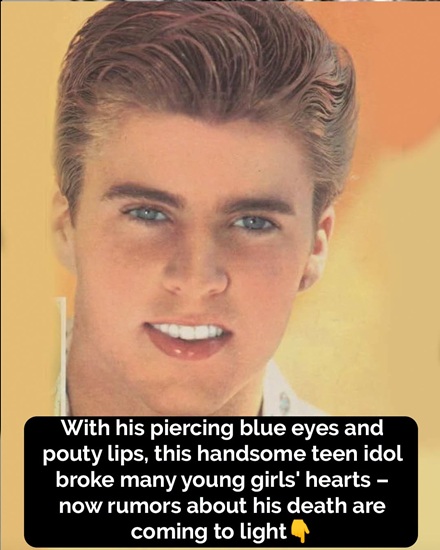
For millions of Americans, Ricky Nelson was once the familiar teenager who seemed to grow up in their living rooms.
Long before musicians could build enormous audiences through social media, Nelson had something remarkably powerful working in his favor: television.
He was already part of one of America’s best-known entertainment families before he became a recording star.
Then music changed everything.
But nearly three decades after his rise to fame, Nelson’s story ended aboard a Douglas DC-3 on New Year’s Eve in 1985.
Seven people died.
Two pilots survived.
And two people who had originally expected to be traveling with Nelson were not aboard at all.
They were his twin sons, Matthew and Gunnar.
The reason they were absent would become one of the most poignant details of Nelson’s final days.

Growing Up in Front of America
Eric Hilliard Nelson, better known professionally as Ricky Nelson and later Rick Nelson, was born on May 8, 1940.
His parents were bandleader Ozzie Nelson and singer and actress Harriet Hilliard Nelson.
Entertainment was therefore part of his life almost from the beginning.
In 1944, Ozzie and Harriet launched The Adventures of Ozzie and Harriet as a radio comedy.
David and Ricky were initially represented by professional actors, but the real Nelson brothers eventually joined the radio program in 1949, when Ricky was eight and David was 12.
The transition would prove important.
When the family program moved to television in 1952, viewers were no longer simply listening to fictionalized versions of the Nelson family.
They were watching Ozzie, Harriet, David and Ricky play versions of themselves.
The television series remained on ABC until 1966, producing hundreds of episodes and becoming one of the longest-running family sitcoms of its era.
For Ricky, however, television eventually became the doorway to an entirely different career.
And it happened while he was still a teenager.
One Television Performance Changed His Future
In 1957, 16-year-old Nelson performed Fats Domino’s “I’m Walkin’” on an episode of the family television series titled “Ricky the Drummer.”

The reaction helped demonstrate something that would soon become impossible to ignore.
Audiences did not see Nelson only as the younger son on a popular sitcom.
They wanted to hear him sing.
His recording career accelerated rapidly afterward.
Nelson became one of rock and roll’s first major teen idols, combining television exposure, youthful good looks and genuine musical ability at a time when the new genre was transforming American popular culture.
His television platform also gave him an advantage almost unimaginable for many other young performers.
He could introduce songs to a national television audience and then watch demand for his records grow.
Hits followed.
Among the songs most closely associated with Nelson are “Poor Little Fool,” “Travelin’ Man,” “It’s Late,” “Hello Mary Lou,” and, later, “Garden Party.”
His success went beyond the image of a television heartthrob.
The Rock & Roll Hall of Fame, which inducted Nelson in 1987, has emphasized that his contribution to rock and roll extended well beyond his teen-idol reputation.
But fame was only one part of his increasingly complicated adult life.
Marriage and Four Children
Nelson married Kristin Harmon in April 1963.
Their families had known one another, and Harmon herself came from a prominent family connected to sports and entertainment.
The couple eventually had four children.
Their daughter Tracy Nelson became an actress.
Their youngest son was Sam Nelson.
Between them came identical twins Matthew and Gunnar Nelson, born in 1967.
Those twins would eventually become musicians themselves.
Years later, they would achieve major commercial success as the rock duo Nelson.
But before they built their own careers, Matthew and Gunnar experienced a loss that shaped the rest of their lives.
They were 18 years old when their father began traveling toward Dallas for a New Year’s Eve performance in 1985.
Initially, they expected to be part of that trip.
Then the plan changed.
The Call That Changed Everything
In a 2005 interview with Larry King, members of the Nelson family discussed the final journey.
Tracy Nelson recalled that her twin brothers had been expected to travel with their father.
Matthew confirmed it.
According to Matthew, he and Gunnar wanted to spend New Year’s Eve with their father and had expected to join him during the trip.
But Rick changed those arrangements.
Instead of having his sons travel aboard the DC-3 with him, he told them to fly separately and meet him in Dallas.
The decision appeared ordinary at the time.
Only later did its significance become clear.
The twins were not aboard when their father’s aircraft departed Guntersville, Alabama, on December 31, 1985.
Nelson was heading to Dallas for a scheduled New Year’s Eve performance.
He never arrived.
Trouble Developed Thousands of Feet Above Texas
Nelson’s aircraft was a Douglas DC-3, registration N711Y.
There were nine people aboard.
They included the two pilots, Nelson, his companion Helen Blair, and five members of his touring group.
According to the National Transportation Safety Board’s investigation, trouble developed during the flight.
The crew had experienced difficulties getting the cabin heater to operate.
Then smoke began appearing.
At approximately 5:08 p.m. Central Standard Time, while the aircraft was cruising at about 6,000 feet, a pilot contacted air traffic control and reported having a problem.
Controllers provided information about nearby airports.
Within minutes, the situation became far more serious.
At approximately 5:11 p.m., the crew reported smoke in the cockpit.
The pilots could no longer continue normally toward Dallas.
They needed to get the aircraft on the ground.
Fast.
The Emergency Landing
At approximately 5:14 p.m., the pilots attempted an emergency landing in a field near De Kalb, Texas.
The aircraft struck wires and a utility pole before continuing into trees.
It was heavily damaged by both impact and fire.
The two pilots escaped through the cockpit windows and survived, though they suffered serious injuries.
The seven passengers did not escape.
Rick Nelson was 45 years old.
Also killed were Helen Blair and five members of his band and touring party.
For Matthew and Gunnar, the news was devastating.
Matthew later told Larry King that he learned about the crash while listening to the radio.
Moments earlier, the station had been playing his father’s music.
Then came the announcement that Rick Nelson had died.
And there was another reality the twins had to process.
They had expected to be traveling with him.
What Actually Caused the Fire?
The accident quickly became surrounded by rumors.
One particularly damaging story suggested that drug activity aboard the aircraft had started the fire.
Federal investigators did not find evidence supporting that explanation.
The NTSB investigation focused heavily on the aircraft’s cabin heater and the area around it.
Investigators determined that the fire originated in the right-hand side of the aft cabin, near the floor.
The cabin heater was located in that general area.
Investigators also learned that the crew had experienced repeated difficulty operating the heater before smoke developed.
But an important distinction remains.
The investigation did not establish the precise ignition source or fuel source of the fire.
In other words, it would be misleading to state with certainty that investigators proved exactly what ignited the blaze.
What investigators could establish was where the fire originated and that there had been significant problems involving the cabin-heating system shortly beforehand.
The NTSB also found no evidence that the much-publicized allegation involving free-basing cocaine caused the fire.
That clarification matters because sensational rumors became attached to Nelson’s death almost immediately.
The official investigation tells a considerably more sober story.
The Detail That His Family Never Forgot
There is no official evidence establishing that Rick Nelson somehow knew his aircraft would crash.
Describing his decision as a proven supernatural “premonition” would therefore go beyond what the historical record supports.
What is documented is more powerful without embellishment.
Matthew and Gunnar Nelson were supposed to spend New Year’s Eve with their father.
They expected to join his travels.
At the last minute, Rick told them not to ride aboard his aircraft and instead instructed them to meet him in Dallas separately.
That decision kept both sons off N711Y.
Had the original plan remained unchanged, the Nelson family could have suffered an even greater tragedy.
It is impossible to know what Rick was thinking when he changed the arrangements.
But the result is undeniable.
His sons were not on the plane.
Carrying Their Father’s Music Forward
Matthew and Gunnar eventually followed the path their father had taken decades earlier.
They became professional musicians.
Performing as Nelson, the twins achieved major success around the beginning of the 1990s and later devoted considerable attention to preserving and celebrating their father’s musical legacy.
For them, Rick Nelson was not simply the television star or teenage idol remembered by millions.
He was their father.
Their performances honoring his music have therefore carried a deeply personal meaning.
Rick Nelson’s own place in music history also endured.
He was inducted posthumously into the Rock & Roll Hall of Fame in 1987, two years after his death.
His recordings remain reminders of an unusual career that connected several eras of American entertainment.
He began as a child on a family radio program.
He grew up on television in front of millions of viewers.
Then, while still a teenager, he transformed himself into one of early rock and roll’s most recognizable performers.
But the final chapter of his story contains a much quieter detail.
It is not a chart position.
It is not an episode of The Adventures of Ozzie and Harriet.
And it is not one of the rumors that circulated after the accident.
It is a simple change of travel plans.
Matthew and Gunnar had expected to board their father’s airplane.
Rick told them to meet him in Dallas instead.
They never got the chance to meet him there.
But because of that decision, they were still alive to carry part of his story forward.
