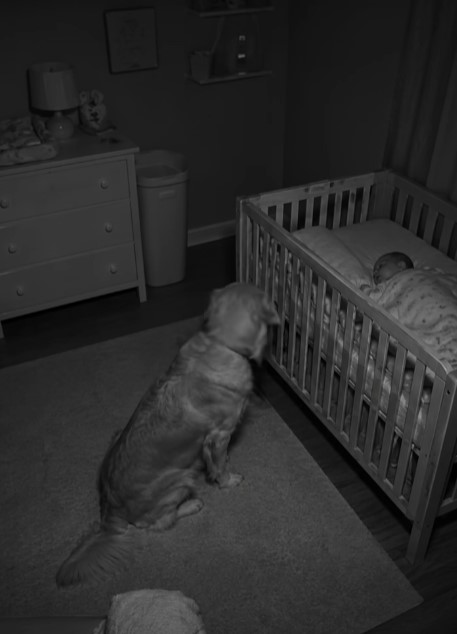
When a young couple welcomed their newborn daughter home, their lives shifted instantly into a new rhythm filled with sleepless nights, soft crying sounds, and constant awareness of responsibility surrounding their fragile new family member. Their home, once calm and predictable, began to feel different in subtle ways. Every sound seemed amplified, every movement more significant, as they adjusted emotionally and physically to parenthood for the first time.
Alongside this transformation, their golden retriever, Lora, also appeared to change her behavior. She had always been gentle, affectionate, and calm, but now she seemed unusually attentive toward the newborn baby. At first, her behavior seemed natural and even comforting. Like many family dogs, she showed curiosity toward the infant, staying nearby whenever the baby was placed carefully into the crib during the day.
The parents initially interpreted this as a positive sign. They believed the dog was simply adjusting to the new family member and forming a protective bond, as dogs often do in such situations. However, over time, Lora’s behavior became more consistent and structured in a way that felt less ordinary. She was no longer just nearby occasionally, but constantly positioned close to the crib.
Every evening, once the household grew quiet and lights dimmed, Lora would walk directly toward the baby’s crib. She would sit beside it and remain there for long periods without moving. Unlike typical resting behavior, she did not lie down or sleep deeply during the night. Instead, she stayed alert, her body still, her eyes focused on the crib throughout the night.
Even when hours passed, her position rarely changed. Occasionally, she would shift slightly or let out a soft sound, but her attention never drifted away from the baby. The consistency of this routine began to stand out more with each passing night. It was no longer seen as random behavior, but as a fixed pattern repeated without variation.
During daytime hours, however, Lora behaved completely normally. She ate, played, and interacted with family members without any signs of fatigue, confusion, or stress from the night before. This contrast between her daytime calmness and nighttime vigilance slowly started to raise quiet concern in the parents’ minds, even though they tried to dismiss their growing uneasiness.
The mother initially believed the behavior was simply maternal instinct expressed through a protective animal response. Many dogs show heightened awareness around newborns, especially in the early adjustment period. Still, as days turned into weeks, the routine did not change. Lora remained fully committed to her nighttime position beside the crib without interruption or apparent relaxation.
The parents began to question whether such constant alertness was truly normal. The idea that the dog never rested at night started to feel increasingly unusual and difficult to ignore. At times, the mother found herself watching the dog instead of sleeping, trying to understand what exactly Lora might be reacting to in the quiet darkness of the house.
The father also noticed the same pattern and began to wonder whether environmental factors, sounds, or unseen disturbances might be triggering the dog’s unusual nighttime focus. As concern gradually increased, the couple discussed the possibility of monitoring the situation more closely. They wanted to ensure both their baby’s safety and their dog’s well-being were not at risk.
Eventually, they decided to install a night-vision camera positioned toward the crib. Their intention was to observe the nighttime environment without interfering and understand Lora’s behavior more clearly. That night, the house felt slightly different. Knowing the camera was recording created a quiet tension, as both parents tried to sleep while remaining subconsciously alert.
Lora followed her usual routine without hesitation. As soon as the house settled, she positioned herself beside the crib and remained still, just as she had done every night before. For several hours, nothing unusual appeared on the recording. The baby slept peacefully, and the room remained quiet except for the occasional movement of the dog shifting slightly.
However, near the early morning hours, the footage captured a sudden change in Lora’s behavior. Her posture shifted, and she appeared to become sharply alert to something outside the room. The dog stood up immediately, ears raised, body tense, and eyes directed toward the window area, as if sensing a disturbance that was not immediately visible. Within moments, subtle movement appeared near the window. The frame shifted slightly, suggesting that someone or something was attempting to manipulate it from the outside.
The movement became more deliberate, and a hand briefly appeared through the narrow opening. It carefully tested the window structure, attempting to create space for entry. Lora reacted instantly. She moved quickly toward the source of the disturbance, barking loudly and positioning herself between the crib and the window.
Her behavior was no longer calm or passive. She appeared fully alert, focused entirely on the threat she seemed to perceive in that moment. The hand withdrew immediately after the dog’s reaction. The window movement stopped, and the room fell back into silence within seconds.
Despite the brief duration, the incident left a strong impression on the footage and on the parents who later reviewed it with growing shock and concern. Realizing the seriousness of what they had seen, the mother immediately contacted authorities and reported the attempted intrusion captured on camera. The father secured the home while waiting for assistance, ensuring that all doors and windows were checked carefully to prevent any further risk that night.
In the following days, investigators reviewed the footage and discovered that similar incidents had been reported in the surrounding area during recent weeks. It became apparent that there had been a pattern of attempted break-ins targeting residential homes during late-night hours when occupants were most vulnerable. Authorities indicated that the behavior suggested a coordinated or repeated effort by an individual or group exploiting quiet nighttime conditions for access.
The evidence from the couple’s camera helped reinforce ongoing investigations and provided a clearer timeline of attempted intrusions in the neighborhood. Eventually, a suspect was identified and taken into custody after additional evidence connected them to multiple similar incidents in nearby homes. Physical traces found near one of the entry points, along with surveillance analysis, contributed to confirming involvement in the attempted break-ins.
The parents were informed that the presence and reaction of the dog may have played a significant role in interrupting the attempted intrusion at their home. While the situation was deeply unsettling, it also brought relief that no physical harm had come to the baby or family during the incident. Afterward, the household atmosphere changed noticeably. Fear slowly gave way to gratitude, especially toward the dog who had remained consistently alert throughout the nights.
Lora’s behavior was no longer viewed with concern but rather with appreciation for her protective instincts and unwavering attention during the most vulnerable hours. The family chose to allow the dog to remain near the crib at night, recognizing the comfort and sense of security her presence seemed to provide. Over time, the nighttime environment became calmer again. The earlier tension faded, and the household slowly returned to a more peaceful routine.
Each night, Lora resumed her quiet position beside the crib, no longer seen as unusual, but as part of the family’s natural sense of safety and companionship. In the end, what once appeared to be unexplained behavior became understood as heightened vigilance, reinforcing the bond between the dog, the baby, and the family.
