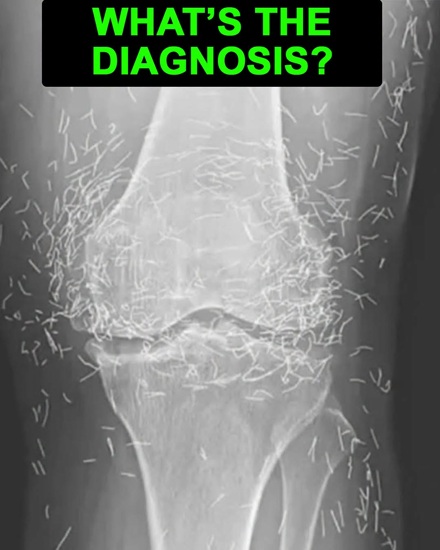
When a 65-year-old woman sought medical attention for persistent pain in both knees, the images taken by her doctors revealed something highly unusual. She had previously been diagnosed with osteoarthritis, a common joint condition that can cause pain, stiffness, and reduced mobility. But her X-rays showed more than the changes expected from osteoarthritis. Surrounding the knee joints were numerous tiny metallic objects. They were not accidentally introduced during the examination—they were gold threads that had previously been implanted as part of acupuncture treatment.
The unusual case was documented by Han-Gyul Yoo and Wan-Hee Yoo and published in the New England Journal of Medicine in December 2013. According to the medical report, the woman had been diagnosed with osteoarthritis of both knees and had previously received treatment with analgesics and nonsteroidal anti-inflammatory drugs, commonly known as NSAIDs. The medication had not adequately controlled her pain, and she experienced stomach discomfort related to treatment. She therefore sought acupuncture as another approach to managing her symptoms.
Osteoarthritis develops when structures within a joint undergo progressive changes over time, including deterioration of cartilage. The knees are among the joints commonly affected because they regularly carry body weight and experience repeated mechanical stress. Symptoms can include pain during movement, stiffness after periods of inactivity, swelling, and difficulty performing ordinary activities. For some people, walking, climbing stairs, getting out of a chair, or bending the knee can gradually become uncomfortable.

The condition becomes increasingly common with age, although aging is not its only risk factor. Previous joint injuries, genetics, body weight, joint anatomy, and repeated mechanical stress can also influence a person’s likelihood of developing osteoarthritis. The severity varies considerably between individuals. Some people have changes visible on X-rays while experiencing relatively little discomfort, whereas others develop significant pain and limitations that interfere with everyday activities.
Managing knee osteoarthritis can therefore involve several different approaches depending on the individual. Exercise, physical activity adapted to a person’s abilities, weight management when appropriate, medications, and other nonsurgical strategies may be considered. More advanced cases may eventually require additional interventions, including joint replacement for selected patients. Treatment decisions are normally based on factors such as symptoms, overall health, functional limitations, and discussions between patients and qualified health professionals.
In the South Korean patient’s case, conventional pain medication had not provided the relief she wanted and had caused gastrointestinal discomfort. According to the published report, she subsequently underwent acupuncture. However, the treatment was different from the type of acupuncture in which needles are inserted temporarily and removed at the end of a session. Small pieces of gold thread were intentionally implanted into the tissue around her knees and remained there.

This practice explains the extraordinary appearance of her radiographs. The images showed many thin, bright metallic fragments distributed throughout the tissue surrounding the knee joints. Because gold strongly blocks X-rays compared with surrounding soft tissue, the implanted pieces appeared clearly on the radiographs. To someone unfamiliar with this form of treatment, the images could easily look as though countless tiny needles had somehow become scattered around the woman’s knees.
The metallic objects were therefore not a mysterious biological phenomenon, nor had doctors unexpectedly discovered naturally occurring gold inside her body. They were the result of a previous therapeutic procedure. Describing the discovery as doctors “finding gold” can make an attention-grabbing headline, but the medical explanation is straightforward: gold threads had intentionally been inserted around the affected joints during acupuncture-related treatment.
The original New England Journal of Medicine case is particularly valuable because it provides documented medical imaging rather than relying on an anecdote circulating online. The authors presented the patient’s history alongside radiographs demonstrating both osteoarthritis and the implanted gold material. The case became notable because the quantity and distribution of the gold threads produced such an unusual radiographic appearance.
Traditional acupuncture generally involves inserting very thin needles through the skin at selected points. The practice originated within traditional Chinese medicine and has existed in various forms for thousands of years. Modern acupuncture is now practiced in many countries and is frequently used by people seeking help with pain. However, techniques can differ considerably, and permanently implanting pieces of metal is not the same procedure as standard acupuncture in which sterile needles are removed after treatment.
Gold-thread implantation represents one of those less conventional variations. Small pieces of gold can be placed around painful joints or other areas with the intention of providing continued stimulation. Reports of permanently implanted acupuncture material have appeared in medical literature for decades. Gold, silver, and stainless-steel fragments have all been described in connection with certain permanent acupuncture practices.
Medical literature has also documented why physicians need to know about implanted acupuncture material. Metallic fragments can appear prominently on X-rays and other imaging examinations, potentially making interpretation more complicated. If clinicians do not know that a patient previously underwent this type of treatment, the unusual pattern may initially raise questions about where the foreign material came from.
Another concern involves the body’s response to implanted foreign material. Whenever something remains inside human tissue, the body may respond to its presence. Depending on the material, location, sterility, and other circumstances, reactions can include inflammation or the formation of fibrous tissue around the foreign object. Infection is another recognized concern associated with improperly performed acupuncture, particularly when sterile techniques are not followed.
Research and medical reports have also described cases in which permanently implanted acupuncture fragments migrated away from their original locations. A 1995 report in the New England Journal of Medicine, for example, discussed patients who had undergone extensive permanent acupuncture and documented migration of some implanted needles. Such reports do not mean that migration occurs in every person receiving these procedures, but they demonstrate why permanently retained metallic material deserves medical attention.
Modern safety guidance distinguishes these permanent implantation practices from appropriately performed conventional acupuncture. The U.S. National Center for Complementary and Integrative Health states that relatively few complications have been reported from acupuncture when it is properly performed. Nevertheless, improper treatment can produce serious adverse effects, including infections, injuries to organs, and damage involving the nervous system.
In the United States, acupuncture needles are regulated by the Food and Drug Administration as medical devices. They are required to be sterile and labeled for single use. These requirements are intended to reduce risks associated with contaminated equipment and improper reuse. Anyone considering acupuncture should therefore seek an appropriately qualified practitioner who follows established hygiene and safety standards.
The evidence surrounding acupuncture and osteoarthritis also requires more nuance than simply saying that acupuncture either “works” or “doesn’t work.” Current information from the National Center for Complementary and Integrative Health indicates that acupuncture may be helpful for some people experiencing knee pain associated with osteoarthritis. Research has produced evidence of benefits, although the size of those benefits can be modest and findings have varied depending on how acupuncture is compared with sham procedures or no treatment.
A 2018 review discussed by NCCIH examined studies involving thousands of participants with osteoarthritis pain. Acupuncture performed better than receiving no treatment and also showed an advantage over sham acupuncture in the reviewed data, although the difference between genuine and sham acupuncture was smaller than the difference between acupuncture and no treatment. Most participants in those studies had knee osteoarthritis.
Clinical recommendations consequently differ in strength and interpretation. The American College of Rheumatology and Arthritis Foundation guideline conditionally recommends acupuncture for osteoarthritis affecting the knee, hip, or hand. A conditional recommendation does not mean that acupuncture is appropriate for every patient. Rather, it reflects a situation in which potential benefits, limitations in evidence, patient preferences, and individual circumstances should all be considered.
It is equally important to distinguish evidence concerning conventional acupuncture from evidence concerning permanent gold-thread implantation. Research suggesting that acupuncture may provide modest pain relief for knee osteoarthritis should not automatically be interpreted as proof that permanently implanting gold fragments around a joint provides the same benefit. They are different procedures and should not be treated as interchangeable simply because both may be described using the word “acupuncture.”
The 65-year-old woman’s case therefore should not be interpreted as evidence that gold itself cured her arthritis. The published medical report documented her condition, previous treatments, and the striking appearance of the implanted threads. It did not establish that the gold implants reversed osteoarthritis. Osteoarthritis involves structural changes in the joint, and an unusual radiograph does not by itself demonstrate that a treatment successfully repaired those changes.
The case instead provides an interesting example of how traditional or complementary treatments can leave permanent findings that later appear during conventional medical examinations. A doctor reviewing such an X-ray needs to understand the patient’s treatment history to interpret the images accurately. This is one reason patients are generally encouraged to tell healthcare professionals about complementary treatments they have received, including procedures that may have left material inside the body.
Communication becomes especially important when future medical procedures or imaging examinations are being considered. Patients with known implanted metallic material should tell their healthcare providers and imaging staff exactly what was implanted, when possible. Decisions about imaging safety depend on factors such as the material’s composition, location, and characteristics, and should be made by qualified medical professionals rather than assumed from an online photograph or article.
The case also highlights the challenges faced by people living with chronic knee pain. When symptoms continue despite treatment, it is understandable that patients may investigate additional options. Chronic pain can interfere with sleep, movement, exercise, work, and ordinary activities. Someone experiencing ongoing discomfort may therefore become interested in complementary approaches when standard treatments have not produced satisfactory results.
That interest makes reliable medical information especially important. A treatment being described as traditional or natural does not automatically establish that it is harmless, just as being conventional does not mean a treatment is appropriate for everyone. Benefits and risks need to be evaluated using available evidence and individual medical circumstances. Qualified healthcare professionals can also help patients understand whether a complementary treatment might interact with other aspects of their care.
For acupuncture specifically, current evidence is more developed than it was when the woman’s case appeared in 2013. NCCIH currently states that research suggests acupuncture may help with several types of pain, including knee pain associated with osteoarthritis. At the same time, the organization emphasizes that proper technique, sterile needles, and appropriately trained practitioners are important for safety.
The striking gold-filled X-rays remain the feature that has kept this case circulating online years after its publication. Rows of tiny bright fragments surrounding the knees make the images immediately memorable. Without context, viewers might imagine an extraordinary medical mystery. Once the patient’s history is understood, however, the radiographs become a documented example of the physical traces that permanent gold-thread acupuncture can leave inside the body.
There is also an important difference between saying that doctors “found gold” and suggesting that the gold unexpectedly formed inside the woman’s body. The former can serve as playful wording, but scientifically the gold had a known external origin. It had been intentionally implanted during previous treatment. Keeping that distinction clear prevents an interesting medical case from turning into a misleading claim.
The woman’s story also offers a broader reminder about medical information shared online. Dramatic cases can be simplified as they move from medical journals to news reports and then onto social media. Details may gradually become exaggerated or lose their original context. Returning to the primary medical publication can help separate what physicians actually documented from assumptions added during later retellings.
In this instance, the fundamental story is already unusual enough without embellishment. A 65-year-old woman with painful knee osteoarthritis underwent medical evaluation after previous treatment with pain medication and acupuncture. Radiographs revealed numerous gold threads that had been implanted around her knees as part of that previous therapy. The images were striking enough to be published as an Images in Clinical Medicine case in one of the world’s best-known medical journals.
Her experience should not be used to encourage people to abandon prescribed treatments or independently pursue permanent metal implantation. Osteoarthritis treatment is individualized, and decisions should be discussed with healthcare professionals familiar with a patient’s medical history. Acupuncture may be one option considered for some people with osteoarthritis pain, but the evidence, technique, safety considerations, and type of acupuncture all matter.
More than a decade after the report appeared, the case continues to attract attention because the radiographs look so extraordinary. Yet the most useful lesson is not simply that doctors discovered gold around a woman’s knees. It is that a patient’s previous treatments can create unexpected findings during later medical care, and that understanding those findings requires accurate medical history and careful interpretation.
Ultimately, there was no hidden treasure and no unexplained medical phenomenon. The bright objects surrounding the woman’s arthritic knees were implanted gold threads from an earlier acupuncture-related treatment. The documented case combines an unusual image with a broader discussion about chronic pain, complementary medicine, treatment safety, and the importance of evidence-based healthcare. It remains a fascinating example of how an ordinary medical examination can reveal an extraordinary-looking—but explainable—part of a patient’s treatment history.
