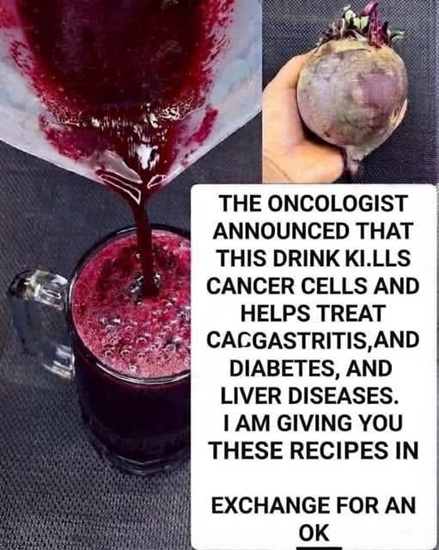
A striking social-media image featuring a glass of deep-red liquid and a whole beetroot has attracted attention because of the dramatic health promises attached to it. The post links the drink with cancer, diabetes, gastritis and liver disease, creating the impression that one simple beverage might address several major medical conditions. It also refers to an oncologist, which can make the message appear authoritative at first glance. However, the material does not identify the doctor, name a medical institution or provide a clinical study supporting the sweeping claims.
It also does not explain exactly what is contained in the drink beyond the visual suggestion that beetroot is involved. For those reasons, the claims require considerably more caution than the image itself suggests. Beetroot is a familiar vegetable that can be eaten raw, roasted, boiled, blended or consumed as juice. It contains a variety of naturally occurring nutrients and compounds, and researchers have studied beetroot and beetroot juice for several possible health effects. One of the areas receiving particular scientific attention is dietary nitrate and its relationship with nitric oxide and blood-vessel function.
That research makes beetroot scientifically interesting, but being the subject of health research does not turn a food into a proven treatment for serious disease. A nutritious vegetable and an approved medical therapy are two very different things. This distinction is particularly important when online posts use words such as “cure,” “treat” or “kill cancer cells.” The most dramatic part of the viral message concerns cancer. Saying that a drink “kills cancer cells” can easily be understood as suggesting that consuming it can fight or eliminate cancer in a person.
That conclusion is not established by the information shown in the post. Cancer is also not one single disease but a broad group of diseases that can behave differently and require different forms of treatment. A statement that lumps all cancers together without specifying cancer type, patients, dosage, treatment conditions or clinical outcomes leaves many essential questions unanswered. An image containing a vegetable and a medical claim cannot substitute for evidence from carefully designed human research.
There is also an important scientific distinction between laboratory findings and proven treatment in people. Researchers can expose isolated cells to substances under controlled laboratory conditions and observe biological effects. Such experiments can be useful for understanding mechanisms and identifying possibilities for further research. However, a substance affecting cells in a laboratory does not automatically mean that eating or drinking that substance will produce the same result inside the human body. Digestion, metabolism, dosage, absorption and many other biological factors can change what happens after something is consumed. For this reason, laboratory observations should not be translated directly into claims that a food or beverage treats cancer in humans.
Cancer treatment normally depends on the specific diagnosis and characteristics of the disease. Depending on the situation, treatment can involve surgery, radiation therapy, chemotherapy, targeted treatments, immunotherapy, hormone therapy or combinations of approaches. Decisions are based on factors including cancer type, stage, biological characteristics and an individual patient’s health. A generic social-media graphic cannot account for those differences. It cannot examine pathology results, imaging, laboratory tests or medical history. Presenting one drink as a replacement for that individualized process would therefore go far beyond the available evidence.
The reference to an unnamed oncologist is another reason to examine the post carefully. Oncology is a highly specialized area of medicine, so mentioning an oncologist can give a message additional credibility. But an authority claim becomes difficult to verify when no name, institution, publication or interview is supplied. Readers have no way to determine who supposedly made the statement or whether it has been presented accurately. A credible medical claim should be traceable to evidence that can be independently examined. Simply attaching a medical title to an assertion does not provide that evidence.
The image also connects the drink with diabetes, another condition requiring careful medical language. Diabetes involves problems with blood-glucose regulation, but it includes different forms and individual circumstances. People with diabetes may use dietary changes, exercise, medication, insulin or combinations of these approaches depending on their diagnosis and medical advice. Diet is unquestionably important in diabetes management, but that is not the same as saying a particular vegetable drink treats or cures diabetes. Foods can be incorporated into an overall eating pattern without becoming replacements for established medical care. Broad claims that blur those differences can give readers a misleading impression.
There has been scientific interest in beetroot and metabolic health, including research involving people with type 2 diabetes. For example, clinical researchers have examined concentrated beetroot juice in relation to measures such as glycemic control, blood pressure and blood lipids. The existence of such studies is useful because it allows researchers to test specific questions under defined conditions. However, individual studies do not justify describing beetroot juice as a cure for diabetes. Clinical evidence must be considered together, including study size, design, duration, consistency and limitations. Responsible health reporting should reflect that uncertainty rather than turning preliminary or limited findings into miracle-treatment language.
The same caution applies to gastritis. Gastritis refers to inflammation of the stomach lining, but it can occur for different reasons. Possible causes and contributing factors vary, which means appropriate management can also vary. Simply saying that a beetroot-based drink “treats gastritis” provides almost none of the information needed to support the statement. The viral material does not describe a clinical trial involving people with gastritis, explain how symptoms were measured or identify the cause of the condition. It does not specify an amount of beetroot juice or a treatment period either. Without those details, the statement remains an unsupported health claim rather than demonstrated medical guidance.
Claims about liver disease are similarly broad. “Liver disease” is not one diagnosis but a general term covering many possible conditions. Different liver problems can have very different causes, levels of severity and treatment requirements. A claim that one homemade beverage treats “liver diseases” collectively therefore raises immediate questions. Which condition is being discussed? What evidence shows an effect? What dose was tested, for how long, and against what comparison? None of those essential details is established simply by showing a red beverage beside a beetroot.
This does not mean that beetroot has no nutritional value. It means that nutritional value and proven medical treatment should not be confused. Vegetables can contribute to healthy eating patterns while still not functioning as medicines for cancer or other serious diseases. That distinction allows people to discuss the genuine qualities of a food without exaggerating what science has demonstrated. It also prevents criticism of an unsupported medical claim from being misunderstood as criticism of the food itself. Beetroot can remain part of someone’s diet without being described as a miracle cure.
One legitimate area of beetroot research involves blood pressure. Beetroot naturally contains nitrate, which can participate in pathways that lead to nitric oxide production in the body. Nitric oxide has important effects on blood vessels, including involvement in vascular relaxation. Researchers have therefore tested whether nitrate-rich beetroot juice can influence blood pressure. Several systematic reviews and meta-analyses have reported reductions in systolic blood pressure in some groups. These findings are considerably more specific and evidence-based than claims that the same beverage cures several unrelated diseases.
Even here, however, careful wording is necessary. Research results have not been identical across every trial or every population. Some studies have found improvements, while others have not demonstrated meaningful changes under particular conditions. Differences in participants, amounts consumed, nitrate concentration, study duration and existing treatment can affect results. A 2024 systematic review of randomized controlled trials involving people with hypertension reported a reduction in clinical systolic blood pressure but rated the certainty of the evidence as low. The researchers also did not find significant effects across every blood-pressure measure they examined.
That example illustrates how real science usually looks very different from a viral health graphic. Researchers do not simply announce that something “works.” They define the population, intervention, comparison and outcomes being tested. They describe uncertainty, limitations and conflicting findings. Other researchers can then examine those results and conduct additional studies. A strong medical conclusion develops from a body of evidence rather than from the confidence of a headline. Responsible reporting should preserve that distinction.
Beetroot juice has also been studied in relation to exercise and cardiovascular physiology. Its nitrate content is one reason it has become popular among some athletes and researchers studying physical performance. Again, this does not establish the cancer, diabetes, gastritis or liver-disease claims circulating online. Evidence for one physiological effect cannot automatically be extended to completely different diseases. A substance might influence blood-vessel function while having no proven therapeutic effect on an unrelated condition. Each medical claim requires evidence specific to that claim.
The wording used in viral posts can make these distinctions easy to miss. A colorful image, a familiar vegetable and a short statement are much easier to process than a clinical research paper. The viewer can understand the message within seconds. When that message also includes words associated with frightening diseases, it can provoke a strong emotional response. The simplicity itself becomes part of the appeal. Unfortunately, medical reality is rarely as simple as a single sentence placed over a photograph.
The promise of an inexpensive and accessible solution can be particularly attractive to people facing serious health problems. Cancer treatment, chronic-disease management and medical testing can be stressful and complicated. A vegetable juice can seem reassuring because it is familiar and easy to obtain. That emotional attraction is understandable, but it is not evidence that the treatment claim is correct. A health claim should be judged by the quality of supporting evidence rather than by how affordable, natural or comforting the proposed solution appears. “Natural” and “effective medical treatment” are not interchangeable categories.
The phrase “natural remedy” can itself create confusion. Many substances found in nature contain biologically active compounds, and modern medicine has learned from natural sources throughout history. But natural origin does not automatically establish effectiveness, dosage or safety. Scientific evaluation remains necessary regardless of whether something comes from a plant, laboratory or other source. The relevant question is not simply whether something is natural. The important questions are what it does, under what conditions, at what dose, for whom and according to what evidence.
Another problem with sweeping online health claims is that they usually ignore individual differences. A beverage that is reasonable for one person’s ordinary diet may not be appropriate in the same quantity for everyone. People can have different health conditions, medications, dietary needs and treatment plans. The viral image does not ask about any of those factors. It communicates one broad message to every viewer. That is very different from individualized medical advice, where personal circumstances matter.
The missing recipe in the original presentation also deserves attention. The wording surrounding the image suggests that additional recipes may be offered after a viewer responds, yet the visible material does not provide a complete preparation method. There are no clearly established quantities or detailed ingredients beyond the suggestion of beetroot. That means someone looking only at the post does not even know precisely what product is being associated with the medical claims. A claim becomes even more difficult to evaluate when the intervention itself is not clearly defined. Medical studies normally specify exactly what participants receive.
Engagement-based wording is common on social media because posts often encourage users to comment, react or share. That alone does not determine whether a health claim is true or false. However, readers should separate the mechanism used to attract engagement from the evidence required to support a medical conclusion. A post can receive thousands of comments and still contain an unsupported claim. Popularity measures attention, not scientific accuracy. The number of people sharing a statement cannot substitute for clinical evidence.
The visual design can also increase the persuasive effect. A whole beetroot beside a glass of burgundy liquid immediately creates a connection between the vegetable and the drink. Large text placed nearby can then connect that familiar food with complex medical conditions. This makes the message easy to remember even when very little supporting information is provided. Visual clarity can therefore create an impression of factual clarity that may not actually exist. Readers should examine what evidence is shown rather than relying on how convincing the design appears.
The words “kills cancer cells” deserve especially careful treatment because similar language can originate from many different types of research. A laboratory experiment involving cells is not equivalent to a randomized clinical trial in patients. An animal study is not equivalent to established therapy in people either. Even an early human study may provide only preliminary information. Scientists move through different stages of research precisely because an observation must survive repeated testing before strong conclusions can be justified. Viral graphics often remove all of that context.
Dose is another important issue. Biological effects can depend heavily on the amount of a substance consumed. A nutrient level found in a normal serving of food may be very different from concentrations used in laboratory experiments. Without dose information, readers cannot reasonably compare a social-media claim with scientific research. The viral image does not provide such context. This is another reason the strength of its language is not matched by the amount of evidence presented.
Duration matters as well. Some dietary studies measure effects after a single serving, while others examine consumption over days, weeks or months. Results can differ depending on the time period being studied. A short-term change in a biological measurement does not necessarily mean long-term disease outcomes will change. Demonstrating that a food influences a laboratory marker is therefore very different from demonstrating that it prevents or treats a serious illness. Claims should reflect exactly what an experiment measured.
Research quality matters just as much as the result itself. Randomization, control groups, blinding, adequate sample sizes and appropriate statistical methods can make evidence more reliable. Replication by independent research groups provides further confidence. Systematic reviews then examine results across multiple studies rather than relying on a single experiment. When experts remain cautious after evaluating multiple trials, a social-media post should not leap to certainty. The level of confidence in the language should follow the level of confidence in the evidence.
This is why the modest findings concerning beetroot juice and blood pressure should not be transformed into much larger claims. Research suggesting that nitrate-rich beetroot juice may modestly reduce systolic blood pressure in certain populations is interesting. It may encourage further investigation into cardiovascular nutrition. But that conclusion does not logically establish that the same juice eliminates cancer cells in patients or treats diabetes and liver disease. Different biological questions require different evidence. Scientific findings cannot simply be transferred from one condition to another.
People should also understand that “associated with better health” and “treats disease” are fundamentally different statements. A food may contain nutrients associated with healthy dietary patterns. Researchers may even identify mechanisms through which some compounds influence biological processes. Those facts can support nutritional discussion without supporting a claim of disease treatment. The distinction might sound technical, but it has major practical importance. Confusing the two can lead to exaggerated expectations.
The same principle applies to antioxidants, another word frequently used in health-related advertising and social media. Beetroot contains compounds that have been studied for antioxidant activity. However, the presence of antioxidant compounds does not prove that consuming a particular drink cures cancer. Human diseases involve complex biological systems that cannot be reduced to one laboratory property. Responsible health information should therefore avoid using terms such as “antioxidant” as shortcuts for medical effectiveness. A biological characteristic is not automatically a clinical outcome.
Anyone encountering a dramatic health claim can apply a few basic questions. Is a specific medical professional actually identified? Is a scientific publication provided? Was the research performed in humans? How many participants were included? Was there an appropriate comparison group? What outcome was measured, and does that outcome actually match the claim being made? A post that cannot answer basic questions like these should not be treated as equivalent to medical evidence.
It is also useful to check whether the claim becomes unusually broad. In this example, cancer, diabetes, gastritis and liver disease are all placed together. These conditions involve different biological systems and medical approaches. One intervention could theoretically be researched for more than one condition, but evidence would still be required for each claim. Combining multiple serious diseases into one promise does not reduce the amount of evidence necessary. If anything, it increases the number of questions that need to be answered.
Readers should be especially cautious if a health post encourages them to abandon established treatment. Nothing about beetroot or beetroot juice provides a sound basis for stopping prescribed cancer treatment, diabetes medication or other necessary medical care. Treatment changes can have serious consequences when made without appropriate medical guidance. Dietary choices and medical treatment are not mutually exclusive concepts. A person can enjoy vegetables while also following evidence-based care recommended for an existing condition.
This is not an argument against nutrition. Nutrition is an important component of health, and dietary patterns can influence the risk or management of many conditions. The point is simply that nutrition should be discussed accurately. Saying that vegetables are useful components of a balanced diet is reasonable. Saying that a particular vegetable beverage has been proven to cure several serious illnesses requires a much higher level of evidence. The viral image does not supply that level of evidence.
The same approach protects people from both exaggerated optimism and unnecessary fear. Fact-checking an unsupported beetroot claim does not require describing beetroot as dangerous or unhealthy. It simply requires separating known information from unsupported promises. This balanced approach is more useful than replacing one extreme claim with another. Food does not need to be a miracle cure to have nutritional value.
Researchers can continue studying beetroot, dietary nitrate, cardiovascular health, metabolism and other possible biological effects. Future studies may clarify where meaningful benefits exist and which people are most likely to experience them. Scientific understanding can also change as larger and better-designed studies become available. That is why accurate reporting should remain open to new evidence while avoiding conclusions that current evidence cannot support. Scientific caution is not the same thing as dismissing research.
The development of medical evidence takes time because human health is complicated. Researchers must consider possible benefits, risks, dose, interactions, patient differences and the reliability of measured outcomes. Those requirements can make legitimate medical conclusions appear less exciting than viral claims. Nevertheless, they are essential for protecting patients and ensuring that treatments actually work. A dramatic headline cannot bypass those steps. Confidence should be earned through evidence.
People living with chronic conditions may understandably search for ways to improve their health through diet. Discussing dietary habits with an appropriate healthcare professional can help place foods such as beetroot into an individual’s broader health plan. This is particularly useful when someone takes medication, follows dietary restrictions or has multiple medical conditions. A clinician familiar with that person’s situation can consider factors that a generic online image cannot. Personal medical decisions should therefore not be based solely on viral content.
It is equally important not to interpret every scientific headline as proof of treatment. Researchers may report that a food affects blood pressure, inflammation markers, exercise performance or laboratory measurements. Those findings can be scientifically valuable without proving disease prevention or cure. Translating scientific research responsibly means preserving the boundaries of what was actually studied. The strongest claim should never be stronger than the evidence supporting it.
The beetroot image is a useful example of why those boundaries matter. The photograph itself establishes only that beetroot and a dark-red beverage are being presented together. The accompanying text adds much larger claims about serious illnesses. The jump from the first fact to the second conclusion requires substantial medical evidence. That evidence is not contained in the image. Recognizing that gap is central to evaluating the post responsibly.
When reliable studies do show an effect, the results should still be described precisely. Research on beetroot juice and hypertension, for example, has reported modest reductions in systolic blood pressure in some analyses. That is much narrower than saying beetroot “cures high blood pressure,” and even narrower than claiming it treats cancer or diabetes. Precision may make a headline less sensational, but it makes the information more accurate. Health reporting benefits from that restraint.
A similar standard should apply whenever social-media posts attribute a statement to a doctor. A physician’s specialty alone is not evidence. Readers should be able to identify the individual, understand the context of the statement and examine the research supporting it. Anonymous authority claims make that verification impossible. If a post says simply that “a doctor revealed” or “an oncologist announced” something extraordinary, the absence of identifying evidence should prompt further scrutiny.
Scientific consensus also matters more than isolated testimony. Even a real doctor’s personal opinion does not automatically establish a medical treatment. Medicine relies on evidence gathered across clinical studies, professional guidelines, ongoing research and repeated evaluation. Experts can disagree, and scientific recommendations can evolve. That is why a single quotation should not be elevated above an entire body of evidence. Extraordinary treatment claims require particularly strong support.
The word “cure” should be used especially carefully. In everyday conversation, people sometimes use it loosely to describe something that made them feel better. In medical contexts, however, it can imply elimination of disease or a definitive therapeutic effect. Applying the term to cancer, diabetes or liver disease without adequate evidence can therefore mislead readers. More cautious language such as “has been studied for” or “may influence” can be appropriate when research remains preliminary. Even those phrases should be tied to the specific outcomes actually studied.
The same rule applies to “detox” and similar marketing terms frequently associated with juices. The human body already has organs and physiological systems involved in processing and eliminating substances. A vague statement that a beverage “detoxes the liver” does not automatically correspond to a clearly defined medical outcome. If a claim cannot specify what is being measured, how it is measured and what evidence demonstrates improvement, it is difficult to evaluate scientifically. Clear definitions matter.
Health information becomes particularly important when the audience includes vulnerable people. Someone recently diagnosed with cancer may be actively searching for hope. A parent caring for a person with diabetes may be looking for ways to make daily management easier. People with chronic liver disease may be worried about their prognosis. Claims promising a simple solution can therefore have a much stronger emotional effect than ordinary food advertising. Publishers should take that context seriously when choosing their wording.
Responsible reporting does not require removing every mention of possible benefits. Instead, it requires putting those benefits into context. Beetroot can be described as a vegetable containing dietary nitrate and other nutrients. Research into beetroot juice and cardiovascular measures can be mentioned. The limitations of that research can be explained at the same time. What should be avoided is turning those facts into claims that have not been established.
It is also worth remembering that scientific evidence exists on a spectrum. A small observational study provides different evidence from a large randomized trial. A laboratory experiment provides different information from a clinical study. A systematic review can synthesize multiple trials, but even systematic reviews may conclude that certainty remains limited. Saying simply that “studies show” can hide all of those distinctions. High-quality health communication gives readers enough context to understand what kind of evidence exists.
This is especially relevant because online content often removes qualifications. A research paper might say that an intervention “may” produce a modest change under certain conditions. A headline can transform that into “scientists discover a cure.” A social-media post can then make the message even stronger. By the time readers encounter it, the original uncertainty may have disappeared completely. Returning to the underlying evidence helps restore the missing context.
In the case of beetroot juice, the available human research provides legitimate topics for discussion without supporting miracle-cure language. Its nitrate content has been researched extensively in relation to cardiovascular physiology. Some evidence suggests modest blood-pressure effects, while other trials have reported limited or no effects in particular populations. Researchers continue examining these questions because results depend on context. None of this justifies telling people that one red drink can solve a collection of unrelated serious diseases.
Food-based health claims often spread because they combine familiarity with scientific-sounding language. Everyone recognizes a beetroot. Terms such as antioxidants, nitrates, inflammation and cancer cells can then make an ordinary ingredient seem medically extraordinary. Some of those scientific terms may be accurate in isolation, but the conclusion built from them may still be unsupported. Readers should therefore evaluate the complete claim rather than being persuaded by individual scientific words.
A useful rule is to separate three different questions: Is the food nutritious? Does it have measurable biological effects? Has it been demonstrated to treat a particular disease in humans? Those questions are related but not equivalent. Beetroot can receive a “yes” or “possibly” in discussions of nutrition and some physiological effects without receiving a “yes” to every treatment claim attached to it. Keeping those categories separate greatly reduces confusion. It also allows legitimate nutrition research to be discussed without exaggeration.
Another useful principle is proportionality. Stronger claims require stronger evidence. Saying that beetroot is a vegetable that can form part of a varied diet requires little controversy. Saying that nitrate-rich beetroot juice may affect systolic blood pressure under certain conditions requires clinical evidence, and such evidence exists. Saying that beetroot juice cures cancer would require entirely different and extraordinarily strong evidence. The viral material does not provide such proof.
The image’s failure to identify a specific recipe adds another level of uncertainty. Different beetroot drinks can vary substantially in concentration, serving size and additional ingredients. A commercially concentrated beetroot shot is not necessarily equivalent to homemade juice or a blended vegetable drink. Even research using beetroot juice does not automatically apply to every product that happens to contain beetroot. Precise formulation matters when interpreting scientific evidence. Generic photographs conceal those differences.
People should therefore avoid reverse-engineering a supposed treatment from the color of a beverage. A dark-red drink may contain beetroot, but color alone cannot establish its full ingredient list or concentration. Additional ingredients can change nutritional characteristics and may matter for people with certain dietary needs. Without the complete recipe, even a basic nutritional analysis becomes difficult. This further demonstrates why the original post cannot support precise medical conclusions.
Medical advice also needs to account for potential interactions and existing health conditions. A short online post cannot evaluate those circumstances for every viewer. That does not mean ordinary beetroot consumption is inherently problematic. It simply means that recommending concentrated products for therapeutic purposes is different from discussing normal food consumption. The greater the promised medical effect, the more important individualized context becomes.
The safest and most accurate conclusion is therefore straightforward. Beetroot is a food with genuine nutritional characteristics and an interesting body of research surrounding dietary nitrate and cardiovascular function. Beetroot juice has been investigated scientifically, and some studies have found modest effects on measures such as systolic blood pressure. But those findings are not evidence that a beetroot drink cures cancer, reverses diabetes, treats all forms of gastritis or heals liver disease. Claims that go that far require evidence that the viral post does not provide.
Readers do not need to reject beetroot to reject exaggerated medical promises. Someone who enjoys beetroot can continue eating it as part of their normal diet. Someone interested in beetroot juice can regard it as a food or beverage rather than assuming it is a replacement for treatment. Separating enjoyment and nutrition from unsupported therapeutic claims is a reasonable middle ground. It preserves what is known without adding what has not been demonstrated.
Ultimately, the central issue is not whether beetroot is “good” or “bad.” The important question is whether the medical statements attached to the image are supported by adequate evidence. Based on the information presented, the sweeping claims go substantially beyond what has been established. No identifiable oncologist, clinical trial, dosage, patient group or treatment protocol is provided in the viral material. That absence makes confident medical conclusions inappropriate.
Online health information can be useful when it encourages people to learn more about nutrition and science. Problems arise when curiosity is converted into certainty before the evidence supports it. A responsible approach is to investigate dramatic claims, distinguish laboratory observations from human clinical results and avoid replacing professional medical care with an online recipe. This is particularly important when cancer, diabetes or other serious conditions are involved. Health decisions deserve more than an eye-catching image and a persuasive caption.
The viral beetroot drink may therefore be best understood as an example of why medical claims on social media deserve careful examination. Its visual presentation is memorable, its proposed solution sounds simple and the illnesses mentioned are serious enough to capture immediate attention. Yet none of those features demonstrates medical effectiveness. Evidence, not virality, should determine how strongly a health claim is stated. Beetroot can be appreciated as a nutritious food while extraordinary treatment promises remain subject to appropriate scientific scrutiny.
For people currently receiving medical care, a viral beverage claim should never be treated as a reason to stop, reduce or replace prescribed treatment without discussing the decision with an appropriate healthcare professional. A qualified clinician can consider diagnosis, medications, laboratory results, dietary needs and other individual circumstances that an online post cannot know. Nutrition may play an important supporting role in health, but support and treatment are not interchangeable concepts. Maintaining that distinction protects readers from both misinformation and unrealistic expectations.
The broader lesson extends well beyond beetroot. Similar posts appear regularly around fruits, herbs, spices, teas and homemade mixtures. Many of those foods may have nutritional value and may even be subjects of legitimate scientific research. That does not mean every medical promise attached to them is supported. The same evidence-based questions should be applied regardless of whether the ingredient is exotic or something found in an ordinary kitchen.
A health claim becomes more trustworthy when readers can trace it to high-quality research, understand exactly what was tested and see that the conclusion matches the data. It becomes less trustworthy when the source is anonymous, the illness is vaguely defined, the recipe is unclear and the promised benefit covers several unrelated diseases at once. Those are practical distinctions anyone can use when evaluating online content. They do not require rejecting science or nutrition. On the contrary, they encourage a more accurate understanding of both.
Beetroot will likely continue attracting scientific interest because of its nutrient composition and naturally occurring nitrate. New studies may refine what researchers understand about its effects, appropriate quantities and the groups most likely to benefit from particular uses. Those findings should be evaluated as they emerge. But scientific interest should never be presented as proof of a cure before such proof exists. Careful language leaves room for new discoveries without misleading people today.
The message to take away is therefore simple. Enjoying beetroot as food is one thing; relying on an unverified beetroot drink to treat a serious medical condition is another. Current evidence does not justify describing the beverage shown in the viral post as a cure for cancer, diabetes, gastritis or liver disease. Legitimate research into beetroot should be discussed for what it actually demonstrates, not expanded into promises it does not support. When health claims are extraordinary, careful verification remains far more valuable than a viral caption.
