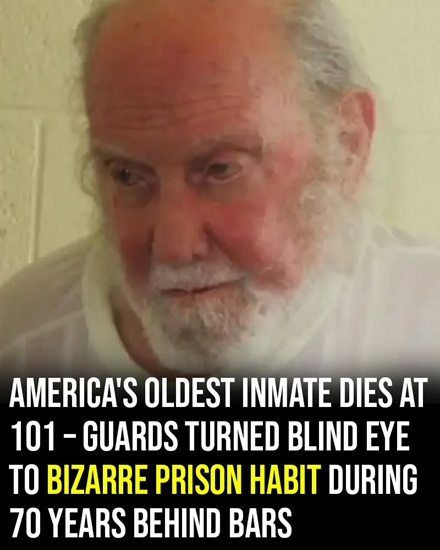
Francis Clifford Smith, a Connecticut man whose extraordinary history in the criminal justice system stretched across more than seven decades, died on June 25, 2026, at the age of 101. Smith was widely described as one of the longest-serving prisoners in American history, although there is no definitive national database that can establish such a record with absolute certainty. He had been convicted of first-degree murder in 1950 in connection with the 1949 killing of Grover Hart, a night watchman at the Indian Harbor Yacht Club in Greenwich, Connecticut.
Originally sentenced to death, Smith ultimately lived for another 76 years after his conviction. His final years were spent on supervised parole at a secure nursing facility in Rocky Hill, Connecticut. Smith was born Francis Clifford Smith on September 1, 1924, in Stamford, Connecticut. His life eventually became inseparable from a criminal case that began when he was still a young man.
The crime for which he was convicted occurred in 1949, when 68-year-old Grover Hart was fatally shot during a robbery at the Indian Harbor Yacht Club. Smith was arrested and prosecuted in connection with Hart’s death. In 1950, when Smith was 25, a jury convicted him of first-degree murder, and he received a death sentence. That conviction began a legal and personal story that would continue through multiple generations of Connecticut’s correctional system.
Smith maintained for decades that he was innocent of Hart’s murder. Questions about aspects of the evidence and testimony in the case also emerged after his conviction, and those questions became an important part of later attempts to stop his execution or secure a new trial. Witness accounts changed, and another man eventually claimed responsibility for the killing. Even one of the law-enforcement officials involved in the original investigation later expressed uncertainty about whether Smith had actually been present when Hart was killed. Those developments did not overturn Smith’s conviction, however, and he remained legally convicted of the murder throughout his life.
The years immediately following Smith’s conviction were dominated by the possibility that Connecticut would execute him. His execution was scheduled repeatedly, and reporting about his case indicates that he faced eight scheduled execution dates. The eighth became particularly dramatic because preparations had progressed extremely far. Smith’s head had been shaved in preparation for the electric chair, and a chaplain stayed with him as the scheduled execution approached. Only hours remained before the sentence was expected to be carried out when another effort was made to persuade Connecticut’s Board of Pardons to intervene.
That intervention changed the course of Smith’s life. Instead of being executed in 1954, his death sentence was commuted to life imprisonment. He therefore left death row and entered the general prison population, beginning what would become an extraordinarily long period within Connecticut’s correctional system. Smith continued challenging his conviction and maintained that he had not committed the murder. According to detailed reporting about his life, he studied legal materials and pursued appeals in an effort to obtain another trial. Those efforts ultimately did not result in the exoneration he sought.
The doubts surrounding the case did not automatically establish Smith’s innocence, and that distinction is important when recounting his history. He remained convicted of Hart’s murder, and courts declined to grant him a new trial based on the evidence presented after his conviction. At the same time, later developments created questions that followed the case for decades. One witness recanted, another person repudiated an earlier statement implicating Smith, and a different man claimed involvement in Hart’s killing. These circumstances help explain why Smith’s case continued attracting attention long after the original trial had ended.
Life in prison eventually became the overwhelming majority of Smith’s existence. The United States changed dramatically around him while he remained within the correctional system. Presidents came and went, technology transformed daily life, television became commonplace, humans traveled to the Moon, personal computers entered homes, and eventually smartphones and the internet reshaped communication. Smith, meanwhile, spent decade after decade within institutions where daily routines were controlled by rules and schedules. By the time he reached old age, the world outside was fundamentally different from the one he had known as a young man.
There was, however, a dramatic interruption to that routine in 1967. Smith escaped from prison after taking a truck, triggering a manhunt. His freedom was brief. He was recaptured after roughly two weeks and returned to custody. The escape became another major episode in a life that had already included a death sentence, repeated execution dates, and years of unsuccessful legal challenges. Ironically, reporting indicates that Smith was approaching eligibility for parole around that period, meaning the escape created additional complications for someone who had already spent many years trying to leave prison through legal means.
Smith later received another opportunity to live outside prison. He was paroled during the 1970s, but the period of freedom lasted only about 10 months. He was subsequently arrested on allegations involving petty larceny and possession of weapons, which constituted a parole violation and resulted in his return to prison. Reporting on the case notes that he was not ultimately convicted on those allegations, but the parole violation was enough to place him back in custody. After that episode, Smith’s life became much quieter from the perspective of public records.
Years turned into decades. Smith worked different prison jobs during various periods of his incarceration, including assignments connected with window washing, clerical work, carpentry and automobile repair. Records examined by The Boston Globe showed that he received positive assessments for some of his work, particularly in automotive mechanics. Eventually, however, advancing age changed what he could physically do. Like many prisoners serving extremely long sentences, Smith gradually moved from being a working-age inmate to an elderly man requiring greater levels of medical assistance.
His social world also became increasingly limited. Records examined by journalists showed that visits declined significantly as the decades passed. At times, years apparently passed without Smith receiving a visitor. People who had known him when he was young grew older or died, and connections to life outside the institution became increasingly distant. His situation illustrated one of the realities of extraordinarily long incarceration: a person may eventually outlive many of the relationships and social structures that existed when the sentence began.
Smith nevertheless developed small routines of his own inside prison. One of the most memorable involved birds. According to Andrius Banevicius, a public information officer for the Connecticut Department of Correction, Smith became known as the “Birdman of Osborn” while at Osborn Correctional Institution. He reportedly collected bread and concealed it in his clothing so that he could take it outside and feed birds. Correctional staff understood what he was doing and generally allowed the harmless routine to continue. The habit became one of the more human details remembered about Smith’s many years in custody.
The nickname inevitably invites comparisons with famous stories about prisoners caring for birds, but Smith’s routine was considerably simpler. There was no elaborate bird-breeding operation associated with him. Instead, accounts describe an elderly prisoner saving pieces of bread and using them to feed birds when he had the opportunity. In a life governed for decades by institutional schedules, this small habit provided a rare image of personal choice. It also became one of the details correctional officials remembered when discussing him after his death.
By the beginning of the 21st century, Smith had already spent longer in prison than most people spend in an entire working lifetime. Yet his continued incarceration became increasingly unusual as he entered his 80s and then his 90s. Records examined by The Boston Globe revealed another surprising development: there appeared to be a long period in which his parole situation received little attention. When Richard Sparaco, then an official associated with Connecticut’s Board of Pardons and Paroles, encountered Smith’s file in 2012, he was surprised that such an elderly prisoner remained incarcerated.
According to the Globe’s detailed examination, Smith had last been considered by the parole board decades earlier, and there were significant gaps in the record. Officials subsequently attempted to discuss parole with him. Exactly why Smith did not immediately pursue the opportunity was unclear. He had spent so long inside institutions that release itself could have been complicated, and Smith later said he did not remember some of the interactions surrounding the issue. What is clear is that he did not leave prison at that point.
The situation highlighted a phenomenon frequently discussed by researchers and criminal-justice professionals: institutionalization after extremely long periods of incarceration. Someone who has spent decades in a controlled environment can face enormous practical and psychological challenges when contemplating life outside it. Everyday decisions that most people make automatically can become unfamiliar after years in which meals, movement, sleeping arrangements and schedules are largely determined by an institution. Smith’s circumstances were particularly extreme because his confinement had begun in the middle of the 20th century.
By 2020, Smith was 95 years old. His physical needs were significantly different from those of the 25-year-old man who had entered prison in 1950. Eventually, he agreed to pursue parole again. During his parole hearing, Smith emphasized the most obvious fact about his situation: he had already been incarcerated for an extraordinarily long time and had reached an advanced age. This time, the process resulted in a major change. He was granted supervised parole and transferred out of a traditional prison environment.
His destination was 60 West, a specialized nursing facility in Rocky Hill, Connecticut, that provides care for people connected with the criminal justice system who may be difficult to place in conventional nursing homes. Smith lived there in a secure setting rather than returning independently to the community. In practical terms, his transition was therefore very different from the familiar image of someone simply walking through prison gates and beginning an entirely new life. He had spent approximately seven decades inside correctional institutions before moving into specialized nursing care.
The move nevertheless gave Smith a different living environment. A 2023 Boston Globe profile described him in his own room at the facility rather than a conventional prison cell. Yet after so many decades in custody, the meaning of freedom was complicated. Smith had not lived an ordinary independent life in the outside world since the mid-20th century. When the Globe interviewed him, he continued thinking about freedom and about Stamford, the Connecticut city where he had been born.
Asked about his life, Smith offered a remarkably simple description of how he approached the passing years. He told the Globe that he went from one day to another according to whatever circumstances presented themselves. The comment captured the unusual rhythm of a life spent largely inside institutions. Rather than describing long-term plans, Smith spoke about taking life as it arrived. At that point, he was already approaching a full century of life and had spent the overwhelming majority of his adult years under correctional supervision.
Smith also continued to maintain his innocence. The original murder remained central to how he understood his situation even many decades after the trial. His conviction had never been formally overturned, meaning the legal record continued to identify him as the person convicted of killing Grover Hart. But Smith consistently disputed that conclusion. The difference between those two facts — his legal conviction and his continuing assertion of innocence — remained essential to responsible accounts of his story.
As Smith became increasingly elderly, his memory reportedly declined. Later reporting described him as experiencing significant memory problems, and conversations sometimes returned to events from the 1940s and 1950s rather than the later decades of his life. The prospect of execution, which had dominated his early years in prison, remained particularly vivid in his recollections. That period had occurred more than 70 years earlier, yet it continued to occupy his thoughts during his final years.
Smith’s longevity was itself extraordinary. People serving extremely long prison sentences frequently experience significant health challenges, and reaching 101 under any circumstances is uncommon. Smith lived long enough to see nearly eight decades pass after the crime for which he had been convicted. He also lived more than 70 years after Connecticut had once expected to execute him. A sentence that initially appeared likely to end his life while he was still in his twenties instead became one of the longest periods of incarceration documented in modern American history.
On June 25, 2026, Smith died at 60 West in Rocky Hill. He was 101 years old and only a little more than two months away from his 102nd birthday. His death was later confirmed by the Connecticut Department of Correction. Reporting about his final moments indicated that he died quietly at the nursing facility where he had spent the final six years of his life. His death closed a story that had begun with a murder investigation in Connecticut more than three-quarters of a century earlier.
David Skoczulek, a spokesman for 60 West, said Smith essentially died from old age. According to accounts of Smith’s final days, there was limited family involvement around the time of his death, but staff at the facility worked to ensure that his wishes were respected and that his passing was handled appropriately and with dignity. Afterward, Smith’s body was cremated. No traditional funeral service was held.
Reports initially describing Smith simply as “America’s longest-serving prisoner” deserve one qualification. His period of incarceration was unquestionably extraordinary, and reputable publications have described him as the longest-serving or likely longest-serving prisoner in the country. However, there is no comprehensive official national record capable of conclusively proving that no American prisoner has ever served longer. The New York Times, for example, described Smith as “one of the longest-serving prisoners in American history” and noted uncertainty about whether his record could officially be considered the longest.
What is not in doubt is the scale of Smith’s time within the justice system. He was sentenced in June 1950 and remained incarcerated until his transfer to supervised parole at 60 West in 2020. Even after that transfer, he remained under supervision in a secure care environment. According to the Connecticut Department of Correction spokesman cited by The New York Times, including those final years meant Smith had served approximately 76 years of his life sentence.
His story therefore stretches far beyond the unusual statistics attached to his age. It includes a 1949 murder, a disputed conviction, a death sentence, eight scheduled executions, a commutation to life imprisonment, decades of appeals, an escape and recapture, a short-lived parole, and finally supervised parole into nursing care at the age of 95. Few individual criminal cases remain active parts of a person’s life across such an enormous span of American history. Smith’s did.
The story also contains unresolved questions, and responsible retellings should acknowledge them rather than trying to provide certainty where the historical record does not. Smith was convicted of murdering Grover Hart, and that conviction remained legally intact. Smith maintained that he was innocent, while later developments raised doubts among some people who examined the case. None of those later developments produced a formal exoneration. Describing both sides of that record is more accurate than declaring either that Smith unquestionably committed the crime or that he was legally proven innocent.
The case also illustrates how dramatically criminal sentences can outlast the world in which they were originally imposed. Smith entered Connecticut’s prison system in an era when the state still used the death penalty and the electric chair. He survived long enough to live into an age of smartphones, streaming television, artificial intelligence and digital communication. The contrast is difficult to comprehend: the young man sentenced in 1950 and the 101-year-old nursing-home resident who died in 2026 belonged, in many ways, to entirely different periods of American life.
For the staff members who knew Smith in his later years, however, his story was not simply a collection of dates and legal milestones. There was also the elderly man who saved bread for birds, the resident who had spent almost his entire adult life under institutional supervision, and the person whose memories repeatedly returned to events that had occurred many decades before. Those smaller details provide a more complete picture without erasing the seriousness of the murder for which he was convicted or the life that Grover Hart lost.
Grover Hart should not disappear from the story. He was the 68-year-old night watchman whose killing at the Indian Harbor Yacht Club in Greenwich led to the prosecution that changed Smith’s life. Historical accounts about exceptionally long prison sentences can easily become centered entirely on the prisoner because of the unusual passage of time. Remembering Hart is necessary for understanding why the criminal case existed in the first place, even while acknowledging the later questions surrounding the evidence used against Smith.
Smith’s death ultimately ended one of the most unusual incarceration stories documented in the United States. He entered prison at 25, survived repeated scheduled executions, had his death sentence converted to life imprisonment, briefly escaped, experienced a short period of parole, returned to custody, and eventually reached his nineties within Connecticut’s correctional system. At 95, he finally moved to a secure nursing facility on supervised parole. Six years later, he died there at 101.
