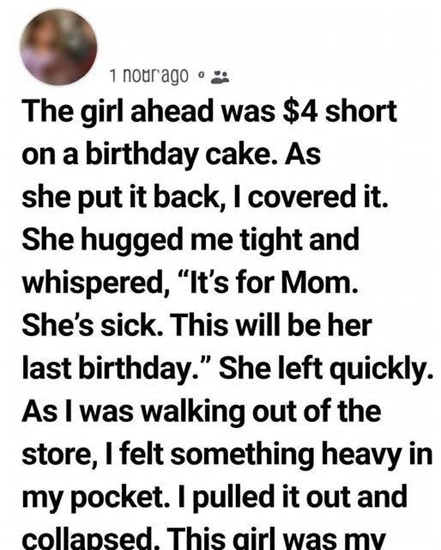
Stories about small acts of kindness often attract attention because they reflect situations that could happen during an ordinary day. A person is standing in a checkout line, another customer realizes they are a few dollars short, and someone nearby quietly offers to cover the difference. There is nothing extraordinary about the setting, yet the interaction can become meaningful because of the circumstances surrounding it. In the account described here, a young girl carrying a birthday cake reportedly found herself unable to pay the full amount.
What followed became a reflection on generosity, empathy, and the importance of noticing people around us. It is important, however, to distinguish an emotional narrative from independently verified reporting. The specific grocery-store encounter described in the original account is not accompanied by enough independently verifiable information to establish every detail as documented fact. For that reason, it is more responsible to present the story as a personal or illustrative account rather than claim that it is confirmed news.
The broader themes do not require exaggeration to be meaningful. Helping someone with a small purchase, responding compassionately to another person’s difficulty, and treating strangers respectfully are all ordinary actions capable of having genuine emotional significance. The setting could hardly have been more routine. Customers were moving through the aisles, employees were handling their usual responsibilities, and people waited for their turn at the checkout.
Most shoppers were probably focused on their own errands and what they needed to accomplish before leaving. In an environment like that, it is easy to pay little attention to strangers. Yet ordinary places are often where small opportunities for kindness arise precisely because people with very different circumstances briefly find themselves sharing the same space.
According to the narrative, a young girl was waiting in line with a birthday cake. At first, there was no obvious reason for anyone nearby to pay particular attention to her. She was simply another customer preparing to make a purchase. Only when she reached the payment stage did it become apparent that something was wrong. She reportedly did not have enough money to cover the complete cost of the cake.
Being short by even a few dollars can be uncomfortable, particularly when other customers are waiting behind you. Adults frequently experience embarrassment in similar situations, and that feeling may be even more difficult for a young person handling a purchase independently. The account describes the girl becoming visibly disappointed and preparing to step away rather than create a scene. Whether every emotional detail can be independently confirmed is unknown, but the situation itself is easy to understand.
A nearby shopper then reportedly offered to pay the small remaining amount. The important part of the gesture was its simplicity. There was no expectation of repayment and no complicated arrangement. One person saw that another needed a modest amount of assistance and decided they could provide it.
Financial generosity should always remain voluntary and appropriate to someone’s own circumstances. Nobody has an obligation to pay for another customer’s purchase simply because they witness a difficult moment. But when someone freely chooses to help and can comfortably afford to do so, a relatively small amount of money can occasionally make an immediate difference for another person.
The girl’s reaction gave the encounter greater emotional significance in the original telling. She reportedly expressed surprise and gratitude after realizing the cake could still be purchased. The narrator then says the girl explained that the cake was intended for her mother, who was ill. That additional information transformed what initially appeared to be a simple shortage of money into a more emotionally complicated situation.
Because the mother’s illness is not independently documented in the material provided, it would be inappropriate to invent a diagnosis, prognosis, or additional medical circumstances. The responsible version of the story goes no further than the account itself. The girl reportedly said her mother was sick, and the cake was meant to bring some happiness to her birthday. Everything beyond that would be speculation.
That distinction matters because emotional stories often become increasingly dramatic as they circulate online. One version may say that someone was ill. A later retelling may add hospitalization, a serious diagnosis, or even claim it was someone’s final birthday without providing evidence. Each addition makes the story more powerful emotionally but potentially less accurate.
Responsible storytelling avoids that pattern. If a detail is unknown, it should remain unknown. The emotional significance of buying a cake for an unwell parent is already understandable without inventing circumstances designed to make readers feel more distressed.
The narrator describes the encounter as changing the atmosphere of an otherwise ordinary shopping trip. After the girl left, routine surroundings reportedly felt different. The shelves, checkout counters, employees, and other shoppers were exactly as they had been moments earlier, but the narrator’s attention had shifted toward the lives unfolding around them.
This reaction illustrates a broader truth about everyday social interactions. People frequently share public spaces without knowing what anyone else is experiencing privately. Someone standing quietly in a checkout line could be celebrating a birthday, worrying about a relative, recovering from disappointing news, rushing to work, or simply buying dinner. Appearance alone rarely provides enough information to understand another person’s circumstances.
Recognizing that uncertainty can encourage empathy without requiring assumptions. Compassion does not mean deciding that every stranger must secretly be experiencing a tragedy. It simply means acknowledging that other people have circumstances we may not know and treating them with basic consideration.
Small acts of kindness can take many forms that involve no money at all. Holding a door, returning a lost item, helping someone reach something on a shelf, allowing a person with only one item to move ahead in line, or speaking patiently to someone who appears confused can all make everyday interactions easier. None of these actions needs to become a dramatic social-media story to have value.
Sometimes kindness simply means avoiding unnecessary judgment. If someone is struggling with a payment terminal, moving slowly, or having difficulty communicating, impatience can make the situation more stressful. Offering a few extra seconds of patience may be more useful than immediately assuming the person is careless or inconsiderate.
The grocery-store story also highlights the difference between generosity and recognition. Paying a small difference for someone’s cake is generous, but noticing the problem in the first place requires attention. Modern public environments are full of distractions. People look at phones, think about schedules, answer messages, and mentally plan the next part of their day.
As a result, opportunities to help can pass unnoticed. This does not mean people should constantly monitor strangers or intervene in private situations. Respecting boundaries is equally important. The useful principle is simply to remain aware enough to recognize when someone clearly needs assistance and when offering help would be appropriate.
When helping a stranger, preserving their dignity matters. Assistance should not be offered in a way that humiliates the recipient or turns their difficulty into a performance. Quietly asking whether help would be useful gives the other person an opportunity to accept or decline.
This becomes particularly important when money is involved. A person may not want financial assistance, even when an observer believes they need it. Asking respectfully is preferable to making assumptions. Kindness works best when it recognizes the other person’s autonomy.
The same principle should apply when sharing these encounters online. Photographing someone during a vulnerable moment without permission can transform assistance into unwanted exposure. A good deed does not require identifying the recipient publicly, and protecting someone’s privacy may be part of treating them respectfully.
The original story is powerful partly because the gesture reportedly remained simple. Someone noticed that a young shopper could not complete a purchase and covered the difference. The girl thanked the person and left with the cake. The narrator was then left thinking about why such a modest interaction had produced such a strong emotional response.
One explanation is that kindness can interrupt routine. People become accustomed to moving through daily responsibilities efficiently. Unexpected generosity breaks that pattern and briefly reminds everyone involved that public spaces are shared by people rather than merely occupied by anonymous strangers.
The amount of assistance does not necessarily determine its emotional value. Four dollars may be insignificant to one person and important to another at a particular moment. A few minutes of someone’s time can likewise be trivial to the person giving it while being extremely useful to someone who needs assistance.
This does not mean small gestures always produce dramatic outcomes. Most acts of kindness probably disappear into everyday life without creating a memorable story. Someone receives directions, another person holds an elevator, and both continue with their day. Their modest scale does not make them worthless.
There is also no need to describe kindness as a guarantee of future reward. Helping another person does not ensure that something good will later happen to the person who offered assistance. Generosity can simply be valuable because it reduces another person’s difficulty in that particular moment.
Likewise, kindness should not be confused with ignoring personal safety or reasonable boundaries. People can be compassionate while remaining cautious. Nobody needs to provide money, transportation, personal information, or access to their home merely because another person asks. Healthy generosity can coexist with sensible judgment.
For children and teenagers, situations involving strangers require additional care. An adult can help with a small public transaction without attempting to obtain private information or move the interaction somewhere isolated. Keeping assistance simple, visible, and appropriate protects everyone involved.
The story also invites reflection on assumptions about financial hardship. Being unable to pay for one purchase does not tell us someone’s entire economic situation. A payment card can fail, cash can be misplaced, prices can be misunderstood, or someone may simply have brought slightly less money than expected. One moment at a checkout counter is not enough information to define another person’s life.
This is why respectful language matters. The girl in the account does not need to be described as helpless, impoverished, or desperate unless those circumstances are actually established. She was reportedly short of the amount required for one purchase. That is the information available.
Similarly, the narrator does not need to be portrayed as a hero. Paying a small difference at a checkout is a considerate action, but turning ordinary generosity into self-congratulation can distract from the more useful lesson. The value lies in one person recognizing another person’s immediate need and responding appropriately.
The account becomes more relatable when viewed this way. Most people will never encounter a dramatic opportunity to transform a stranger’s entire life. They may, however, encounter countless smaller moments when patience, generosity, or simple courtesy can make someone’s day slightly easier.
These moments can happen at grocery stores, schools, workplaces, restaurants, public transportation stops, and countless other ordinary locations. They are rarely planned. Someone simply notices what is happening and makes a choice about how to respond.
That choice can sometimes influence observers as well. Seeing another person behave generously may encourage others to reconsider how they react in similar circumstances. This does not require turning kindness into a competition. It simply demonstrates that considerate behavior can contribute to a more respectful social environment.
The emotional element involving the birthday cake adds another dimension. Birthdays often carry symbolic importance because they provide opportunities for families and friends to express affection. A cake is an ordinary object, but in the context of a celebration it can represent effort, tradition, and the desire to make someone feel remembered.
If the girl’s mother was indeed unwell, as the account states, preparing even a small birthday celebration may have felt especially important to her. The cake itself would not solve whatever difficulty the family was facing. It could, however, contribute to a moment of normality and connection.
That is one reason seemingly minor purchases can carry meanings invisible to outside observers. A bouquet may be intended for someone recovering from illness. A small toy could be a birthday present bought with carefully saved money. Groceries may be intended for an elderly neighbor. The object alone does not reveal the story behind it.
This does not mean every purchase should be interpreted sentimentally. Most shopping is exactly what it appears to be. The point is simply that context can change the significance of an ordinary object, and strangers rarely have access to all of that context.
The narrator’s reflection afterward therefore becomes more meaningful than the monetary transaction itself. The experience reportedly served as a reminder that kindness does not always require a grand plan. Sometimes it begins by paying attention.
There is an equally important second lesson: emotional stories deserve factual care. A narrative can encourage compassion without presenting unverified details as established truth. If an account cannot be independently confirmed, it should be described as a personal story or illustrative narrative rather than as documented news.
That approach does not weaken the message. In fact, transparency can make a story more trustworthy. Readers can engage with its themes without being misled about what has or has not been verified.
The broader principle remains simple. People routinely encounter strangers whose circumstances they do not fully understand. Responding with patience and respect costs little, and when an appropriate opportunity to help arises, even modest assistance can matter.
The grocery-store encounter described here may be small compared with the dramatic events that dominate headlines. There was no extraordinary rescue and no reason to invent one. There was reportedly only a young girl, a birthday cake, a small shortage at the register, and another person willing to cover the difference.
Yet that simplicity is precisely why the story resonates. Kindness is often portrayed as something exceptional, when in practice it can consist of ordinary people making thoughtful decisions during ordinary moments.
Whether the gesture is worth a few dollars, a few minutes, or simply a little patience, its significance depends on the circumstances. We rarely know exactly what another person is carrying into an interaction.
The most useful takeaway is therefore not that every checkout-line encounter hides an emotional story. It is that slowing down before judging others can leave room for understanding. When appropriate, a small act of assistance may mean more to someone than its size would suggest.
And sometimes, after the person has walked away and the ordinary day continues, the person who offered the help may discover something unexpected as well: that a modest moment of generosity can remain memorable long after the receipt, the shopping bags, and the few dollars involved have been forgotten.
