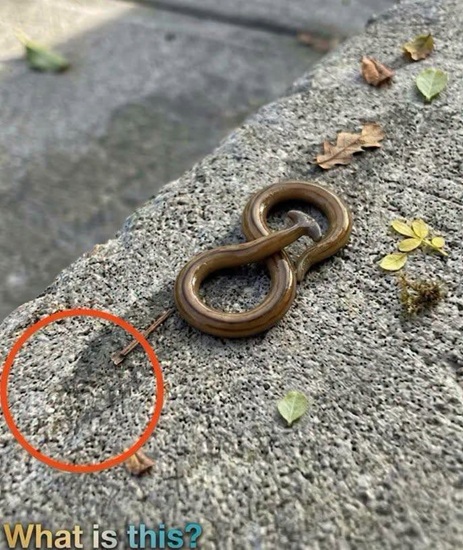
An ordinary morning outdoors can become surprisingly memorable when something unfamiliar appears in a familiar place. In the account described here, a long, dark creature was noticed slowly moving across damp soil shortly after sunrise. At first glance, it looked enough like an earthworm that there seemed little reason for concern. A closer look, however, revealed several unusual characteristics, particularly its smooth movement and broad, flattened head.
Those features are consistent with terrestrial flatworms commonly called hammerhead worms or hammerhead flatworms, although identifying an exact species would require a clear photograph or specimen rather than description alone. These animals belong to a group of land planarians, and several species have become established outside their native ranges. The initial confusion with an earthworm would be understandable.
Both animals can be long, soft-bodied, and commonly encountered on damp ground, particularly after rain or when humidity is high. Yet hammerhead flatworms are biologically quite different from earthworms. They belong to the flatworm phylum Platyhelminthes rather than the segmented-worm group that includes familiar earthworms. Their bodies often appear flattened and glossy, and certain species have stripes extending lengthwise along the body. The most recognizable feature of many Bipalium species is the expanded head, which can look like a hammer, shovel, crescent, or half-moon.
That unusual head is probably what would make someone stop and take another look. A typical garden earthworm has no broad, dramatically expanded head of this kind. Some hammerhead flatworms instead possess a distinct semicircular or fan-shaped anterior end that is wider than the remainder of their bodies. Bipalium kewense, one widely established species, is described as having a narrow, snake-like body and a rounded hammer-shaped head, often with longitudinal dark stripes. The species can grow surprisingly long, although size varies among individuals and species.
Their movement also provides another clue. Earthworms move partly through coordinated muscular contractions acting against the segments of their bodies. Land planarians instead glide over surfaces using mucus and microscopic hair-like structures on the underside of the body. To an observer, the result can appear unusually smooth, almost as though the animal is sliding rather than crawling in the familiar way expected from an earthworm. A hammerhead worm moving slowly across a wet patio, garden bed, or patch of soil can therefore look particularly unusual.
Moist conditions suit terrestrial flatworms because their soft bodies are vulnerable to drying. They are often encountered in humid environments, beneath logs, rocks, flowerpots, leaf litter, or other sheltered places where moisture persists. They may become more noticeable following rain or during periods of high humidity. This is one reason discovering one on damp ground early in the morning would not be especially surprising from a biological perspective. The animal may look exotic, but several introduced hammerhead flatworms have existed in parts of North America for many decades.
The U.S. National Invasive Species Information Center identifies Bipalium kewense as a species native to Southeast Asia that was introduced into the United States through movements of plants and soil. Records place its U.S. introduction in the late nineteenth century, meaning these animals are not a brand-new arrival despite periodic waves of alarming social-media posts. They can be transported unintentionally through nursery plants, soil, landscaping materials, and other human activities. Once introduced into sufficiently warm and moist environments, they may establish local populations.
Hammerhead flatworms are predators rather than plant-eating garden worms. Depending on the species, terrestrial planarians can feed on earthworms and other soft-bodied invertebrates, including slugs and snails. Bipalium kewense is particularly known for preying on earthworms. This feeding behavior is one reason scientists and agricultural agencies pay attention to introduced land planarians: predators introduced to a new ecosystem can potentially influence populations of other soil organisms. However, the scale of ecological impact varies, and dramatic claims that every individual hammerhead worm will devastate an entire garden go beyond what the evidence establishes.
Their hunting behavior can also explain why the flattened head may seem to move from side to side. Land planarians use sensory structures to explore their surroundings and locate potential prey. To someone watching for the first time, the movement may look as though the worm is deliberately sweeping the ground with its head. There is no need to describe the behavior as aggressive toward people. These animals are predators of much smaller soil organisms, not creatures that chase humans through gardens.
One part of the hammerhead-worm story deserves particular care because sensational online coverage often exaggerates it. Some land planarians, including certain Bipalium species, have been found to contain tetrodotoxin, the potent compound famously associated with pufferfish. That does not mean a hammerhead worm behaves like a venomous snake or injects poison into people. Maine’s Board of Pesticides Control notes that they do not have a mechanism for injecting the toxin into humans or pets, while still recommending caution with handling. The sensible approach is simply to avoid unnecessary bare-handed contact and wash exposed skin if contact occurs.
Finding one therefore does not justify panic. Keeping some distance, as described in the account, is perfectly reasonable while attempting to identify an unfamiliar organism. A photograph taken without touching the animal is often more useful than immediately trying to pick it up. Clear images of the head, overall body shape, stripes, and approximate size may help an extension specialist or other qualified identifier distinguish between species.
Species identification can matter because “hammerhead worm” refers to multiple terrestrial flatworms rather than one identical organism everywhere. Different species can vary in coloration, markings, size, and geographic distribution. For example, Bipalium kewense is commonly described as light brown or honey-colored with several dark stripes and a distinctive head, but another land planarian could have different markings. A verbal description such as “long, dark, glossy, and shovel-headed” supports a reasonable identification at the group level, but it does not establish an exact species with certainty.
One unusual feature of some land planarians is their ability to regenerate after injury. For that reason, simply cutting an unwanted hammerhead flatworm into pieces is not recommended as a control method. Government guidance specifically cautions that fragmentation can allow some of these worms to regenerate rather than providing an effective solution. Anyone concerned about an introduced land planarian should follow guidance from their state agriculture or extension service rather than improvising disposal methods found in viral posts.
Another reason to resist immediate conclusions is that not every long flat organism outdoors is a hammerhead worm. Native flatworms, leeches, slugs, unusual earthworms, caterpillars, and other invertebrates can sometimes be mistaken for one another in photographs. Lighting can also distort color, while perspective can make the head appear broader than it really is. Identification works best when several characteristics match, rather than relying on a single feature.
The described combination is nevertheless distinctive: a long terrestrial animal moving smoothly over moist ground, a relatively flat glossy body, longitudinal markings, and a broad shovel- or hammer-shaped head. Those characteristics strongly suggest a hammerhead land planarian rather than an ordinary earthworm. The responsible wording is still “consistent with” or “likely,” however, unless a qualified identifier has examined a good photograph or specimen.
If someone finds a suspected hammerhead worm, photographing it and noting where it was seen can be useful. Depending on the location, state agricultural departments, invasive-species programs, or university extension services may provide identification or reporting advice. Requirements vary by jurisdiction, so one universal reporting instruction should not be assumed to apply everywhere.
The encounter also illustrates how quickly unfamiliar wildlife can seem threatening simply because its appearance does not match what we expect. Most people recognize earthworms immediately. Replace the ordinary rounded front with a wide, crescent-shaped head and smooth gliding movement, and suddenly the animal can appear almost artificial or alien. Yet the unusual appearance reflects an established group of terrestrial flatworms rather than evidence of a newly discovered “mutant” creature.
Social media can amplify that confusion. Photos of hammerhead worms are sometimes accompanied by alarming language suggesting that a mysterious new organism has suddenly appeared. In reality, Bipalium kewense has been documented in the United States for more than a century, and other introduced terrestrial flatworms have also been recorded across portions of North America. That does not mean introduced species should be ignored; it simply means concern should be based on accurate biology rather than frightening headlines.
The safest response to an unusual outdoor organism is therefore straightforward. Do not handle something unfamiliar unnecessarily, particularly with bare hands. Take a clear photograph, observe its characteristics, and compare the information with reliable sources rather than relying exclusively on social-media comments. If accurate identification matters, an extension specialist or relevant biological authority can provide better guidance than speculation.
What initially appeared to be a strange worm moving through the morning soil can consequently become an interesting lesson in local ecology. The flattened head, glossy body, smooth movement, and unusual proportions are all clues pointing toward a terrestrial flatworm. The animal may be introduced and ecologically noteworthy, but it is not a supernatural creature and should not be described as an immediate threat to anyone simply walking nearby.
Sometimes the most useful response to something unfamiliar is exactly what this account suggests: stop, observe, take a photograph, and investigate before making assumptions. A creature that looks unsettling for the first few seconds may become considerably easier to understand once its biology is known. In this case, the strange visitor was most likely not an unusual earthworm at all, but a member of the remarkable group commonly known as hammerhead flatworms—an organism worth identifying carefully rather than fearing unnecessarily.
