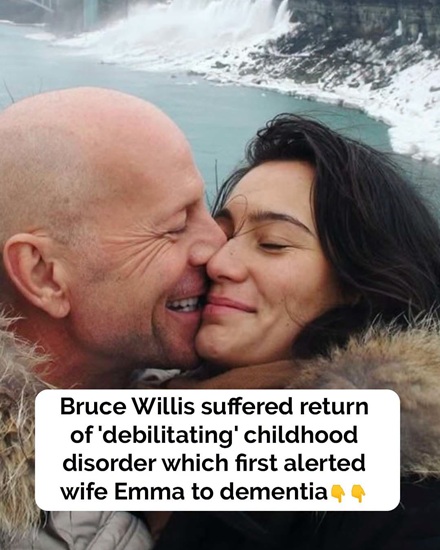
Emma Heming Willis has continued speaking openly about life alongside her husband, Bruce Willis, as their family navigates his diagnosis of frontotemporal dementia, or FTD. In a recent conversation with Hoda Kotb, Emma reflected on the complicated emotions of caregiving, including the guilt she sometimes experiences when allowing herself moments of celebration. She also discussed one early change in Bruce’s communication that, in hindsight, took on greater significance: the return of a severe stutter he had learned to manage after struggling with it as a child.
Bruce’s family first announced in March 2022 that he was stepping away from acting after being diagnosed with aphasia, a condition affecting communication. In February 2023, the family provided a more specific update, announcing that his condition had progressed and that doctors had diagnosed him with FTD. At the time, the family explained that communication difficulties were only one possible part of the disease and expressed relief at finally having greater clarity about what Bruce was facing.
FTD is not simply another name for Alzheimer’s disease. It refers to a group of disorders associated primarily with degeneration of the frontal and/or temporal regions of the brain. Depending on the form and progression, FTD can affect language, behavior, personality, judgment and movement. The Association for Frontotemporal Degeneration notes that symptoms vary substantially among individuals and can change as the disease progresses.
That distinction has become an important part of Emma’s advocacy. She has repeatedly tried to explain that dementia does not always begin with the kind of memory loss many people automatically associate with Alzheimer’s disease. In Bruce’s case, Emma has said that communication and language changes were among the things that initially stood out to the family.

Looking backward can be emotionally difficult, particularly because some early changes did not initially seem like evidence of a neurological disease. Bruce had lived with a stutter since childhood and had developed ways of managing it throughout his adult life. Because that history was already familiar to those closest to him, changes in his speech could initially be understood through the context of something he had dealt with for years.
Emma has described Bruce’s childhood stutter as severe and debilitating. Although it never simply vanished, he became skilled at managing it. That history makes his decades-long career particularly remarkable: Bruce became internationally famous in a profession where speaking, timing and communication were central to his work.
From Moonlighting to the Die Hard films and numerous other projects, audiences knew Bruce as an actor capable of moving between comedy, drama and action. His recognizable delivery became part of his screen persona. For Emma, therefore, seeing communication become increasingly difficult was especially striking.
During her recent conversation with Kotb, Emma explained that she eventually noticed Bruce was no longer managing his stutter as he previously had. At the time, however, she did not interpret that change as an early indication of the diagnosis that would eventually follow.
That hindsight is an important distinction.
Emma is describing what she observed in her husband’s individual experience. Her account should not be interpreted as evidence that a returning or worsening stutter generally means someone has FTD.
Stuttering has many possible characteristics and causes, and FTD cannot be diagnosed from one communication change. Bruce’s case involved medical evaluation that eventually led to a specific diagnosis. Someone experiencing new or worsening speech or neurological symptoms should seek appropriate medical assessment rather than trying to diagnose the cause from a celebrity’s experience.
Emma has acknowledged how surprising the eventual explanation was. The idea that Bruce’s changing communication could represent dementia was not something she had expected, particularly because the family had a familiar explanation available: the stutter he had managed for much of his life.
That experience illustrates one reason FTD can be difficult for families to recognize.
People commonly associate dementia with forgetting names, places or familiar faces. While memory difficulties can occur in various neurological conditions, FTD may initially present differently. Depending on which areas of the brain are affected, early changes can involve language, behavior or executive functioning rather than the classic memory-centered picture people often imagine.

Bruce’s family initially had the diagnosis of aphasia before receiving the more specific FTD diagnosis. Aphasia describes difficulties involving language and communication; it does not by itself identify a single underlying disease. The family’s 2023 statement explained that Bruce’s condition had progressed and that FTD provided a clearer diagnosis.
Since then, Emma has increasingly used her public platform to discuss caregiving and FTD awareness.
Her advocacy has included another subject that caregivers frequently struggle with: guilt.
Emma turned 50 in June 2026. Under ordinary circumstances, such a milestone might naturally call for a celebration. Yet she told Hoda Kotb that she initially was not sure she wanted to mark the occasion because she had not felt particularly celebratory amid everything happening in her family.
A friend encouraged her not to allow the milestone to pass completely unnoticed.
Emma eventually reconsidered.
She realized that she did not want to look back and wonder why she had allowed her 50th birthday to disappear without acknowledging it. She decided to celebrate with people close to her, describing a relatively intimate gathering centered around simple things she wanted: friends, tacos and a margarita.
Even then, the emotional conflict remained.
Emma said guilt is something she continues to wrestle with. She has learned, however, that carrying guilt does not necessarily help either the caregiver or the person receiving care.
Instead, she returns to a question that has become important to her:
What would Bruce want for her?
From everything she knows about her husband, Emma believes he would want her to celebrate her life and enjoy time with friends and family. She has described Bruce as spontaneous, warm, charismatic and full of life—qualities she remembers from the earliest period of their relationship.
The couple first met in Los Angeles in 2005 and eventually began dating after Emma’s previous engagement ended. They publicly appeared together by 2008 and married in 2009. They share daughters Mabel and Evelyn, while Bruce also has daughters Rumer, Scout and Tallulah with his former wife Demi Moore.
The extended family has presented a notably united public response to Bruce’s illness. When his FTD diagnosis was announced in 2023, the statement was signed by Emma, Demi and all five of Bruce’s daughters. They thanked the public for its support while asking for continued compassion and understanding.
The family also expressed hope that Bruce’s diagnosis could bring greater attention to FTD.
That awareness remains important because there is currently no treatment that stops or reverses the underlying progression of FTD. The Association for Frontotemporal Degeneration states that there is presently no cure and no way to prevent its onset, although supportive care can help address symptoms and quality-of-life needs.
At the same time, Bruce’s personal medical situation should not become a subject for unsupported speculation.
AFTD specifically advised media organizations after the family’s announcement not to speculate about symptoms Bruce may or may not be experiencing beyond what his family has chosen to disclose. That guidance remains important when discussing a progressive neurological disease involving a public figure.
Emma’s own descriptions provide enough insight without attempting to fill in private details.
She has spoken about communication changes.
She has discussed the return of Bruce’s stutter.
She has described caregiving and the complicated emotions surrounding it.
And she has tried to help people understand that FTD can look different from common assumptions about dementia.
Her comments about Bruce’s stutter are particularly poignant because hindsight can make earlier events appear much clearer than they did when they were happening.
Before the diagnosis, a returning communication difficulty had an existing explanation.
Bruce had struggled with stuttering before.
He had spent years learning to manage it.
When that ability began changing, Emma could not reasonably know simply from observing it that a progressive neurological disorder was responsible.
This is also why her experience should not be transformed into a message that caregivers should have recognized everything sooner.
Neurological diseases can be complicated, and diagnosis can require time and specialist assessment. Symptoms may overlap with other medical conditions or appear to resemble characteristics a person has experienced previously.
Emma’s reflections instead offer a window into what it feels like to understand earlier moments differently after receiving a diagnosis.
Her comments about guilt reveal a similar process.
Caregiving can coexist with birthdays, friendships, family gatherings and moments of happiness. Emma’s decision to celebrate turning 50 did not mean that Bruce’s condition suddenly mattered less.
For her, it meant recognizing that continuing to live her own life was something she believed her husband would want.
Bruce himself has long been associated publicly with an energetic approach to life. Emma recently recalled one of his characteristic expressions: “Live it up.” She said she tries to carry some of that spontaneity into life with their daughters.
That sentiment appears to have influenced how she approached her birthday.
Rather than viewing celebration and caregiving as opposites, she allowed both realities to exist at once.
There could be sadness.
There could be guilt.
And there could still be an evening with family and friends.
For families affected by FTD, Emma’s public conversations may also help challenge misconceptions about dementia. Not every form begins in exactly the same way, and not every person’s symptoms follow an identical progression.
Bruce Willis’ experience belongs specifically to Bruce Willis.
His returning stutter was something Emma noticed in retrospect as part of a larger pattern that eventually received medical explanation. It should not become a diagnostic checklist for other people.
What can be taken from her story is something more measured.
Significant or persistent changes in communication, behavior, movement or cognitive functioning deserve medical attention, particularly when they represent a noticeable departure from someone’s usual abilities.
For Emma, understanding came gradually.
First there were changes that seemed puzzling but potentially explainable.
Then came the aphasia diagnosis and Bruce’s retirement from acting.
Finally, the family received the more specific diagnosis of frontotemporal dementia in 2023.
Years later, Emma continues navigating that reality while raising their daughters, supporting her husband and speaking publicly about caregiving.
She has not pretended that the process is easy.
Her comments about guilt make that particularly clear.
But she has also emphasized that caregivers remain people with lives, relationships and milestones of their own.
Her 50th birthday became one example.
She initially wondered whether celebrating was appropriate.
Eventually, she asked herself what Bruce would have wanted.
The answer allowed her to make room for joy without pretending the difficult circumstances surrounding her family had disappeared.
And perhaps that is one of the most important themes in Emma Heming Willis’ recent reflections: caregiving can contain love, grief, responsibility, uncertainty and happiness simultaneously.
Bruce’s diagnosis changed their family’s life.
It did not erase everything that came before it.
Nor, in Emma’s view, does it require the people who love him to stop living while they continue caring for him.
