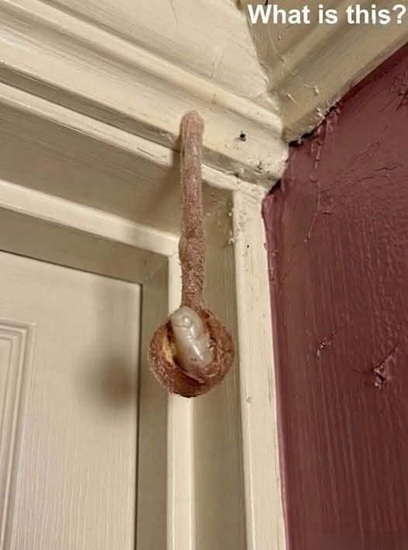
Imagine checking into a quiet hotel after a long journey, placing your suitcase beside the bed and expecting nothing more unusual than a peaceful evening. The room appears completely ordinary at first: clean sheets, a window overlooking the surrounding landscape, heavy curtains and the familiar collection of furniture found in countless hotels. Then, while moving one of the curtains, you notice something unexpected near the upper corner of the window. Attached firmly to the wall is a small structure made almost entirely from dried mud.
The first reaction might understandably be concern. Finding an unfamiliar insect structure indoors can make people wonder whether they have discovered a dangerous infestation. Yet appearances can be misleading. Certain solitary wasps known collectively as mud daubers construct distinctive nests from mud, sometimes choosing sheltered locations around human buildings. Depending on the species, these nests can appear as elongated tubes, rounded cells or compact masses of dried mud attached to protected surfaces.
Mud daubers are not a single species but a general name applied to several kinds of solitary wasps that use mud when constructing nests. Unlike familiar social wasps that live together in colonies, individual female mud daubers generally build and provision their own nests. This difference in social behavior is important because mud daubers typically do not defend large colonies in the way some social wasps can.
A female mud dauber begins the construction process by locating an appropriate source of moist soil. She gathers a small amount of mud, carries it to the selected nesting location and gradually shapes it into a chamber. The process is repeated again and again until the structure takes form. To a human observer, the finished result can look surprisingly deliberate, almost like something assembled by a miniature mason.
The location is usually selected for practical reasons rather than because the insect is interested in people. Protected surfaces can shield the nest from rain and other environmental conditions. Eaves, sheds, garages, barns and sheltered parts of buildings can therefore provide suitable locations. Occasionally, an insect may gain access to an indoor or semi-enclosed space and construct a nest somewhere people do not expect to find one.
The inside of the nest is even more interesting than its exterior.
Mud daubers typically provision their nest cells with prey, particularly spiders. Depending on the species, a female captures spiders and uses her sting to immobilize them rather than immediately consuming them. The spiders are then placed inside the mud chamber as a food source for the developing offspring.
An egg is deposited in the provisioned cell before the chamber is sealed.
After hatching, the developing larva has access to the stored prey. It feeds and continues developing inside the protected chamber. Eventually, after completing its development, the new adult emerges from the nest.
This life cycle explains why an apparently abandoned lump of dried mud may actually contain an active developmental chamber.
Mud-dauber nests can also reveal clues about whether they are currently occupied. Holes in older nests can indicate that adult wasps have already emerged, although identifying the exact status of a nest is not always straightforward without closer examination.
Their use of spiders also gives mud daubers an ecological role as predators. They are part of the larger network of predator-and-prey relationships that helps shape insect and spider populations in an ecosystem.
However, describing them as completely harmless would go too far.
Mud daubers possess stingers, and a sting is possible. They are generally considered less defensive around their nests than many social wasps, but people should still avoid deliberately grabbing, crushing or provoking them. Anyone with a history of serious reactions to insect stings should exercise particular caution around unfamiliar wasps.
This is why discovering an insect nest in a hotel room should not become an invitation to investigate it with bare hands.
A guest who encounters one can simply keep some distance and inform hotel staff. Management can then determine whether pest-control or wildlife professionals need to inspect the structure and decide on an appropriate response.
There is another reason not to destroy an unfamiliar nest immediately.
Correct identification matters.
Not every structure that looks vaguely similar belongs to the same type of insect. Different wasps and other organisms have different behaviors and potential risks. Someone unfamiliar with insect identification can easily mistake one species for another.
A photograph taken from a safe distance can sometimes help a knowledgeable professional identify what has been discovered.
What makes mud daubers particularly fascinating is the amount of biological behavior hidden inside such an unassuming structure. To most people, mud is simply soil mixed with water. To these insects, it becomes construction material capable of protecting the next generation.
There are no architectural drawings.
There is no construction crew.
The behavior is driven largely by instinct refined through evolution.
Yet the finished structure can be remarkably functional.
This is one reason encounters with insects can become opportunities for curiosity rather than immediate fear. Many animals living around homes and buildings are not actively trying to interact with people. They are searching for food, shelter or suitable places to reproduce.
Human structures unintentionally create countless miniature habitats.
A gap underneath an eave can become shelter.
A porch light can attract insects at night.
A quiet corner protected from rain can become a nesting location.
Even a building designed entirely for human use can therefore become part of a much larger ecological landscape.
For a hotel guest, discovering such a structure would certainly be surprising. It could also indicate that staff need to inspect the room and determine how the insect entered. Hotels have responsibilities concerning cleanliness and guest comfort, so reporting the discovery would be appropriate.
That practical response does not prevent someone from appreciating the biology involved.
Looking closely—without touching—can reveal layers of dried mud and the distinctive shape of the structure. Something that initially resembles a random clump of dirt may represent repeated trips between a mud source and the nesting site.
The encounter can also illustrate why sensational descriptions of unfamiliar animals should be treated carefully.
A mysterious nest does not automatically mean a room contains an aggressive swarm.
Mud daubers are generally solitary rather than colony-forming insects. Their nesting behavior is substantially different from that of some social wasps whose nests can contain many workers.
At the same time, “generally less aggressive” should not be converted into “incapable of stinging.”
Responsible nature information leaves room for both facts.
The insect can be fascinating without being something people should handle.
The nest can be impressive without needing to remain inside an occupied hotel room.
Hotel staff can address the practical problem while guests appreciate the unexpected glimpse of natural behavior.
Perhaps that is the most interesting lesson from an encounter like this.
Nature does not stop at the boundary between wilderness and civilization.
Animals continually adapt to environments modified by people, sometimes using buildings in ways their human occupants never anticipated.
A mud structure beside a hotel window may initially appear unpleasant or alarming.
Once properly identified, however, it can reveal an intricate reproductive strategy involving construction, hunting and parental investment carried out by an insect small enough to pass almost unnoticed.
The appropriate response is neither panic nor careless handling.
It is awareness.
Observe from a safe distance, notify the people responsible for the property, and allow someone with appropriate knowledge to determine what should happen next.
Something unexpected in the corner of a room does not necessarily need a frightening explanation.
Sometimes the truth is considerably more interesting.
What looks like an ordinary patch of dried earth may actually be evidence of one of nature’s smallest builders quietly completing a complex life cycle alongside the human world.
