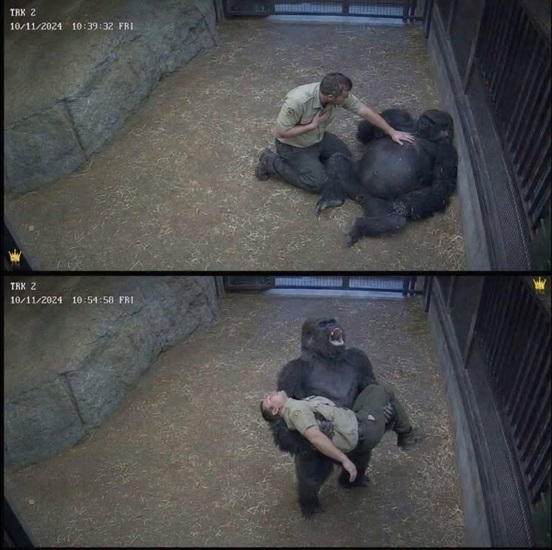
For years, Daniel had worked closely with a rescued gorilla at a fictional wildlife sanctuary. Their relationship had not developed through one dramatic encounter but through hundreds of ordinary days. Daniel helped prepare food, participated in enrichment activities and spent long periods observing the gorilla’s behavior. Over time, the animal became familiar with his voice, movements and routines. Daniel never described the relationship as friendship in exactly the human sense, but there was clear familiarity between them.
The gorilla knew when Daniel arrived and often responded differently to him than to unfamiliar people. One morning, Daniel arrived at work feeling unusually tired. He had noticed pressure in his chest earlier and experienced discomfort extending into one arm, but he initially convinced himself that it might pass. In this fictional story, he made the mistake of continuing his routine rather than immediately seeking medical help. The sanctuary day began normally, and Daniel moved through his usual responsibilities.
By the time he reached the gorilla’s area, however, the discomfort had become stronger. He stopped for a moment but still did not realize how serious the situation was. Daniel entered a protected keeper area used during supervised interactions and routine care. The gorilla approached as expected and watched him closely. Daniel began one of the familiar enrichment routines they had practiced many times before. A few moments later, he suddenly lost consciousness and collapsed. The change was immediate.
One second, the familiar caretaker was moving and responding normally; the next, he was lying motionless. For an animal accustomed to Daniel’s predictable behavior, the difference was impossible to miss. At first, the gorilla remained close and watched him. The animal touched Daniel carefully and moved around him while he remained unresponsive. When there was still no reaction, the gorilla became more vocal.
The calls were louder and more persistent than those employees usually heard during that part of the daily routine. Nearby sanctuary workers noticed the unusual sounds and began moving toward the area. They did not know immediately what had happened, but they understood that something inside the enclosure required attention.
When staff members reached the protected area, they saw Daniel on the ground and immediately activated the sanctuary’s emergency procedures. The gorilla was directed away from the access point so trained staff could enter safely. Employees checked Daniel’s condition and called emergency medical services. Within minutes, responders arrived and transported him to a hospital. In this fictional account, doctors determined that Daniel had experienced a serious cardiac event. Medical personnel emphasized that receiving treatment quickly was extremely important.
The gorilla did not diagnose Daniel’s condition and did not understand human emergency medicine. What the animal could recognize was that a familiar person had suddenly stopped behaving normally. Great apes are capable of learning routines, recognizing individuals and responding to changes in their social environment. In this fictional scenario, the gorilla’s unusual vocalizations helped attract the attention of people who were able to provide the medical assistance Daniel needed. The emergency response ultimately depended on trained sanctuary staff and medical professionals.
After Daniel recovered, colleagues told him what had happened during the minutes when he was unconscious. They explained that the gorilla had remained nearby, touched him and then vocalized strongly enough to attract attention. Daniel found the account deeply moving, but he also understood that it would be inaccurate to claim that anyone knew exactly what the gorilla had been thinking. The animal may have been confused, concerned, responding to an unusual situation or relying on learned social behavior. Human observers could describe the actions, but they could not prove the animal’s internal motivation.
That distinction mattered to Daniel because he had spent years learning not to automatically assign human thoughts to animal behavior. Animals can form strong social relationships and recognize familiar individuals without experiencing every situation exactly as humans do. A gorilla’s response can be meaningful without needing to be described as a conscious decision to perform a human-style rescue. In the fictional story, the most important fact is simply that the animal noticed a dramatic change and reacted in a way that attracted attention.
The experience also changed the way Daniel thought about the ordinary routines he had shared with the gorilla. Feeding schedules, enrichment sessions and quiet observation might have seemed repetitive from day to day, but those activities created familiarity. The gorilla knew what Daniel normally looked and sounded like when he entered the area. When that pattern suddenly disappeared, the difference was obvious. Long-term familiarity can make changes in behavior easier to notice, whether the observer is a human or another social animal.
Sanctuary staff also recognized that the successful outcome depended on preparation. The gorilla’s vocalizations may have alerted employees, but those employees still needed clear procedures for responding safely. Working around great apes requires strict separation protocols, trained personnel and careful control of access points. A medical emergency involving a caretaker cannot be handled by simply running into an enclosure. The fictional sanctuary therefore relied on established procedures that allowed the animal to be moved away before staff entered to help Daniel.
The story also offers a reminder about warning signs of medical emergencies. Chest discomfort combined with pain or numbness involving an arm can occur during a heart attack, although symptoms vary and other medical conditions can produce similar sensations. Someone experiencing possible heart-attack symptoms should not rely on assumptions about indigestion or wait for the problem to disappear. Emergency evaluation is important because rapid treatment can reduce the risk of severe complications. This fictional story should not be used as medical guidance for any specific individual.
Daniel later returned to the sanctuary after his doctors cleared him to resume work. His first days back were deliberately quiet. He followed medical advice, avoided unnecessary physical strain and allowed colleagues to handle more demanding responsibilities. When he eventually returned to the gorilla’s area, the animal responded to his presence with the same familiar attention shown before the emergency. There was no dramatic movie-like reunion. Instead, there was something much more consistent with their relationship: recognition and the return of an established routine.
For Daniel, that ordinary reaction was enough. He did not need to believe that the gorilla understood exactly what a heart attack was or had intentionally designed a rescue plan. The animal had noticed when something was wrong, reacted to the change and helped draw human attention to the situation. Staff members had then performed their jobs, and medical professionals had provided treatment. The outcome resulted from several events working together rather than from a single heroic act.
The fictional incident also illustrates why great apes generate so much interest among researchers and animal-behavior specialists. Gorillas live in complex social environments and communicate through vocalizations, gestures, posture and physical contact. They can recognize familiar individuals and learn routines through repeated experience. Those abilities do not make them human, but they do demonstrate sophisticated social awareness. Careful observation allows researchers to appreciate those abilities without exaggerating them into unsupported claims about human-style reasoning.
Animal stories can easily become distorted when they spread online. A real observation may gradually acquire invented dialogue, exact medical details or claims about an animal’s thoughts that nobody could actually know. Emotional versions often spread faster because they provide a clear hero and dramatic conclusion. Yet an animal’s behavior can be compelling without adding unsupported details. Describing observable actions accurately usually produces a stronger and more respectful account than pretending certainty about motivation.
That is particularly important when a story involves medical survival. Saying that an animal “saved” someone can sometimes hide the crucial role of emergency responders, trained staff and hospital treatment. In this fictional example, the gorilla’s behavior helped alert people, but the successful response required human intervention. Employees recognized the emergency, moved the animal safely, contacted paramedics and followed established procedures. Medical professionals then diagnosed and treated Daniel’s condition.
The relationship between caretakers and animals in accredited sanctuaries is also built around professional responsibility rather than casual physical companionship. Staff members use training, observation and enrichment to support animal welfare while maintaining safety boundaries. Great apes are extremely powerful animals even when they appear calm. Responsible facilities therefore rely on carefully designed protocols rather than assuming familiarity eliminates risk. The fictional bond between Daniel and the gorilla exists within that professional framework.
In the weeks that followed, Daniel became more attentive to his own health. He understood that dedication to animals did not require ignoring physical warning signs. His colleagues also reviewed their emergency procedures to make sure everyone knew what to do if a staff member became ill while working near an animal area. The incident became a reminder that animal care also requires protecting the people responsible for providing that care. A functioning sanctuary depends on both animal-welfare standards and human-safety planning.
The gorilla, meanwhile, returned to the routines that had existed before the emergency. There was food to forage for, enrichment activities to investigate and other members of the animal’s social environment to observe. The dramatic meaning humans attached to the incident did not need to become part of the gorilla’s life. For the animal, Daniel’s eventual return may simply have represented the restoration of something familiar. That interpretation remains appropriately cautious because even in a fictional account, the exact thoughts of an animal cannot be known.
The larger message of this fictional story is not that gorillas possess a supernatural ability to detect heart attacks. There is no such claim. The story instead explores something much simpler: social animals can notice when familiar patterns change. A caretaker who suddenly collapses behaves very differently from a person who normally speaks, moves and interacts predictably. An animal responding strongly to that change is plausible, but assigning a precise intention should still be avoided unless supported by controlled scientific evidence.
It is also worth distinguishing emotional storytelling from factual animal behavior. Terms such as loyalty, concern and affection can be useful descriptions in ordinary conversation, but scientific interpretation requires more caution. Researchers generally focus on observable behavior and controlled comparisons rather than assuming internal states from a single event. In this story, the gorilla touches an unresponsive caretaker and vocalizes. Those are observable fictional actions. The claim that the gorilla consciously understands a medical emergency would be an interpretation rather than a directly observable fact.
Daniel ultimately viewed the event as a powerful reminder of the familiarity built through years of patient care. The animal had become accustomed to his presence, and when that presence suddenly changed, the gorilla reacted. Human coworkers noticed the reaction and provided help. The chain of events depended on recognition, attention and emergency preparedness. None of those elements needs to be exaggerated for the story to carry meaning.
This is an original fictional story and does not describe a verified incident involving a caretaker named Julius or a real sanctuary. It does not claim that the publisher witnessed such an event, works with gorillas, represents a wildlife facility or speaks as a local voice from any community. It also does not present fictional medical details as real reporting. The scenario is intended as inspirational storytelling based on general knowledge that great apes are socially complex animals capable of recognizing familiar individuals and responding to changes in their environment.
