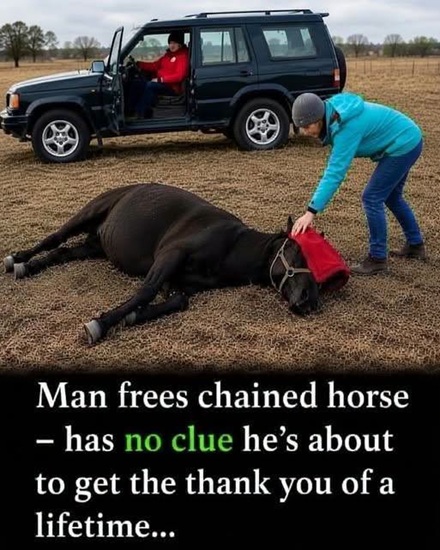
A widely shared animal-rescue video from Romania captured veterinarian Ovidiu Roșu helping a free-roaming horse whose movement had been severely restricted by a metal chain. The horse was found in the Letea area of the Danube Delta, a region known for its population of semi-feral horses. The restraint prevented the animal from moving normally and created a risk that the metal could injure its legs. Roșu approached the animal carefully and carried out the intervention in a controlled manner.
After the horse was immobilized, the chain could be removed without placing the animal or rescuers at unnecessary additional risk. The encounter later became widely known because of what happened immediately after the horse was freed. Footage associated with the rescue shows another horse approaching Roșu and making close physical contact with him. Many viewers interpreted the behavior as a gesture of gratitude or even described it as a “kiss.”
That interpretation is understandable from a human perspective, but it should not be presented as a scientifically established explanation of the horse’s intentions. Horses routinely communicate through body position, proximity, movement and physical contact. A brief nuzzle can occur in several social contexts and does not allow an observer to know exactly what an animal is thinking. The most accurate description is therefore that another horse approached and touched Roșu after the chained animal had been released.
The rescue also drew attention to a controversial form of restraint that has been documented in parts of Romania. Chains or other hobbles can be attached to a horse’s legs to restrict how far or how quickly the animal can move. Horse Illustrated reported in 2016 that unpadded metal chains can injure horses when they dig into the skin or are fitted too tightly. In the case involving Roșu, the animal’s restraint was serious enough that veterinary intervention was needed. Removing such equipment from a frightened free-roaming horse is not simply a matter of walking up with a pair of cutters. The size and strength of the animal mean that trained handling and veterinary judgment can be important for the safety of everyone involved.
Ovidiu Roșu’s involvement with horses in the Danube Delta was part of a much broader veterinary effort. FOUR PAWS documented him as one of the veterinarians working with the free-roaming horse population around Letea. His work included field immobilization, health examinations and fertility-control procedures intended to manage the population humanely. Research published in 2021 also lists Roșu as an author of a scientific study evaluating chemical immobilization methods for feral horses in Romania. That work reflects the practical difficulty of treating animals that cannot simply be approached and handled like accustomed domestic horses. Veterinary teams must balance the need for treatment with the risks associated with sedation and handling in open terrain.
The horses of the Danube Delta have a complicated history that makes simple labels such as “wild” incomplete. FOUR PAWS describes the population as semi-feral and notes that horses have lived in the region for centuries. Historical accounts cited by the organization connect part of the population’s ancestry with horses left in the region many centuries ago. The population also grew substantially after Romania’s communist system collapsed in 1989, when agricultural cooperatives changed and some working horses were left without their previous management. During the following decades, free-roaming horses reproduced across the Delta. Their increasing numbers eventually created both animal-welfare concerns and disputes about their effects on protected habitat.
The Letea Forest is a protected environment within the Danube Delta, and the expanding horse population became a conservation issue as well as an animal-welfare one. Romanian authorities and conservationists expressed concern that uncontrolled grazing could damage sensitive vegetation. At the same time, proposed methods for reducing the number of horses generated serious concern among animal-welfare organizations. The debate illustrated that protecting individual animals and protecting an ecosystem can sometimes require difficult decisions rather than simple slogans. Allowing a population to grow without management can create pressure on food resources and habitat. Removing animals through inhumane capture or slaughter, however, raises a separate set of welfare concerns.
Those tensions became particularly visible in 2011. FOUR PAWS says that more than 70 horses were rounded up in May of that year and were intended for transport to a slaughterhouse. The organization intervened and says it was able to stop the transport, eventually rescuing more than 40 animals. After approximately six months of care, the rescued horses were returned to the Danube Delta. The incident became a turning point in the organization’s involvement with the Letea horse population. Instead of relying on repeated removals, FOUR PAWS proposed a long-term population-management strategy based on fertility control.
Beginning in 2012, veterinary teams implemented a birth-control program for the free-roaming horses. One method used was immunocontraception with porcine zona pellucida, commonly abbreviated as pZP. The treatment is designed to temporarily reduce fertility in mares rather than permanently sterilizing every treated animal. Because the effect is not necessarily permanent, veterinarians must identify animals, administer treatment and return for follow-up work. The approach is therefore more complicated than a one-time intervention, but it allows population growth to be reduced gradually without mass killing. FOUR PAWS reports that Romanian veterinary teams used the program for more than a decade.
Population management was only one part of the work. The program also included veterinary treatment for sick, injured and older horses, along with monitoring of the herd. FOUR PAWS reported providing hay during periods when winter conditions caused shortages of available forage. Veterinarians also monitored the effects of fertility control and tracked changes in the population over time. These activities demonstrate why dramatic individual rescues represent only a small part of long-term animal-welfare work. Removing a chain can change one horse’s circumstances immediately, while maintaining a healthy population requires years of observation and repeated intervention.
The viral rescue involving Roșu is particularly memorable because it condenses that much larger issue into a brief human-animal encounter. Viewers can immediately understand that an animal unable to move freely because of a metal restraint needs assistance. The close contact from another horse afterward gives the footage an additional emotional dimension. Still, accurately describing the scene means avoiding claims about emotions that cannot be proven from the video. It is reasonable to describe the second horse as approaching or nuzzling the veterinarian. Calling the behavior definite gratitude, however, moves from observation into interpretation.
The distinction matters because animal behavior is often described online in strongly human terms. A horse can form social bonds, seek contact and respond to changes in the behavior of animals around it. Those facts do not mean humans can confidently assign a specific thought to every movement. A video can therefore be moving without needing an invented internal monologue for the animal. In this case, the observable events are already compelling: a restrained horse received veterinary help, its chains were removed, and another horse approached Roșu afterward. Keeping the description at that level preserves the emotional significance without turning interpretation into fact.
The situation surrounding the Letea horses also changed organizationally after more than a decade of FOUR PAWS involvement. The organization states that from 2025 onward it handed its equine programs in Romania and Jordan over to the relevant authorities. In Romania, the program had included work involving both working horses and the semi-feral horses of the Danube Delta. FOUR PAWS described the transition as the conclusion of a long period of direct involvement rather than an indication that the underlying welfare responsibilities had disappeared. Long-term horse management still requires monitoring, veterinary capacity and decisions about population size and habitat. The transition means that those responsibilities increasingly rest with Romanian institutions and local structures.
That handover also demonstrates why a single rescue should not be confused with a complete solution. Individual animals can require urgent intervention when injured or restrained, but the wider population presents different questions. Authorities must consider animal health, reproduction, available habitat and the condition of protected areas. Sustainable management also requires resources and continuity because fertility-control programs do not function without repeated monitoring. The experience in the Danube Delta shows how veterinary medicine, animal welfare and environmental management can overlap. None of those responsibilities disappears when a viral rescue video stops circulating online.
The terminology surrounding the horses deserves similar care. FOUR PAWS has sometimes used “wild horses” in public-facing material while also describing the Danube Delta animals more precisely as semi-feral or feral. True wild horses and populations descended substantially from domesticated horses are not biologically identical categories. The Letea horses live largely free from ordinary daily human management, which explains why they are commonly described as wild in popular coverage. Their history, however, includes domesticated ancestors and horses released or abandoned after major social and economic changes. Describing them as free-roaming or semi-feral therefore gives readers a more accurate picture.
Visitors who encounter free-roaming horses should also remember that these animals are not props for photographs. Even apparently calm horses can react quickly when frightened, crowded or approached too closely. Responsible observation means respecting distance and following guidance established for the protected area. Feeding wildlife or semi-feral animals can also change their behavior and encourage them to associate people with food. The famous rescue involved trained veterinary personnel working under circumstances that required intervention. It should not be interpreted as encouragement for untrained visitors to approach or physically handle free-roaming horses.
The story of Ovidiu Roșu and the chained horse remains powerful precisely because the confirmed events do not require exaggeration. A veterinarian working in Romania’s Danube Delta encountered an animal whose movement had been restricted by a harmful metal restraint and helped remove it. After the intervention, another horse approached and made physical contact with him. The episode took place against the background of a much larger effort to improve the welfare and management of the Letea horse population. That wider effort included veterinary treatment, population monitoring and a long-running immunocontraception program rather than relying solely on emergency rescues.
What began as a short rescue video therefore connects to a much broader history. The horses of the Danube Delta have been shaped by centuries of human activity, changing agricultural systems and the unique landscape in which they now roam. Their population has created genuine challenges involving both animal welfare and habitat conservation. The response developed over the past decade shows that those concerns do not necessarily require a choice between ignoring population growth and resorting immediately to mass killing. Veterinary care and fertility management offered another approach, although such programs require sustained effort. Their success depends on institutions continuing the work after the original organizations step back.
This account is based on publicly available reporting and information from FOUR PAWS about Ovidiu Roșu and the horses of Romania’s Danube Delta. It is written entirely from an outside, third-person perspective and does not claim that the publisher lives in Romania, witnessed the rescue, represents Romanian residents, or speaks for FOUR PAWS, local communities or government authorities. Interpretations of the horses’ emotions are distinguished from observable behavior, and the second horse’s contact with Roșu is not presented as scientifically proven gratitude. The article also uses “free-roaming” and “semi-feral” where appropriate rather than assuming that every horse in the population is a truly wild animal. The purpose is to describe the documented rescue and its broader context without inventing firsthand knowledge or presenting speculation as fact.
