At a remote mountain wildlife sanctuary, a scheduled public demonstration was meant to showcase the capabilities of trained working dogs in conservation and search support roles. Visitors had gathered to observe how K9 units assist handlers in tracking, detection, and safety operations in controlled environments. Among the participating professionals was an experienced handler, Elias Thorne, who had spent nearly two decades working alongside service dogs in various operational settings.
His partner for the demonstration was a highly trained Belgian Malinois named Blitz, known for discipline, responsiveness, and advanced scent detection skills. The event had been carefully structured with predefined scent trails and safety boundaries to ensure a smooth educational experience for attendees. Everything appeared routine at first glance, with staff coordinating logistics and visitors preparing for a standard demonstration.
However, as soon as the exercise began, Blitz’s behavior shifted in a way that immediately drew attention. Instead of following the designated scent path, the dog abruptly diverted toward a restricted area near the edge of the sanctuary grounds. His movement was focused and urgent, suggesting a strong external stimulus that was not part of the planned exercise.
Elias, recognizing that trained dogs rarely deviate without reason, quickly followed. The situation escalated when Blitz disappeared briefly into dense vegetation before returning with an unusual object. The moment immediately changed the tone of the demonstration from controlled training to an unplanned and serious situation requiring attention.
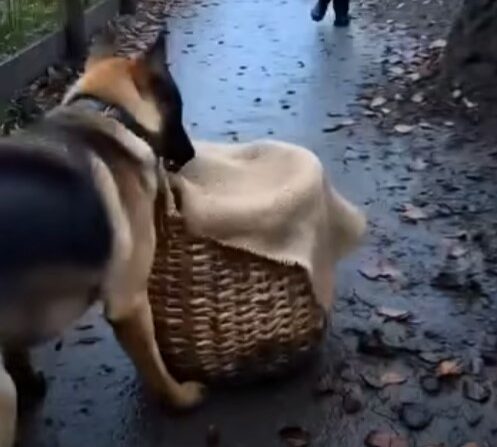
What Blitz retrieved was a worn, weathered basket that appeared out of place within the structured environment of the sanctuary. Its condition suggested prolonged exposure to outdoor elements, and it was reinforced in a manner that raised questions about its origin. Staff members and visitors quickly gathered as Elias approached the object with caution, aware that K9 alerts often indicate something significant.
Upon opening the basket, Elias discovered a newborn infant inside. The situation immediately shifted from confusion to urgent concern. The child appeared weak and in need of immediate care, prompting Elias to prioritize stabilization and safety above all else. Nearby staff members quickly moved to clear the area as shock spread among the visitors witnessing the event.
The discovery created immediate uncertainty. While some personnel suggested the child may have been abandoned near the property boundaries, the circumstances surrounding its placement inside a restricted zone raised questions that required careful examination. The rapid and somewhat inconsistent responses from different staff members added to the complexity of the situation.
Elias, relying on his experience in critical field operations, insisted that emergency medical services and external authorities be contacted immediately. His priority was ensuring that the infant received professional medical attention and that all procedures were documented transparently through proper channels.
As the situation developed, internal discussions within the sanctuary staff became increasingly urgent. While some individuals attempted to manage the situation internally, Elias remained firm in his position that external oversight was necessary. In high-risk or unclear circumstances, standard protocol typically requires immediate involvement of independent emergency responders.
The tension in the environment reflected competing priorities: operational control versus procedural transparency. Elias chose to prioritize the welfare of the child and procedural accountability, opting not to allow the matter to remain solely within internal management structures.
With Blitz remaining close and attentive, Elias carefully removed himself and the infant from the immediate area. The decision was driven by caution, ensuring the child was not exposed to further uncertainty while awaiting professional medical assistance. The surrounding terrain made movement difficult, but the handler relied on his experience navigating remote environments to reach safer ground.
As daylight began to fade, Elias located a small, unused ranger shelter deeper within the surrounding forest area. The structure, though basic, provided protection from environmental exposure and allowed for temporary stabilization of the situation. Using available supplies, he focused on maintaining the infant’s warmth and monitoring condition until help could arrive.
Blitz remained alert throughout the process, maintaining a protective position near the entrance. Trained working dogs often retain heightened awareness during uncertain situations, and the dog’s presence contributed to a sense of security in an otherwise unstable environment.
During this period, Elias reflected on the unexpected turn of events. While he had participated in numerous training exercises and operational deployments throughout his career, encountering such a situation in a controlled demonstration setting was highly unusual. The incident highlighted the unpredictability that can sometimes emerge even in structured environments.
By the following morning, emergency response teams and relevant authorities had been notified. The discovery prompted an immediate review of sanctuary procedures, restricted access areas, and internal operational protocols. Investigators began assessing how an infant could have been present within a secured conservation facility without prior detection.
Attention also turned to the sequence of events during the demonstration itself, particularly the K9’s deviation from the planned route. In working dog operations, behavioral anomalies are often considered significant indicators requiring further examination. Blitz’s actions were documented as part of the review process due to their central role in locating the basket.
Medical professionals took custody of the infant, conducting necessary evaluations and confirming that the child was receiving appropriate care. Officials emphasized the importance of allowing investigations to proceed methodically while prioritizing safety and welfare.
Throughout the incident, significant attention was given to the role of Blitz, whose instinctive response led directly to the discovery. Working dogs are trained for precision, detection, and environmental awareness, often responding to cues that may not be immediately apparent to humans.
Handlers and observers noted that the deviation from the planned demonstration route was unusual but ultimately critical in identifying the concealed object. The incident highlighted the importance of trust between handler and dog, particularly in unpredictable field conditions.
Blitz’s behavior was later described as focused, calm, and consistent with trained operational responses, reinforcing the importance of K9 units in specialized support roles.
While the situation remained under formal review, it raised broader questions about safety protocols, restricted access enforcement, and operational oversight in large facilities. Incidents involving unexpected discoveries often prompt reassessment of procedural safeguards, even in environments designed for public interaction and education.
For Elias, the experience underscored the unpredictable nature of field operations and the importance of remaining responsive to unexpected developments. Despite the controlled nature of the original event, the outcome demonstrated how quickly circumstances can shift.
The incident at the wildlife sanctuary serves as a reminder of how quickly routine operations can evolve into complex situations requiring rapid decision-making and cooperation between human and animal teams. While investigations and reviews continue in the fictional narrative, the focus remains on ensuring safety, accountability, and proper response procedures.
At the center of the story is the partnership between handler and working dog—a relationship built on training, instinct, and trust. In this scenario, that bond became the key factor in identifying a situation that required immediate attention and professional intervention.
