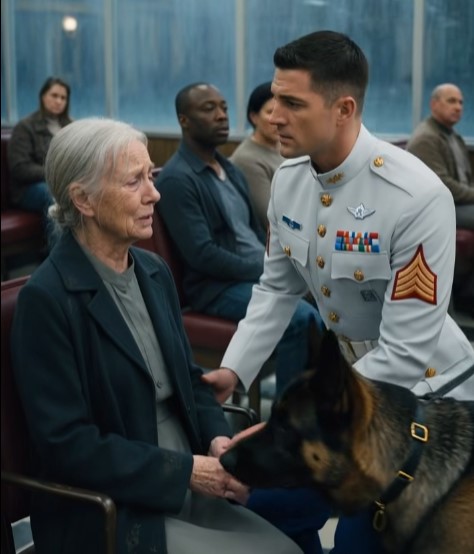
A severe storm moved across a remote stretch of West Texas highway, reducing visibility and forcing travelers to seek shelter wherever possible. One of those travelers was Daniel Brooks, a former United States Marine who had been on the road for several hours. He stopped at a small roadside diner to wait out the weather and take a brief break from driving. With him was Atlas, a trained German Shepherd who had previously served alongside him during his military deployment.
The diner was quiet, with only a few patrons inside as rain continued to strike the windows. The atmosphere was calm, but the weather outside made travel unsafe. While Brooks sat near the back of the diner, an elderly woman entered the building visibly distressed. Her clothing was damp from the storm, and she appeared unsettled as she looked around the room.
After a brief hesitation, she approached Brooks directly and asked him a surprising question. She requested that he pretend to be her grandson for a short period of time. Although the request was unusual, Brooks immediately noticed her anxiety and concern. He sensed that the situation involved more than a simple misunderstanding and agreed to stay alert while observing what was happening.
Shortly afterward, a black SUV arrived outside the diner, followed by the entry of a man who introduced himself as Victor Hale. He claimed to represent an assisted living facility and stated that the woman, identified as Evelyn Carter, had left the facility without authorization. He presented documents that he said confirmed his legal authority over her care arrangements. However, Evelyn appeared increasingly uncomfortable in his presence, avoiding eye contact and remaining visibly tense. Brooks also noticed that two additional individuals remained near the diner entrance, which heightened the sense of concern in the situation.
Brooks remained calm and observant as the interaction continued, carefully listening to both sides without escalating tension. Based on his experience in high-pressure environments, he focused on assessing behavior rather than reacting immediately. Evelyn’s fear appeared genuine, and her body language suggested distress rather than confusion. After considering the circumstances, Brooks made the decision to assist her in leaving the diner safely. He guided her out of the building discreetly, ensuring that the situation did not escalate into confrontation.
Once they left the diner, Brooks, Evelyn, and Atlas traveled a short distance away from the area to ensure safety and privacy. Later that evening, they stopped at a small motel to rest and allow Evelyn to explain her situation in detail. She described her late husband, Harold Carter, who had previously worked in financial accounting for a company known as Red Mesa Energy. According to her account, he had discovered irregularities in financial records involving questionable transactions and asset transfers. She explained that he had been gathering documentation related to these findings before his sudden death, which was officially classified at the time as an accident.
Evelyn further stated that after her husband’s passing, she discovered a collection of materials he had preserved, including a flash drive and handwritten notes. These documents reportedly contained references to financial accounts, transaction records, and internal approvals that raised concerns. She believed that these materials were directly connected to pressure she later experienced regarding legal and financial decisions. According to her account, she was asked to sign documents transferring control of certain assets, which she refused to do. She also described being placed in a care facility where her communication and independence were significantly restricted.
Recognizing the seriousness of the situation, Brooks decided that the matter required professional review. He traveled with Evelyn to Colorado, where they met Miguel Torres, a former Marine who had transitioned into investigative and advisory work. Torres carefully reviewed the documents provided by Evelyn and identified several inconsistencies that warranted further examination. The materials suggested possible irregular financial patterns involving contracts, approvals, and asset management structures. While no immediate conclusions were made, the evidence indicated that the situation extended beyond a personal dispute.
As the investigation progressed, additional review of the records revealed patterns that required formal legal attention. Authorities began to examine financial transactions and administrative records connected to the company mentioned in Evelyn’s account. The scope of the inquiry expanded as more documentation was analyzed. Officials determined that certain elements required immediate preservation to prevent potential loss of evidence. At this stage, the matter transitioned from a private concern into an active investigative case involving multiple jurisdictions.
Brooks and Torres delivered the collected materials to federal authorities in Colorado Springs for official review. Special Agent Rebecca Langford received the documentation and initiated a preliminary assessment. Based on the information provided, she recommended immediate precautionary measures to secure relevant financial accounts and records. Authorities responded by initiating account freezes and conducting a structured review of related business and property transactions. The assisted living facility mentioned earlier was also placed under regulatory review while further investigation continued.
During the course of the investigation, additional attention was given to the circumstances surrounding Harold Carter’s death. Three days after the submission of evidence, officials determined that the case required reclassification for further review. The matter was reopened for homicide investigation based on inconsistencies identified in the supporting documentation. This development marked a significant shift in the direction of the case and prompted further examination of related events. For Evelyn, this represented the beginning of long-delayed answers regarding her husband’s final days.
In the following days, Evelyn visited her husband’s gravesite in a quiet cemetery located in a mountainous region. The visit was private and reflective, offering her a moment to process recent developments. Atlas remained close by, providing a sense of comfort during the visit. Brooks accompanied her but maintained distance to allow privacy. Evelyn expressed gratitude for the support she had received, acknowledging that the situation had changed significantly due to the emergence of the preserved records and the willingness of others to investigate further.
As the case continued to develop, investigators emphasized the importance of documentation, persistence, and careful review of financial systems involving vulnerable individuals. What began as an unexpected encounter during a storm had evolved into a complex investigation requiring coordination between multiple agencies. The situation highlighted how critical evidence preservation can be in uncovering potential wrongdoing. It also demonstrated how individual actions in uncertain moments can lead to broader accountability when properly investigated.
By the time Brooks concluded his involvement and prepared to leave Colorado, the investigation had already progressed significantly under official oversight. While many details continued to be reviewed, the core evidence had been secured and formally processed. For Evelyn, the situation represented both closure and the possibility of justice being pursued through proper channels. For investigators, it remained an ongoing case requiring continued attention. And for those involved, it served as a reminder that sometimes ordinary moments can lead to the discovery of far-reaching truths.
