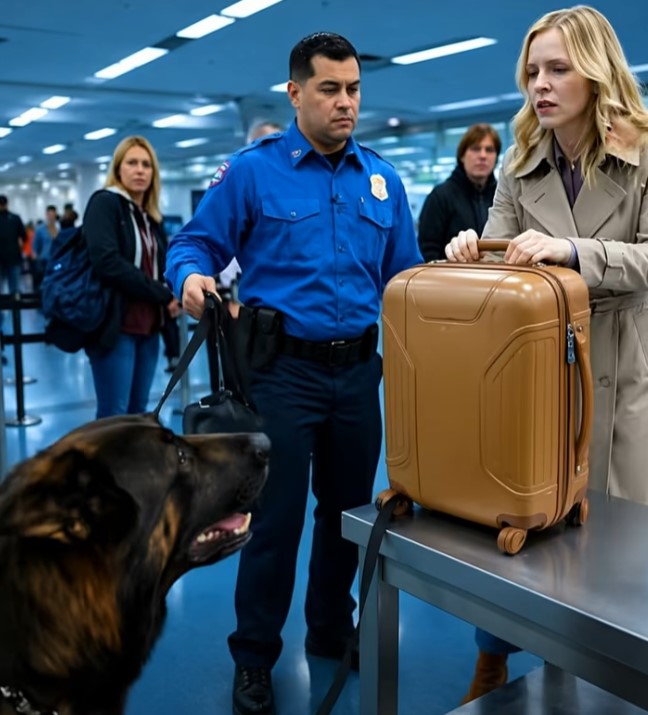
Working as a K9 handler at a busy international airport requires discipline, patience, and absolute trust between handler and dog. Over nearly a decade on duty, I learned that no scanner or electronic system could replace the instincts of a trained service dog. My partner, Bear, was a highly trained airport security K9 known for his calm behavior and consistent performance. He had worked countless shifts across terminals, baggage areas, and passenger screening zones. Over time, he became known among staff for his reliability and focused detection work.
In many situations, his behavior provided the first indication that something required closer inspection. Terminal 4 that afternoon was especially crowded, with long queues forming at security checkpoints and passengers moving quickly between gates. The sound of rolling luggage filled the hallways, mixing with announcements and general travel noise. Staff were managing steady passenger flow, ensuring standard procedures were followed without delay.
Bear and I moved through the terminal as part of a routine patrol, observing luggage movement and passenger behavior. Most travelers paid little attention to security personnel as they passed through the area. Everything appeared normal, as it usually did during peak travel hours.
As we continued through the concourse, one passenger stood out—not because of obvious behavior, but because of subtle differences in movement and posture. The individual carried a well-maintained suitcase and appeared outwardly calm and composed. Nothing about their appearance suggested immediate concern or irregular activity. However, trained K9 units are not guided by appearance alone. Bear suddenly slowed his pace and shifted focus toward the luggage being carried. His posture changed slightly, indicating heightened attention rather than routine scanning behavior.
Within moments, Bear’s response became more pronounced. He stopped walking entirely and fixed his attention on the suitcase as it passed. His body language shifted into a clear alert posture, signaling that something required further attention. He did not bark or act aggressively, but his focus intensified in a way that differed from normal patrol behavior. The passenger continued moving forward, seemingly unaware of the attention being drawn. Other travelers nearby noticed the change and began to observe the situation more closely. The atmosphere around the area became noticeably quieter.
Following standard protocol, we maintained observation and allowed the passenger to proceed to the next security stage. Bear, however, continued to track the suitcase visually and physically, refusing to disengage from its movement. This level of sustained attention was uncommon for routine inspections. Based on procedure, a secondary screening request was initiated. Security staff coordinated the inspection process in a controlled area to ensure safety and privacy. The passenger was informed calmly that additional screening was required, and compliance was requested.
The secondary inspection area was secured, and staff began a detailed examination of the luggage. The passenger expressed concern about delays and handling procedures but cooperated with instructions. Bear remained nearby, continuing to display focused attention on the suitcase throughout the process. As officers carefully inspected the exterior and interior compartments, they noted irregular structural modifications within the luggage frame. These modifications appeared to interfere with normal scanning results, raising immediate procedural concerns. At that point, the inspection shifted from routine to heightened security protocol.
Upon further examination, officers identified concealed structural alterations within the suitcase lining. These modifications were not standard and appeared to have been intentionally integrated into the luggage design. Due to the complexity of the construction, additional specialized security personnel were called to assist. The situation was treated with increased caution as procedures for handling modified baggage were initiated. Throughout the inspection, Bear remained alert but calm, maintaining position near the luggage without distraction. The environment inside the inspection area became highly controlled and procedural.
As the internal structure of the suitcase was carefully disassembled, officers discovered a concealed compartment that had been built into the base of the luggage frame. Inside this hidden space, they found an object that required immediate medical and security attention. Emergency personnel were called to the scene without delay. The discovery was handled according to established airport safety protocols, ensuring proper care and assessment. The area was secured, and access was restricted to authorized staff only. The situation transitioned fully into a coordinated emergency response.
Medical staff arrived quickly to assess the contents of the compartment, while security teams documented the findings and ensured proper chain-of-custody procedures. The passenger was detained for questioning as authorities began reviewing identification documents and travel records. During this process, inconsistencies were identified in the provided documentation, prompting further investigation. Officials escalated the case to airport security leadership for additional review. The situation was no longer treated as a standard baggage inspection but as a complex security incident requiring full procedural response.
What stood out most during the entire event was Bear’s initial reaction before any discovery had been made. His behavior was not random or uncertain; it was focused, sustained, and consistent with trained detection responses. Even without knowing the exact cause, his alert indicated that something required attention beyond routine screening. Working with K9 units over the years, I had learned that their instincts often identify risks long before human assessment confirms them. That day reinforced the importance of trusting trained working dogs in high-security environments.
Airport security relies heavily on advanced scanning systems, surveillance technology, and structured procedures. However, trained K9 units remain one of the most effective layers of detection in complex environments where human movement is constant and unpredictable. Dogs like Bear are trained to detect subtle changes that technology alone may not immediately identify. Their role is not only supportive but often critical in initiating further investigation. The events in Terminal 4 demonstrated how quickly routine operations can shift into high-priority situations when alerts are properly followed.
In the aftermath of the incident, procedures were reviewed, and all involved personnel documented their observations for official reporting. Bear returned to regular duty after evaluation and rest, continuing his role as a working K9. For me, the experience reinforced the deep trust built between handler and service animal over years of shared work. Not every shift produces major incidents, but each one requires readiness for unexpected developments. That day became a lasting reminder of why K9 teams remain essential in modern airport security operations, where awareness and instinct often work together to maintain safety.
