For twenty years, I lived in a wheelchair after a single moment changed everything. It happened when I jumped into a lake to save a drowning child. I never thought about consequences in that moment—only about getting her out alive. I remember the cold water, the panic, the weight of the current, and then the sharp impact that I didn’t fully understand until later. That was the moment my life split into before and after. I became known as the man who saved a life but lost his own ability to walk.
People called it heroic. I learned to smile when they said it, because that was easier than explaining how much I had lost. My wife Claire stood by me through everything, helping me rebuild a life that no longer looked anything like the one I had planned. Over time, I adapted. Success, business, meetings, and routine replaced the life I thought I would have.
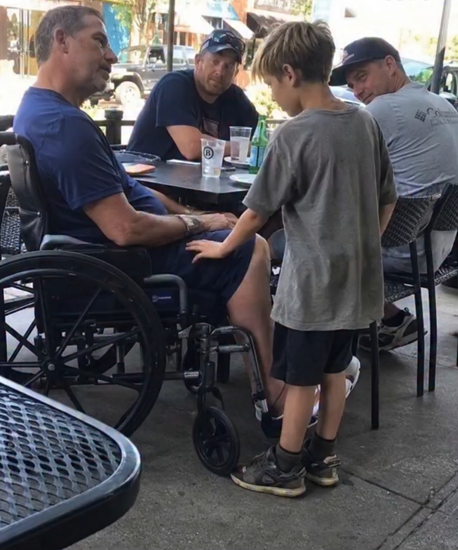
One morning, I sat in a crowded café with my business partners, Mark and Greg. The world around us was loud, full of movement and conversation, while I remained in my wheelchair, quietly listening and thinking about contracts and numbers. On the surface, everything looked normal. But underneath, I often drifted back to the lake, to the moment that had defined the last two decades of my life.
That was when something unexpected happened.
A boy appeared beside my table. He looked no older than ten, thin and serious, with a worn backpack hanging loosely from one shoulder. He wasn’t behaving like a child who was lost or curious. Instead, he was focused, almost unsettlingly calm, as he stared at my motionless legs.
He looked at me and said something that made the entire table fall silent.
“I can make you walk again.”
At first, I thought it was a joke. My partners laughed, assuming it was some kind of childish imagination or misunderstanding. Even I smiled, because it felt easier than reacting to something so impossible. But the boy didn’t laugh. He didn’t move away. He just waited.
Then he knelt down beside my wheelchair.
“Count with me,” he said quietly.
Before I could respond, he placed his hand on my foot. Something about the moment made the air feel heavier, like time itself had slowed. My mind told me nothing would happen. My body had been this way for twenty years. There was no reason to expect anything different.
“One,” he said.
Nothing.
“Two.”
A strange tension formed in my chest. I couldn’t explain it, but I suddenly felt like I needed to hold onto something.
“Three.”
And then it happened.
My toes moved.
At first, I thought I was imagining it. A small, almost imperceptible motion inside my shoe. But then it happened again, clearer this time. My foot shifted slightly against the ground. The entire café seemed to freeze around me.
Forks stopped mid-air. Conversations disappeared. My business partner’s smile vanished completely.
I couldn’t speak.
The boy looked at me, completely calm, as if this was expected.
“My name is Eli,” he said.
Before I could respond, a woman’s voice came from behind me.
“You don’t remember me,” she said softly, “but I know exactly who you are.”
She introduced herself as Sarah.
She told me something I struggled to process. Years ago, I had saved her life in the same accident that destroyed mine. That moment, she said, had changed her entire path. She became a physician specializing in rehabilitation and nerve recovery.
But what she told me next changed everything I thought I knew.
She explained that she had reviewed my medical records and discovered something unusual—signs of nerve regeneration that had never been properly addressed or explained. According to her, there were indications that my body had been slowly recovering for years.
That statement hit me harder than anything I had heard in decades.
I immediately thought of Dr. Voss, the physician who had treated me since the beginning. The man I trusted. The man who had always reassured me that my condition was permanent.
When I confronted Sarah about it, she didn’t accuse anyone directly. She simply told me I needed to see the records myself.
That same day, I went to Dr. Voss.
His office looked exactly the same—clean, controlled, familiar. He greeted me warmly, as if nothing was wrong. But when I placed the file on his desk and mentioned Sarah’s findings, something changed in his expression.
At first, he dismissed it. He suggested I had been misled, that the report was unreliable, that people often misinterpret medical data. But as I pressed further, his confidence began to weaken.
Still, I left without resolution.
I needed proof.
So I got a second opinion.
Three days later, a specialist confirmed what I had been told. There was evidence of long-term nerve regeneration—slow, incomplete, but real. My body had not been static as I had been told for twenty years. It had been trying to recover.
And no one had told me.
The realization was overwhelming. It wasn’t just about walking again. It was about time—twenty years of time I had lived under a belief that may not have been fully accurate.
When I confronted Dr. Voss again, this time with Sarah present, the conversation escalated. He insisted he had acted cautiously, that early signs were unclear. But the evidence contradicted his explanation.
Eventually, it became clear that something deeper had been hidden—whether out of fear, ego, or reputation.
I didn’t stay to argue further.
I reported everything to the medical board.
Months passed. Dr. Voss’s license was suspended pending investigation. Other patients began asking questions about their own cases. The situation expanded beyond me, becoming something larger than I had expected.
But I was no longer focused on the past.
I was focused on what came next.
With Sarah’s guidance and Eli’s quiet determination, I began a structured rehabilitation program. It was slow at first—small movements, controlled steps, moments of doubt followed by moments of progress.
Then one day, in my garden, everything changed.
Claire stood nearby, watching silently as I held onto parallel bars placed among the roses. Sarah was at one end. Eli stood beside her, counting softly.
“One… two… three…”
I let go.
One step.
Then another.
For the first time in twenty years, I was not defined by a wheelchair.
I looked at the people around me—at the boy who had changed everything, at the woman who believed in what others had missed, and at the life I thought was gone forever.
And I walked forward.
Not just into recovery—but into a future I had stopped believing was possible.
