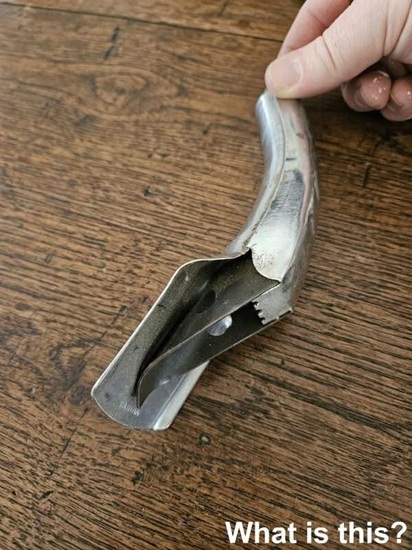
I found it at the very bottom of my toolbox, hidden beneath layers of rusted screws, worn-out gloves, and small parts I no longer remembered collecting. It looked like something from a different era, a forgotten piece of metal that had somehow survived years of being ignored. At first glance, it didn’t resemble anything I could immediately recognize, which made it even more intriguing.
The object was small but solid, with a weight that suggested it was meant for real work rather than decoration or guesswork. Its shape was unusual—neither fully flat nor fully curved, with edges that seemed carefully designed rather than randomly formed. There were no labels, no brand markings, and no instructions attached to it. It felt like a tool that had outlived its documentation.
I turned it over in my hands, trying to match it with anything I had seen before in workshops or online repair videos. Nothing came to mind. It didn’t fit the profile of a wrench, a cutter, or any standard handyman instrument. Instead, it felt like something specialized, made for a very specific task that I simply hadn’t encountered yet.
Curiosity quickly replaced confusion. I started imagining possible uses for it. Maybe it was part of an old industrial machine. Maybe it belonged to mechanics who worked with heavy equipment decades ago. The more I thought about it, the more I convinced myself that it had to have some complex, technical purpose that required training to understand.

That assumption led me to experiment with it. I tried using it as a lever on a few loose fittings in the garage. I tested it against small objects that might reveal a hidden function. I even attempted to apply it to tasks where I normally would use other tools, just in case it had a multi-purpose design I didn’t recognize.
But every attempt ended the same way. It didn’t cut, tighten, pry, or grip anything in a meaningful way. It simply existed in my hand as a solid piece of metal that refused to “click” mentally into any known category. Instead of becoming clearer, the mystery deepened with every failed attempt.
After a few days, I brought it with me while cleaning out the garage, where an older family acquaintance happened to stop by. He had spent most of his life working in mechanical repair, the kind of person who could identify obscure tools just by feeling their weight and shape without needing to see a manual.
Almost without thinking, I showed him the object. He took it calmly, turned it once between his fingers, and immediately gave a knowing nod. There was no hesitation in his expression, no sign of uncertainty. Just recognition, as if he had been reintroduced to something from his past.
“That’s an old oil can opener,” he said simply, with a faint smile that suggested nostalgia rather than surprise. According to him, tools like this were far more common in earlier decades, when motor oil was stored in sealed metal cans rather than modern plastic containers.
He explained that its purpose was very practical. In workshops and garages, mechanics needed a reliable way to open those sealed metal cans without spilling oil everywhere or damaging the container in an uncontrolled way. This tool solved that exact problem with a simple but clever design.
The way it worked was surprisingly straightforward. It would be placed on top of the metal lid and pressed or twisted in a controlled motion, creating a clean puncture or opening. This allowed the oil to be poured more precisely, reducing waste and avoiding the mess that would otherwise come from forcing the lid open with improvised tools.
What surprised me most was not just its function, but how elegant its simplicity was. There were no moving parts, no complicated mechanisms, and no need for additional equipment. It relied entirely on shape, pressure, and design efficiency—qualities that made it reliable in environments where tools had to be durable and consistent.
Standing there holding it again after hearing the explanation, I realized how easily everyday objects can lose their meaning once the context around them disappears. What once felt like a mysterious industrial artifact turned out to be a practical solution to a very specific everyday problem from another time.
The experience left me with a different perspective on old tools in general. Many of them are not mysterious inventions or complex machines, but rather simple answers to problems that used to exist in daily life. As technology evolves, those solutions fade into storage boxes, garages, and forgotten corners of toolkits.
In the end, the object wasn’t strange at all—it was just out of time.
