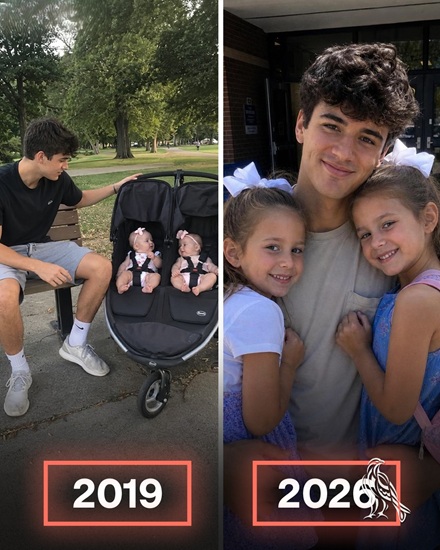
I never imagined becoming a parent before I was even old enough to legally drink. At eighteen, my life was supposed to be about finishing school, planning for college, and figuring out what kind of future I wanted. Instead, I found myself in a cramped apartment at three in the morning, holding one crying newborn while another screamed in a bassinet beside me, both of them depending entirely on me. My mother was gone. No note, no explanation, just absence. That silence changed everything about the direction of my life.
My mother, Lorraine, had always been unpredictable. She could be warm and affectionate one day, then distant and volatile the next, as if she was constantly fighting something invisible that the rest of us couldn’t see. When she became pregnant with twins, I honestly believed something might shift in her. I thought motherhood might anchor her, give her stability. Instead, she became more restless, more emotionally distant, and harder to understand. She never even told me who the father was, and whenever I asked, the conversation would end in anger.
When Ava and Ellen were born, there were brief moments where it seemed like she might try. For about two weeks, she held them, fed them, and attempted to keep a routine. But even that effort quickly faded. She would disappear into her room for hours, leaving me to manage two newborns while still trying to finish high school. I remember studying between feedings, surviving on no sleep, and feeling like I was drowning in responsibilities I was never prepared for. It didn’t feel like life anymore—it felt like survival.
Then one night, everything collapsed. I woke up to crying, but there was something worse beneath it: silence where my mother’s presence should have been. Her coat was gone. So was she. That was the moment I understood there was no backup plan. No one was coming to fix things. If I didn’t step in, the twins would have no one at all.
I gave up college applications that same week. I had once dreamed of becoming a surgeon after watching a documentary as a child, imagining operating rooms and years of study. But those dreams suddenly felt like they belonged to someone else. My reality became diapers, formula, and exhaustion. I worked wherever I could—warehouse shifts, delivery jobs, stocking shelves late at night—anything that could keep food on the table and bottles filled.
I learned how to stretch money in ways I never thought possible. I learned how to survive on very little sleep, how to calculate formula costs like they were life-or-death math problems, and how to function while holding two babies at once. People often told me I should let the system take over, that I was too young, that I deserved a life of my own. But every time I imagined letting go, I saw two little girls growing up without anyone who truly stayed.
So I stayed.
Over time, something unexpected happened. The girls began calling me “Bubba.” It started as a mispronunciation, but it stuck. Teachers used it. Neighbors used it. Even I started responding to it without thinking. It became the foundation of our life together. We built routines—simple, imperfect ones. Pancakes on weekends, movie nights on the couch, homework at the kitchen table, and drawings taped to the fridge that read, “Me, Ellen, Ava, and Bubba.” It wasn’t traditional, but it was ours.
For years, that was enough. Until Lorraine came back.
Seven years later, she appeared again as if no time had passed. At first, I barely recognized her. She looked polished, composed, and expensive in a way that didn’t match the version of her I remembered. Designer clothes, perfect makeup, and an effortless confidence replaced the chaos I had grown up with. But the moment she heard the girls laughing, her entire expression changed, as if she could instantly step back into a role she had abandoned long ago.
She came in with gifts, shopping bags, and a carefully rehearsed energy. Tablets, clothes, toys—things she believed would bridge a seven-year gap in an instant. The girls were curious, even excited at first, because children naturally hope for connection with their parents. I tried not to judge too quickly, but something about the performance felt unsettling. It didn’t feel like returning. It felt like acting.
Then the legal papers arrived.
Custody filings. Guardianship claims. Official documents that made everything real in a way her visits hadn’t. My hands shook as I read them. She wasn’t just trying to reconnect—she was trying to take them. When I confronted her, she didn’t deny it. She simply said she was doing what was “best” for them, claiming she could now offer more stability and opportunity than I could. She didn’t say she loved them. She said she needed them. That word stayed with me.
The turning point came when the girls came home early from school and walked into the conversation. They heard enough. Ava immediately started crying, and Ellen stood frozen, processing everything in real time. Then Ellen whispered, “You left us.” And Ava followed with, “Bubba stayed.” That moment broke whatever control Lorraine thought she had over the situation.
They ran to me without hesitation. They weren’t confused about who raised them. They already knew. Ava cried into my shirt and said something I will never forget: “You’re our real parent.” Lorraine didn’t respond the way I expected. Instead of remorse, there was frustration, as if reality had failed to match her expectations. Before leaving, she simply said I would regret it. Then she walked out.
After that night, I stopped reacting emotionally and started preparing practically. I hired a lawyer. I filed for guardianship and child support, not out of revenge, but because truth needed structure in a system that required it. The court process was exhausting. Lorraine’s legal team tried to paint me as unstable and unfit, but years of documentation told a different story—school records, medical forms, teacher statements, and neighbors who had watched me raise the twins from infancy.
When the judge spoke privately with the girls, they didn’t hesitate. They chose me. The ruling granted full guardianship, and Lorraine was ordered to provide child support. The result wasn’t dramatic or emotional in the way movies portray—it was quiet, final, and stabilizing in a way I didn’t realize I needed.
For the first time in years, life became manageable. I dropped one of my jobs. I slept properly. I cooked meals that weren’t rushed or survival-based. Slowly, space opened up in my life for something I had buried long ago: myself.
I started looking at college programs again at night after the girls were asleep. Nursing. Science courses. Pre-med paths. The dream I once abandoned didn’t feel impossible anymore. One evening, Ellen noticed me looking at the screen and asked if it was “doctor school.” I smiled and said maybe. She simply nodded and said, “You’ll do it. You always do.” Ava added, “We’ll help you now.”
I broke down quietly after that, not from sadness, but from relief.
Now I’m twenty-five. Life is still busy, still imperfect, but it’s stable in a way I never thought I would experience. I study at night, work part-time, and raise two girls who feel more like partners in survival than dependents. Lorraine hasn’t returned since the court ruling, except for monthly payments that arrive without words attached.
And I’ve realized something important.
I don’t need her to come back and explain anything anymore. I don’t need closure from the past to build a future. The girls already have what they needed most—someone who stayed.
And for the first time in my life, I’m starting to believe that staying didn’t just save them.
It also saved me.
