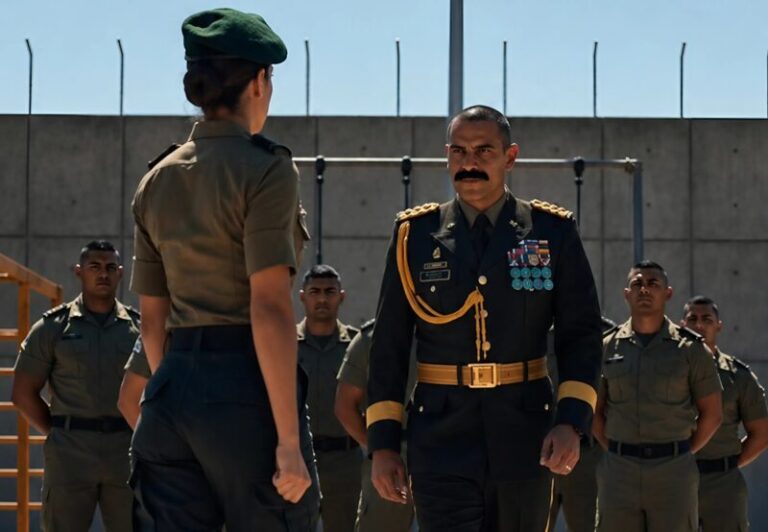
A harsh morning at the Northern Corps military academy set the stage for a routine inspection that would unexpectedly become one of the most talked-about moments in the facility’s history. The parade ground was already tense long before the commanding officers arrived. Rows of cadets stood in rigid formation under the heavy weight of discipline, their uniforms perfectly aligned, boots polished to a shine, and posture locked into absolute stillness. Every recruit knew that even the smallest mistake could be noticed during inspection day, and consequences were rarely lenient.
The atmosphere was shaped by the presence of Colonel Viktor, a senior officer whose reputation for strict discipline and psychological pressure had earned him fear among recruits. Known informally as “Hammer,” he had developed a name for himself through years of uncompromising training methods. His inspections were often described as tests of endurance as much as discipline, where cadets were expected not only to perform correctly but also to withstand emotional pressure without breaking focus.
Among the formation stood a young recruit whose presence did not initially draw attention from most observers. She was smaller in stature compared to many of the others but maintained an unusually steady posture. Unlike the cadets around her, who subtly avoided eye contact with the approaching officers, she remained forward-facing and composed. Her calmness, rather than blending into the background, stood out in contrast to the tension surrounding her.
As Colonel Viktor walked along the formation line, his attention eventually settled on her. He paused, studying her expression, noting that she did not lower her gaze like the others. To him, this was not a sign of confidence but of defiance. The silence stretched as he stepped closer, making it clear that the entire formation was now listening.
His voice broke through the stillness as he demanded to know why she was standing “like a statue” and whether she believed herself to be above discipline. The recruit responded briefly and respectfully, stating that she did not believe she was special. Her tone remained steady, showing no visible fear or hesitation despite the intensity of the situation.
However, rather than calming the situation, her composure appeared to intensify the colonel’s frustration. In a sudden escalation, he ordered her to kneel in front of the entire formation. The command echoed across the parade ground, immediately drawing the attention of every cadet present. A wave of discomfort passed through the ranks, though no one dared to react openly.
The recruit complied without resistance, slowly lowering herself to her knees on the hard surface. Even in this position, she did not appear distressed. Her calmness remained unchanged, which only reinforced the unusual tension in the air. The colonel continued speaking sharply, making comments intended to assert dominance over the formation while emphasizing discipline through public humiliation.
Moments later, he physically shoved her shoulder, causing her cap to fall onto the ground. A few nervous reactions rippled through the formation, but they were quickly suppressed as cadets returned to rigid silence. The colonel’s behavior reinforced the fear-based structure that governed daily life at the academy, where emotional restraint was often mistaken for strength.
Despite this, the recruit did not respond emotionally. Instead, she slowly lifted her head, her expression steady and controlled. There was no visible anger or fear, only quiet composure. She then reached into her uniform pocket in a deliberate and unhurried motion, drawing the attention of both the colonel and nearby officers.
The colonel, assuming she might be reacting emotionally or attempting to explain herself, made a dismissive remark. However, the atmosphere shifted instantly when she revealed a small identification badge marked with official military authority. The badge carried distinct insignia and security markings that immediately drew the attention of trained personnel nearby.
Whispers began spreading through the formation as officers recognized the classification level associated with the insignia. It was not an ordinary identification card but one linked to internal oversight and inspection authority. The shift in atmosphere was immediate, as the perception of the situation began to change among those present.
The recruit then presented her identification card more clearly. The details on it indicated that she was affiliated with an internal inspection division operating under high-level command oversight. Her role was not that of a standard cadet but of an authorized observer assigned to evaluate conduct and discipline within military training environments.
The realization spread rapidly, and the confidence previously displayed by the colonel began to fade. What had started as a disciplinary demonstration had transformed into an official inspection scenario. The balance of authority on the parade ground shifted completely, leaving those present uncertain how to respond.
The recruit calmly addressed the colonel, informing him that the academy had been under evaluation for an extended period of time. Her words were measured and factual, delivered without emotion or provocation. She stated that the inspection covered leadership conduct, training methods, and adherence to institutional standards.
The colonel remained silent, visibly processing the implications of what had just been revealed. The same authority he had used moments earlier to dominate the formation now appeared irrelevant in the face of higher institutional oversight. Cadets observed the change in silence, realizing that the dynamic they had always known was no longer in effect.
For several seconds, no one moved. The parade ground, which had been filled with tension and command-driven energy, fell into complete stillness. The silence itself carried more weight than any spoken order, marking a clear turning point in the situation.
The recruit then concluded her statement, indicating that the evaluation of the academy had reached its final stage. Her tone remained neutral, reinforcing that her role was procedural rather than personal. The implication of her words made it clear that the behavior displayed during the inspection would be part of an official report.
Colonel Viktor, who had built his reputation on control and intimidation, was left without a response. His authority, once absolute within the academy environment, no longer carried the same weight in that moment. The presence of oversight had shifted the entire structure of power in seconds.
As the inspection concluded, cadets were left processing what they had witnessed. Many had never seen the colonel lose composure or authority in any situation. The realization that an unnoticed observer had been evaluating them for months added an entirely new layer of awareness to their training environment.
In the days that followed, the incident became a subject of quiet discussion throughout the academy. Some viewed it as a justified correction of excessive discipline, while others saw it as a reminder of how quickly authority can be challenged when accountability is present. Regardless of interpretation, the event left a lasting impression on everyone who witnessed it.
Ultimately, the moment at Northern Corps demonstrated a fundamental principle of structured systems: authority is not only defined by power, but also by oversight, responsibility, and accountability. The calm presence of a single recruit had been enough to transform an entire environment built on fear into one moment of reflection, leaving behind a silence that spoke louder than any command ever could.
