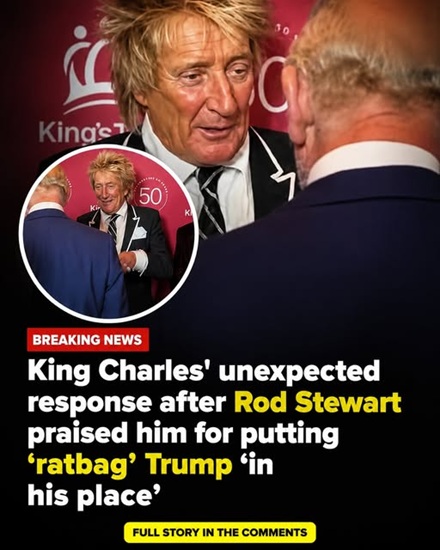
The atmosphere at the high-profile London event was one of refined elegance, where diplomacy and tradition typically shape every interaction. The room was filled with carefully selected guests, many of them accustomed to public attention and the subtle etiquette required in royal settings. Conversations moved in soft tones, and every gesture seemed deliberately measured, reflecting the weight of the occasion and the presence of senior members of the British monarchy.
Among the attendees was legendary musician Rod Stewart, whose long career has been defined by both musical success and a reputation for speaking his mind. Known for his outspoken personality and rock-and-roll attitude, Stewart has often stood apart from the polished restraint typically expected in formal royal environments. His presence at such an event already drew attention, given his history as one of Britain’s most recognizable cultural figures.
Also present was King Charles III, who has spent decades navigating the delicate balance between public duty and political neutrality. As monarch, his role requires careful attention to tone, especially in conversations that could be interpreted as political commentary. His interactions at public events are often closely observed, as even minor expressions can be analyzed in the media and by the public.
According to the narrative circulating around the event, a brief exchange between Stewart and the King became the center of unexpected attention. In what was described as a spontaneous moment, Stewart allegedly made a sharply worded remark referencing former U.S. President Donald Trump. The comment, reportedly delivered in a casual but emphatic tone, immediately stood out within the otherwise formal setting.
The phrase attributed to Stewart used highly informal and critical language, reflecting his well-known tendency to speak candidly in public settings. While such language is not unusual in informal discourse, its alleged placement within a royal environment made it particularly notable. The moment quickly became the subject of discussion due to the contrast between the relaxed tone of the musician and the structured formality of the royal setting.
Observers of the interaction focused not only on Stewart’s remark but also on King Charles’s reaction. Reports and interpretations suggested that the King responded with a reserved expression, one that could be interpreted in multiple ways. Some described it as a polite acknowledgment, while others suggested it may have been a brief moment of discomfort or restrained amusement, consistent with his long-practiced diplomatic composure.
The situation highlights how public figures in royal environments are often required to navigate unpredictable conversational moments. Even in controlled settings, unexpected comments can arise, and responses are carefully moderated to maintain institutional neutrality. For King Charles, such moments are part of a lifelong role shaped by protocol and public expectation.
Rod Stewart’s public persona adds another layer to the interpretation of the event. Throughout his career, he has often expressed strong personal opinions on cultural and political matters, sometimes in informal or humorous tones. His supporters often view this as authenticity, while critics occasionally see it as impulsive. In this context, the alleged comment fits a broader pattern of outspoken remarks rather than a structured political statement.
The mention of Donald Trump in the reported exchange reflects the continued global attention surrounding the former U.S. president. Even outside formal political contexts, Trump remains a figure who frequently appears in public commentary, discussions, and media narratives. This has contributed to his presence in conversations far beyond the United States, including cultural and entertainment settings.
King Charles, on the other hand, remains bound by strict expectations of political neutrality. Any perceived reaction to politically charged remarks can quickly become a subject of analysis, even if no official stance is intended. This creates a situation in which silence, facial expression, or even a brief smile can be interpreted in multiple and sometimes conflicting ways.
The interaction, whether fully accurate in its reported form or shaped by media interpretation, reflects the broader tension between celebrity culture and institutional tradition. In modern public life, informal speech by high-profile individuals can quickly become amplified, especially when it occurs in proximity to royal or political figures.
The event also illustrates how modern media environments transform small moments into widely discussed narratives. A short exchange, a facial expression, or a single comment can be expanded into broader debates about politics, personality, and power. This dynamic often blurs the line between verified reporting and interpretive storytelling.
Ultimately, the story surrounding Rod Stewart and King Charles serves as an example of how quickly perception can become as influential as fact in contemporary media culture. Whether viewed as humor, criticism, or simple conversation, the alleged moment gained attention because it brought together two very different worlds: the disciplined structure of monarchy and the unfiltered voice of rock music.
In the end, what remains most significant is not necessarily the exact wording of the exchange, but the way it was received, interpreted, and circulated. It reflects a world where public figures are constantly under observation, and where even the smallest interactions can take on symbolic meaning far beyond their original context.
