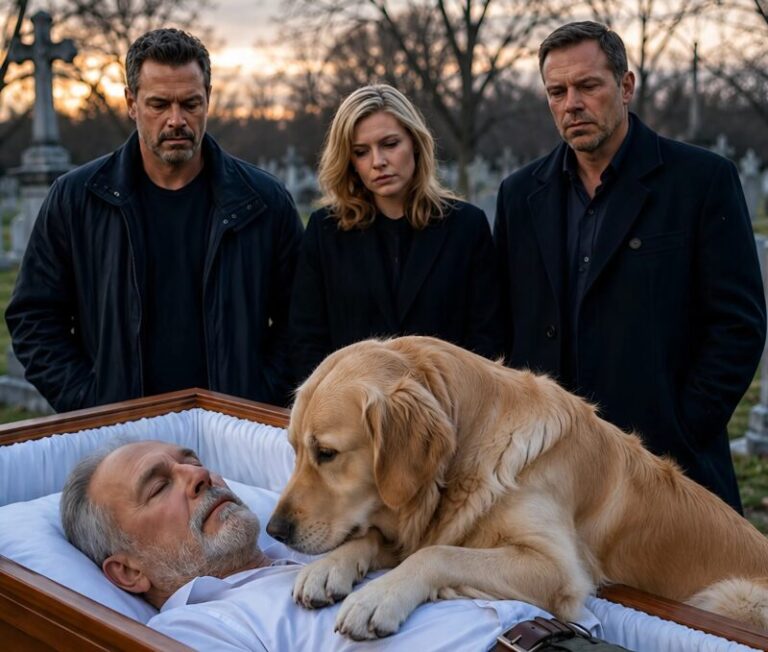
The funeral of Henry Wallace began under a heavy, overcast sky at a quiet rural cemetery located just outside a small town. A cold wind moved through the trees, carrying fallen leaves across the damp ground as mourners gathered in silence. Family members, neighbors, and close friends stood near the open grave, reflecting on the life of a man who had spent most of his years living close to nature rather than in crowded communities.
Henry Wallace had been known locally as a calm and private individual who enjoyed hunting, fishing, and long walks through the surrounding forests. At the age of sixty-seven, he had built a reputation as someone dependable and kind, always willing to help neighbors when they needed assistance. Many in the community described him as a man who preferred simplicity, solitude, and the company of his loyal golden retriever.
That golden retriever, named Buddy, had been by Henry’s side for nearly ten years. The dog had become more than a pet to him; it was a constant companion through daily routines, outdoor trips, and quiet evenings at home. After the passing of Henry’s wife years earlier, those close to him often said that Buddy had become his primary source of emotional comfort and companionship.
In the days leading up to the funeral, the dog’s behavior changed noticeably. Family members observed that Buddy appeared withdrawn and restless. He refused food at times, drank very little water, and spent long hours lying near Henry’s bedroom door. His unusual behavior made relatives increasingly concerned, although they assumed it was a natural response to grief.
As preparations for the funeral continued, some relatives initially debated whether Buddy should attend the service at all. They worried that the emotional environment might cause distress for the animal and for the family. However, the situation became more difficult as the dog reacted strongly whenever it was separated from the household or prevented from leaving with the family.
Eventually, Henry’s niece insisted that Buddy be allowed to attend the funeral. She believed that the bond between the dog and Henry was too strong to ignore, and that denying the dog a final goodbye would be unfair. The family ultimately agreed, and Buddy was brought to the cemetery alongside the mourners.
When the coffin was placed near the gravesite, the atmosphere remained quiet and solemn. Buddy walked slowly beside the coffin without resistance, showing no signs of aggression or confusion. Witnesses later described the dog as unusually focused and calm, as if fully aware of the significance of the moment.
As the ceremony continued, Buddy approached the coffin and placed his front paws gently against its wooden edge. He remained still for several seconds, staring at Henry’s body in silence. Many attendees were visibly emotional, and several family members struggled to hold back tears as they witnessed the dog’s reaction.
After a brief moment of stillness, Buddy climbed into the open coffin. The movement startled several mourners, but no one immediately intervened. The dog lay beside Henry, resting its head against his chest and producing soft whimpering sounds. The scene created a powerful emotional reaction among those present, with many describing it as a heartbreaking farewell.
For a short time, the cemetery remained completely silent except for the sound of wind moving through nearby trees. The priest conducting the service paused, allowing the moment to continue uninterrupted. Family members stood quietly, observing the connection between the dog and its owner one last time.
However, the emotional atmosphere shifted abruptly when the priest stepped forward to continue the service. As he approached the coffin, Buddy suddenly lifted his head and became visibly alert. His posture changed, his ears lowered, and a low growl began to form, drawing immediate attention from those nearby.
The priest attempted to continue calmly, assuming the dog was reacting to stress or confusion. He moved closer once again, but Buddy responded by jumping up and positioning himself between the coffin and the priest. The growling intensified, and the dog began barking loudly, surprising everyone present.
Witnesses noted that Buddy did not react aggressively toward the mourners or family members but focused entirely on the priest. This unusual behavior created confusion and concern among those attending the funeral. Some relatives attempted to restrain the dog, but Buddy resisted and returned repeatedly to the same defensive position.
As tension escalated, the dog suddenly lunged toward the priest and grabbed onto the sleeve of his robe. The sudden movement caused panic among the mourners, with several people shouting and stepping forward to intervene. Two men quickly moved to separate the dog from the priest.
During the struggle, something unexpected fell from the priest’s sleeve onto the ground. The object immediately drew attention from nearby family members, who paused as they realized it was a silver locket belonging to Henry Wallace. The discovery created confusion and shock among the attendees.
Henry’s sister recognized the locket immediately, explaining that it had belonged to Henry for decades and contained a photograph of his late wife. The item was considered deeply personal and meaningful, and its sudden appearance raised immediate questions about how it had ended up in the priest’s possession.
As the family examined the locket more closely, they discovered a folded note hidden inside behind the photograph. The handwriting was identified as Henry’s. The message expressed concern about a man who had been visiting him under the appearance of providing spiritual support, and it suggested that something unusual had been happening in the days leading up to his death.
The contents of the note changed the atmosphere at the cemetery significantly. What had begun as a funeral quickly shifted into a moment of suspicion and confusion. Relatives turned their attention toward the priest, who denied any wrongdoing and insisted that the locket had been given to him willingly.
Despite his denial, the situation became increasingly tense as more details were recalled by those present. Some mourners began remembering unusual activity near Henry’s home in the days before his death, including late-night vehicle sightings and unexpected visits.
As emotions escalated, someone contacted local authorities to report the incident. While waiting for law enforcement to arrive, the priest stood apart from the group, avoiding direct interaction with the family. Meanwhile, Buddy returned quietly to the coffin and lay beside Henry once again.
When police later arrived, they began documenting statements from witnesses and reviewing the circumstances surrounding Henry Wallace’s death. Although initial observations at his home had not indicated anything suspicious, the new information provided at the funeral prompted further review.
Investigators reportedly found signs that suggested disturbance inside Henry’s home prior to his death, along with missing personal items and an empty storage container. These findings led authorities to reexamine earlier assumptions about the case and consider whether external involvement may have occurred.
Additional inquiry revealed that the priest had visited Henry multiple times in the months before his death. This connection became a key focus of the investigation, as it raised questions about trust, access, and possible motives. However, official conclusions were not immediately released, and the matter required further examination.
For those who attended the funeral, the most memorable moment remained the behavior of Buddy. Many believed that the dog’s reaction had drawn attention to something that might otherwise have gone unnoticed. His refusal to remain calm during the ceremony became a central part of the day’s events.
As the service concluded under a changed atmosphere, mourners left the cemetery with mixed emotions. What had begun as a farewell to a respected man ended with unanswered questions and renewed uncertainty. The loyalty of the dog, however, left a lasting impression on everyone present.
In the end, Buddy’s actions became a symbol of unwavering loyalty and instinct. Whether interpreted as coincidence or intuition, the dog’s behavior played a central role in reshaping the moment and ensuring that details surrounding Henry Wallace’s final days were not overlooked.
