Tomson Morrison was a young content creator who had built his online presence on TikTok through attention-grabbing videos designed to provoke reactions. At just 22 years old, he had grown a following of more than 847,000 users, often relying on controversy and shock value to push his content into viral reach. Over time, his style became increasingly aggressive, as he searched for new ways to maintain relevance in an environment driven by fast engagement and short attention spans.
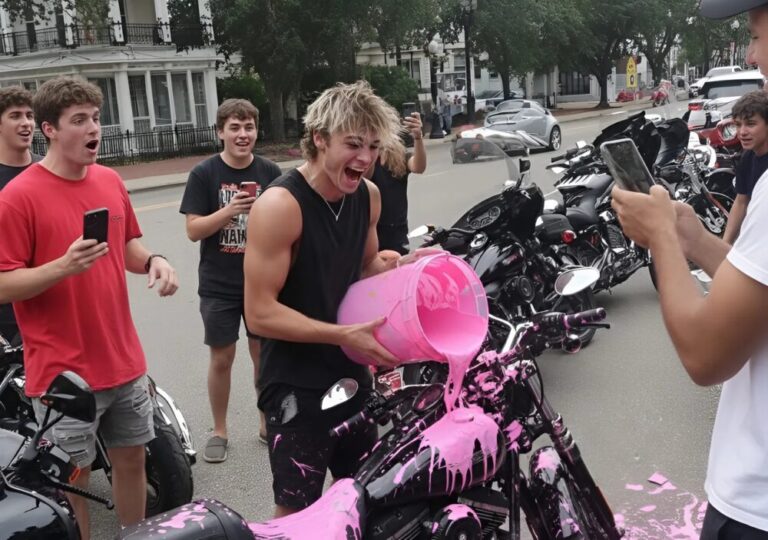
His latest idea was meant to push boundaries even further. Along with his friend Jordan, who frequently filmed his content, Tomson arrived at a small roadside diner carrying a gallon of bright pink paint. The location appeared ordinary at first glance, but what he saw in the parking lot changed his focus immediately. A group of motorcycles was lined up outside, belonging to an older riding club known as the Desert Eagles MC, who had gathered there before a planned charity ride.
Inside the diner, the members of the Desert Eagles MC were having breakfast together, unaware of what was happening outside. The group consisted mostly of older riders in their sixties and seventies, many of whom had spent decades riding together and participating in charity events for local causes. Their gathering that morning had a meaningful purpose, as they were preparing for a ride supporting children in need.
Tomson, however, viewed the situation differently. He saw the motorcycles as an opportunity for content. Without fully considering the consequences, he began recording a livestream, framing the moment as part of a so-called “social experiment.” He shouted provocative statements to attract attention from his audience while Jordan filmed from different angles to maximize engagement.
What followed was an act of vandalism that quickly escalated. Tomson began pouring pink paint over the motorcycles parked outside the diner, deliberately targeting the bikes for dramatic effect on camera. His livestream chat reacted in real time, filling with comments, reactions, and emojis that encouraged the behavior, further fueling his actions. The situation outside the diner was becoming more serious by the minute.
Inside the restaurant, the mood changed abruptly when one of the staff members alerted the bikers to what was happening. The members of the Desert Eagles immediately moved toward the windows and saw their motorcycles being damaged. Among them was Wayne Patterson, a 64-year-old rider whose motorcycle held deep emotional significance, as it had been a final gift from his late wife.
Despite the growing tension among the group, Wayne chose not to act impulsively. While some members were visibly angry and ready to confront the situation immediately, he asked them to remain calm and observe instead of reacting with aggression. His approach was measured, reflecting years of experience and a belief in restraint even under pressure.
Outside, Tomson continued filming, speaking directly into his phone as he justified his actions to his online audience. He framed the bikers as symbols of environmental harm, using exaggerated claims to provoke reactions and increase engagement. The livestream continued to grow in viewership, reinforcing his belief that the stunt was successful from a digital perspective.
However, the situation shifted when the bikers finally stepped outside. Instead of reacting with immediate confrontation, Wayne approached the scene with calm composure. When he spoke, he did not raise his voice or threaten retaliation. Instead, he shared something personal, explaining the emotional connection he had with his motorcycle and the memory of his late wife associated with it.
That moment changed the tone of the encounter. The anger that had been building among the bikers began to settle, replaced by a quieter sense of disappointment and reflection. While one member of the group struggled to contain his frustration, Wayne prevented any physical escalation. He chose to document the damage instead, taking photos as a record of what had happened.
When Wayne asked for Tomson’s real identity, the influencer responded with his online persona rather than his legal name, further highlighting the divide between internet identity and real-world consequences. After a brief exchange, the bikers returned to their motorcycles and left the scene without engaging in violence or retaliation, leaving Tomson with an unexpected outcome that did not match his expectations for viral content.
Two weeks later, the situation took an unexpected turn. Tomson and Jordan found themselves stranded in a remote desert area after their vehicle broke down during the night. With no phone signal, limited supplies, and dropping temperatures, the situation quickly became dangerous and uncertain.
As they waited for help in the darkness, distant headlights appeared on the horizon. The lights grew closer, revealing a familiar sight—the motorcycles of the Desert Eagles MC. The same group of bikers they had previously disrespected now approached their location in the middle of nowhere.
Instead of responding with anger or revenge, the bikers stopped to help. They provided water, blankets, and assistance, ensuring that both Tomson and Jordan were safe while they assessed the situation. The unexpected kindness left Tomson visibly confused, as he had anticipated hostility rather than support.
During the interaction, Wayne explained that helping others was a core belief shared by the group, shaped by personal values and the memory of loved ones who had influenced their outlook on life. He emphasized that responding to harm with kindness was not a sign of weakness, but a conscious choice to break cycles of negativity.
This experience had a profound impact on Tomson. For the first time, he began to see the bikers not as targets for entertainment, but as individuals with meaningful lives, values, and contributions to their community. Their involvement in charity rides, support for veterans, and assistance to families in need reshaped his understanding of who they truly were.
Over time, Tomson began changing the direction of his content. Instead of producing prank videos or controversial stunts, he started documenting the charitable work of the Desert Eagles MC. His focus shifted toward storytelling, highlighting community events, fundraising rides, and the positive impact the group had on others.
His audience also began to notice the transformation. While some followers were surprised by the change in tone, others appreciated the more meaningful direction of his content. His online identity evolved from controversy-driven entertainment to documentary-style storytelling focused on real human experiences.
Eventually, Tomson updated his public profile to reflect this shift, signaling a departure from his previous online persona. Rather than seeking attention through shock value, he began using his platform to amplify stories of kindness, resilience, and community service.
Nearly a year after the initial incident, the Desert Eagles MC attended another charity event supporting children facing serious illnesses. Among those present was a young girl who had benefited from their efforts. When she recognized Tomson standing with the bikers, she greeted him warmly, calling them “angels on motorcycles,” a moment that deeply resonated with everyone present.
For Wayne and the group, the transformation of that encounter symbolized the broader impact of patience and compassion. What had begun as a destructive act fueled by online attention had ultimately led to reflection, accountability, and personal growth.
The Desert Eagles MC continued their regular tradition of riding every weekend and supporting community causes. Their story remained consistent, built on decades of camaraderie and service. However, their connection with Tomson added a new layer to their journey, showing how unexpected encounters can lead to meaningful change.
In the end, the story serves as a reminder that online actions can have real-world consequences, but also that people are capable of growth and change when given the opportunity. It highlights how compassion, even in moments of conflict, can reshape perspectives and create outcomes that no one initially expects.
