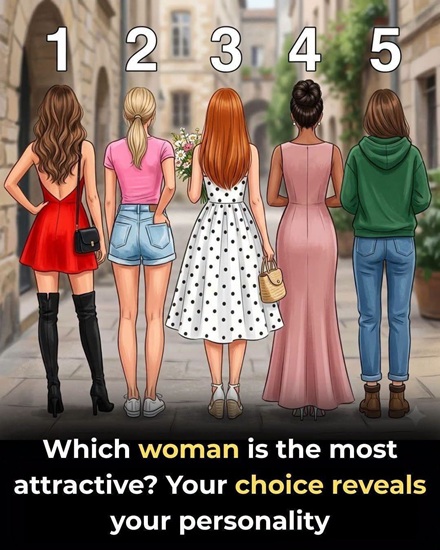
An illustration showing several women from behind asks viewers to choose which one they believe will be the most attractive when she turns around. The image then connects each answer with a personality description, suggesting that the viewer’s choice can reveal something important about character. It is an entertaining format because the image leaves out one of the most important pieces of information: the women’s faces. Since viewers cannot actually see what each person looks like from the front, they have to fill in the missing information using posture, clothing, hairstyle, body position, color, and intuition.
That makes the puzzle interesting, but it does not make it a scientific personality assessment. The exercise is better understood as a demonstration of how quickly people create stories from incomplete visual information. A viewer may look at one figure and immediately associate upright posture with confidence. Another person may focus on clothing and assume that a particular style suggests elegance, creativity, or independence. Someone else may choose the least obvious figure because they deliberately want to avoid the choice that appears most conventional.
None of those reactions is necessarily right or wrong, but they are shaped by expectations rather than by verified information about the illustrated women. Because the figures are shown from behind, the viewer has almost no reliable information about their faces, expressions, voices, personalities, or behavior. Even the question of which one will be “most attractive” cannot be answered objectively from the image. Attraction is personal, and people respond differently to facial features, style, expression, movement, and many other characteristics. What one viewer finds beautiful may not be particularly attractive to another. The puzzle therefore works by encouraging prediction where the evidence is intentionally incomplete.
This missing information is important. Human beings are very good at creating complete stories from partial clues. When we see someone standing with straight shoulders, we may describe that person as confident even though posture can change for dozens of reasons. A person might simply be comfortable, posing for a picture, stretching their back, or following instructions from an illustrator. Likewise, someone with a more relaxed posture is not automatically shy, insecure, or less confident. The visual clue exists, but the personality conclusion is added by the viewer.

Clothing can produce similar assumptions. A tailored outfit may be interpreted as professional, disciplined, or ambitious. Casual clothing might be described as relaxed or creative. A bright color could be associated with confidence, while darker clothing could be interpreted as mysterious or reserved. Those interpretations can feel natural because people learn visual associations throughout life. Yet clothing choices can depend on weather, comfort, work requirements, available options, fashion, cost, culture, occasion, or simple personal taste.
Hair can also influence how viewers construct a personality story. Long hair, short hair, curls, straight styles, tied-back hair, and different colors can all create different visual impressions. But hairstyle alone cannot tell us whether someone is kind, intelligent, loyal, confident, generous, ambitious, or trustworthy. A person may choose a hairstyle because it is practical, because they enjoy the appearance, because of cultural tradition, or simply because it is easy to maintain.
The image therefore says more about interpretation than about the women shown. Each viewer brings personal experiences, memories, preferences, cultural expectations, and learned associations to the decision. Two people can look at exactly the same figure and imagine completely different personalities. One may see confidence where another sees formality. One may interpret a style as elegant while another sees it as ordinary. Neither reaction automatically tells us anything factual about the illustrated person.
Why the Personality Descriptions Often Feel Accurate
These kinds of visual personality games often provide broad descriptions after the viewer makes a selection. One answer may say that the viewer is independent and confident. Another may describe sensitivity and loyalty. A third might emphasize ambition, creativity, or emotional depth. The descriptions are usually positive overall, while also including a small weakness or vulnerability to make them feel more realistic.
For example, a result may tell someone that they are strong but occasionally doubt themselves. Another might say they care deeply about people but sometimes hide their emotions. A third could describe someone as independent while also valuing close relationships. These statements can feel highly personal, but they apply to many different people because human behavior changes according to situation and context.
This is related to what psychologists commonly call the Barnum effect. People can interpret broad or general statements as uniquely accurate when they believe the description was specifically produced for them. The effect becomes stronger when the description contains positive characteristics combined with believable imperfections. Instead of simply saying someone is confident, a test might say they are confident in important moments but occasionally question themselves. That combination is broad enough for many readers to recognize their own experiences.
The act of choosing a picture can make the result feel even more specific. The viewer does not receive a random paragraph. They first make a decision, which creates the feeling that the later description was somehow discovered through the choice. That small process gives the interpretation greater psychological weight even though the image itself did not scientifically measure personality.
This does not mean that people are foolish for finding a result relatable. Humans naturally search for patterns and connections between new information and their own experiences. When a description matches something familiar, people notice it. When part of the description does not fit, they may give that section less attention. This is a normal part of human reasoning.
Attractiveness Cannot Be Predicted From a Hidden Face
The central question in the puzzle also depends on a very limited idea of attractiveness. The women are shown from behind, which means the viewer cannot see facial expressions or many other characteristics that often influence attraction. A person’s smile, eye contact, facial movement, voice, humor, warmth, and behavior can all affect how attractive others find them. None of those qualities is available in the illustration.
Even when a face is visible, attractiveness remains subjective. Different people have different preferences, and standards of beauty vary across cultures, historical periods, and individual experiences. There is no single set of physical features that every person considers the most attractive. What appears elegant or beautiful to one viewer may not attract another viewer at all.
Culture also shapes how people interpret posture and appearance. A clothing style associated with confidence in one environment may represent formality, modesty, rebellion, tradition, or practicality somewhere else. The same hairstyle can carry different meanings depending on cultural background and setting. That makes universal personality claims based on appearance especially unreliable.
Personal memories can influence attraction as well. Someone might prefer a particular hairstyle because it reminds them of a person they once knew. A certain color might feel pleasant because it is associated with a happy experience. Another viewer may avoid the same color because it brings back an unpleasant memory. These reactions are real, but they belong to the viewer rather than revealing objective characteristics of the illustrated woman.
Posture Can Influence First Impressions
Posture is one of the strongest visual signals in this kind of puzzle. Someone standing upright with shoulders back may immediately appear confident to many viewers. That association is understandable because upright posture is often used in photographs, advertising, theater, and public speaking to communicate self-assurance.
However, posture alone is not a reliable personality measurement. People change posture depending on fatigue, pain, footwear, mood, environment, habit, and the activity they are performing. Someone can stand confidently for a photograph while feeling nervous. Another person may have relaxed posture while feeling completely secure in themselves.
First impressions often depend on these small visual signals because people have limited information during an initial encounter. The mind tries to interpret what it sees quickly. That ability can sometimes be useful, but it also creates room for errors. A first impression is an impression, not a final fact about someone’s character.
The puzzle demonstrates this clearly because the viewer is asked to make a major judgment while possessing very little evidence. A confident-looking posture may become an entire imagined personality. A particular outfit may become a story about ambition. A hairstyle may become a story about creativity. The missing information is supplied almost automatically.
The Position of Each Figure Can Influence the Choice
Image design itself can strongly affect which woman attracts attention first. Figures placed near the center of an illustration may receive more visual attention than figures near the edges. Larger shapes may feel more important. Bright colors can stand out against muted backgrounds. Contrast can direct the eye before the viewer consciously begins comparing the options.
Negative space also matters. If one figure has more empty space surrounding her, she may appear more visually distinct. Another figure may blend into nearby shapes or colors. These are design choices, but they can influence which option feels more noticeable or attractive.
The device used to view the image can create another difference. A person looking at the puzzle on a small phone screen may see the figures at a different size from someone viewing it on a computer monitor. Some social platforms may crop or resize the image. Screen brightness, color settings, and resolution can also affect how strongly certain colors appear.
If the visual arrangement influences the decision, then the result cannot reasonably be treated as a pure measurement of personality. Moving the women into different positions might change some viewers’ choices without changing anything about those viewers themselves.
One useful way to test this idea would be to rearrange the figures and repeat the question. If a person makes a different selection after the positions change, the shift does not mean their personality changed. It means presentation influenced attention.
Why Clothing Creates Instant Stories
Clothing communicates information, but that information is often incomplete. People choose outfits for many reasons, including comfort, work, weather, culture, availability, personal style, occasion, and cost. Despite that complexity, viewers can quickly attach personality traits to clothing.
A formal outfit may lead someone to imagine professionalism or seriousness. A flowing dress may suggest freedom or romance. Athletic clothing might create assumptions about energy or health. Bright clothing might be interpreted as confidence. These associations come from familiar cultural patterns rather than reliable knowledge about the person wearing the clothes.
The problem appears when a visual association becomes a judgment about character. A person wearing expensive clothing is not automatically more successful or intelligent. Someone dressed casually is not automatically less ambitious. A quiet style does not prove shyness, and a dramatic style does not prove confidence.
The illustration becomes more interesting when viewers notice these assumptions rather than accepting them automatically. Instead of asking only which woman appears most attractive, ask what information led to the decision. Was it the outfit? Was it the body position? Was it a color? Was it an assumption about what a certain style represents?
That second question reveals much more about how perception works.
First Impressions Are Powerful but Incomplete
People form first impressions quickly in everyday life. In workplaces, classrooms, social events, interviews, shops, and other settings, appearance can influence what people expect before a conversation even begins. Someone may be assumed to be confident, friendly, serious, competent, shy, or creative based on visual cues alone.
Those impressions are not always conscious. A person may simply feel more comfortable approaching one individual than another without immediately understanding why. Clothing, posture, facial expression, age, voice, and surroundings can all influence those reactions.
The important point is that first impressions can change. Once people begin talking, initial assumptions may be confirmed, modified, or completely overturned. Someone who initially appears reserved may turn out to be highly expressive. A person who looks confident may actually be nervous. Someone whose clothing seems formal may have an extremely playful personality.
Real understanding requires more information than appearance provides.
That is why a puzzle based on hidden faces should not be used to judge actual women or make serious claims about people. The illustration creates uncertainty intentionally. Turning those incomplete clues into permanent judgments would miss the most interesting lesson of the exercise.
Appearance Cannot Reveal Kindness or Intelligence
A photograph cannot reliably tell us whether someone is kind. Kindness is demonstrated through behavior over time. It involves how a person treats others, responds to difficulties, handles responsibility, and behaves when there is nothing to gain from being helpful.
The same applies to intelligence. Clothing, posture, hairstyle, body shape, or attractiveness cannot measure intelligence. Cognitive ability is complex and cannot be determined by looking at a person’s appearance.
Health is another area where visual assumptions can be especially misleading. Someone may look energetic while managing a health condition, or appear tired after an ordinary sleepless night. A single image cannot provide the information needed for health conclusions.
Relationship status is equally impossible to determine reliably from this kind of illustration. A hairstyle or outfit cannot tell us whether someone is single, married, dating, happy in a relationship, or interested in a relationship at all.
Moral character also cannot be read from physical appearance. Reliability, honesty, generosity, and integrity become visible through actions and choices, not through the way someone stands in an illustration.
A Better Question to Ask After Making Your Choice
The puzzle becomes much more useful when the viewer asks why they selected a particular figure. Try identifying the exact detail that influenced the decision. Was it posture? Clothing? Hair? Color? Symmetry? Position? Or was the choice based almost entirely on intuition?
Once the reason is identified, imagine changing that detail. If clothing colors were exchanged between the figures, would your answer remain the same? If every woman had the same hairstyle, would one still stand out? If their positions were rearranged, would you notice someone else first?
These small thought experiments show how much visual information influences preference.
Another useful exercise is to imagine that every figure has the same face. Would the prediction about attractiveness still feel as strong? If not, the original choice probably depended on a story created from the visual clues rather than real information about the face.
Now imagine that all the women have identical personalities and backgrounds. Would you still associate one posture with confidence and another with sensitivity? The answer may reveal how quickly appearance becomes connected with imagined character.
Attraction Is Personal
There is nothing wrong with having visual preferences. Attraction does not require scientific justification. Someone may simply prefer one hairstyle, style of clothing, body position, or visual composition over another.
Personal attraction becomes problematic only when it is treated as proof of another person’s value or character. Finding someone attractive does not mean they are kinder, smarter, more trustworthy, or more successful. Likewise, not being attracted to someone does not make that person less valuable.
The puzzle works because it combines attraction with personality storytelling. Viewers first select an image and then receive a description that makes the choice feel meaningful. As entertainment, this can be enjoyable. As evidence about personality, it is extremely limited.
Keeping that distinction clear allows people to participate without turning the result into an unfair label.
Personality Is Much More Complex Than One Visual Choice
Real personality assessment involves patterns of behavior across different situations and over time. Personality is not captured by a single preference or a quick answer to an online image.
Even formal psychological assessments have limitations and must be interpreted carefully. Good assessment methods use structured questions, evidence, validation, and appropriate context. They do not determine someone’s personality from which illustrated woman appears most attractive from behind.
People also contain traits that may seem contradictory. Someone can be confident in one setting and uncertain in another. A person may be highly independent while also valuing close relationships. Someone can be sensitive and resilient at the same time.
That complexity is normal.
A short online result cannot summarize everything about an individual, and it should never be treated as though it can.
The Barnum Effect Helps Explain the Appeal
Imagine receiving the statement: “You are strong, but sometimes you question your decisions.” Many people could recognize themselves in it.
Now imagine receiving that statement immediately after selecting Figure No. 3 from a personality puzzle. Suddenly, the same sentence may feel much more personal.
The image creates the impression that the statement was generated specifically because of the choice.
This is where the Barnum effect becomes important. Broad statements feel personalized when people believe a process has identified something unique about them.
Personality puzzles often make these statements even more believable by combining strengths and weaknesses. Instead of saying only that someone is independent, the result might say they are independent but occasionally wish others understood them better.
That balance feels realistic because almost everyone experiences both confidence and vulnerability in different situations.
The Most Interesting Result May Be the Assumption Itself
Rather than asking whether the personality description is correct, consider examining the story your mind created before you even clicked an answer.
What did you assume about the woman you selected?
Did you imagine she was confident?
Friendly?
Elegant?
Independent?
Successful?
Why?
If those ideas came entirely from posture, clothing, or hair, then the exercise has demonstrated something interesting about first impressions.
The mind often fills missing information very quickly.
That ability helps people navigate complicated environments, but it can also create inaccurate assumptions.
Recognizing the process can make future judgments more careful.
First Impressions Do Not Have to Become Final Conclusions
Nobody can completely avoid first impressions. Human perception works quickly, and people naturally notice appearance and behavior.
The goal is not to pretend those impressions never happen.
A better approach is to recognize that an early impression may be incomplete.
If someone initially appears unfriendly, wait for actual behavior before making a final judgment. If someone looks confident, allow the possibility that they may still feel nervous. If a person’s clothing creates an assumption about their background or personality, remember that clothing is only one small piece of information.
The illustration demonstrates this principle in an exaggerated way because it deliberately hides the women’s faces.
The viewer is forced to make a prediction without enough information.
That is precisely why the puzzle can become more interesting than its personality labels suggest.
Try the Puzzle as a Small Experiment
Choose one woman quickly without thinking too much.
Then write down the reasons for your choice.
Look at the image again and identify which reasons came from visible evidence and which came from assumptions.
Now imagine changing the colors of the clothing.
Would your choice change?
Imagine moving the figures into different positions.
Would someone else attract your attention first?
Finally, imagine that all the women turn around and have exactly the same face.
How many of your original assumptions would remain?
This small exercise does not reveal a hidden personality trait, but it can reveal how visual information influenced the decision.
Beauty and Character Are Different Questions
One of the most important distinctions in the puzzle is between attractiveness and personality.
A person can be physically attractive to someone without sharing the personality that viewer imagined.
Likewise, someone who does not match a viewer’s personal beauty preferences can have qualities that make them deeply appealing once they are known.
Conversation, humor, kindness, creativity, reliability, intelligence, shared interests, and emotional connection can all influence attraction over time.
A static illustration cannot represent those experiences.
That is another reason the question “Who will be most attractive when she turns around?” has no objectively correct answer.
The viewer is predicting something that remains unknown.
Enjoy the Puzzle Without Turning It Into a Judgment
There is no harm in choosing a figure and reading the description as entertainment.
Perhaps the result will feel surprisingly accurate.
Perhaps it will seem completely wrong.
Either response is fine.
The important thing is to keep the conclusion proportionate.
The image does not diagnose personality.
It does not determine values.
It does not reveal intelligence.
It does not identify someone’s emotional health.
And it does not tell us anything reliable about the actual women represented in the illustration beyond the visual details shown.
What the Puzzle Can Genuinely Show
The puzzle can demonstrate that people notice different details.
One viewer may focus on posture.
Another may notice color.
Someone else may care most about hairstyle.
A fourth person might deliberately reject the most visually obvious answer.
These differences can lead to an interesting conversation about preference, expectation, and perception.
They do not need to become psychological labels.
The viewer can simply ask, “What made that figure stand out to me?”
That question is grounded in the actual experience of looking at the image.
The Missing Information Is the Point
Perhaps the most interesting thing about the illustration is everything it does not show.
The faces are hidden.
The personalities are unknown.
There are no voices.
There is no behavior.
There is no background information.
Yet within seconds, viewers may feel they know which woman will be beautiful, confident, friendly, ambitious, or interesting.
The mind has filled in the gaps.
That process is far more revealing than any prepared personality result.
It demonstrates how quickly expectations can turn incomplete information into a complete narrative.
A Playful Puzzle Can Still Encourage Better Judgment
Online personality images do not need to be scientific to be enjoyable.
They can simply be used as conversation starters.
Choose a figure.
Read the result.
Then ask whether the description genuinely follows from the evidence or whether your mind supplied most of the story.
That small distinction can encourage more thoughtful first impressions in everyday life.
People are always more complicated than the first visual clues they present.
Posture can change.
Clothing can change.
Hair can change.
Mood can change.
Context can change.
Character requires much more information.
The Real Takeaway
The illustration may promise to reveal personality by asking which woman will look most attractive when she turns around, but the available information cannot support that conclusion scientifically.
The more realistic lesson concerns expectation.
People naturally make predictions from incomplete visual information.
Those predictions are influenced by personal taste, culture, memory, design, and learned associations.
Sometimes the predictions may happen to be correct.
Other times they may be completely wrong.
The image cannot tell the difference.
That is why the best way to enjoy the puzzle is to treat it as entertainment and reflection rather than a test.
Choose whichever figure catches your attention.
Enjoy the personality description if it resonates.
Then take one more moment to ask what actually influenced the decision.
Was it posture?
Color?
Clothing?
Hair?
Position?
Or simply intuition?
The answer may reveal something about your current preference, but it does not define your personality.
More importantly, it may demonstrate how quickly the human mind creates a story when important information is missing.
That is a much more useful observation than trying to predict which hidden face will be the most beautiful.
First impressions are natural, but they do not have to become permanent conclusions.
A person is always more complex than a silhouette, an outfit, a hairstyle, or a single moment captured from behind.
