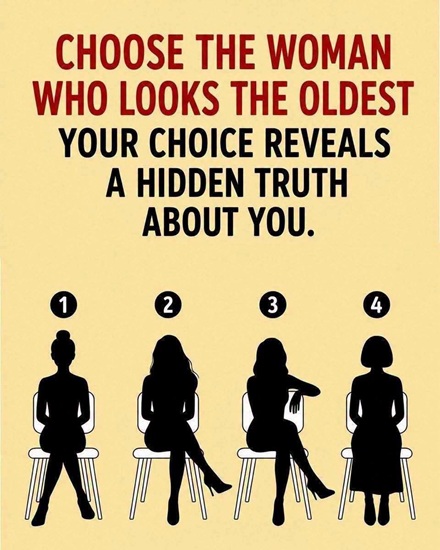
A picture showing four stylized women and asking viewers to decide which one looks the oldest may appear to be a simple visual challenge. Within seconds, many people will probably feel confident that one figure is the obvious answer. Yet the illustration does not provide verified ages, biographies or enough objective information to determine which woman is actually older. The puzzle is therefore better understood as entertainment and an opportunity to examine first impressions rather than as a genuine psychological assessment.
Human beings are remarkably quick at forming impressions from visual information. Clothing, posture, hairstyle, body position, facial expression and movement can all influence how old, confident or approachable someone appears. These judgments can happen before we consciously analyze why we made them. That speed is useful in many everyday situations, but it also means an impression can feel certain even when it is based on limited evidence.
Age is particularly difficult to estimate accurately from an ambiguous drawing. In real life, people of the same age can look dramatically different, and people separated by many years can sometimes appear similar. Genetics, hairstyle, clothing, health, environment, facial expression and numerous other factors can influence perceived age. A simplified illustration removes even more information, making any confident age ranking largely subjective.
Culture can influence these judgments as well. A hairstyle associated with older adults in one person’s childhood may appear fashionable among younger people in another place or generation. Conservative clothing might suggest maturity to one viewer while communicating professional style to another. Even posture can be interpreted differently depending on the observer’s previous experiences.
That is why two people can study the same four women and immediately choose different answers. Neither person necessarily failed to notice something obvious. Instead, each may have prioritized different visual cues. The interesting part of the exercise is therefore not discovering a hidden “correct” personality but considering which details influenced the choice.
If You Choose Woman Number One
People selecting Woman Number One may be responding to visual cues they associate with composure, structure or maturity. Perhaps her posture appears controlled, her clothing seems organized or her overall presentation feels more formal than the others. In a playful personality interpretation, those preferences can be connected with qualities such as discipline, responsibility and dependability.
Someone who values organization may prefer to understand a situation before reacting. They might appreciate schedules, clear expectations and practical solutions. Friends or colleagues may see such a person as reliable because they tend to remain focused when circumstances become complicated. These are broad possibilities rather than conclusions that can genuinely be derived from choosing a drawing.
The same preference for structure can occasionally create challenges. People who feel comfortable with organization may become frustrated when plans change unexpectedly or when someone approaches a problem in a less systematic way. They may also interpret disorganization as irresponsibility even when circumstances provide a reasonable explanation.
A useful reflection for anyone who recognizes these tendencies is to leave room for additional information. Organization can remain a strength without becoming rigidity. A person can prefer structure while acknowledging that other people may achieve equally good results through different methods.
If You Choose Woman Number Two
Woman Number Two might attract viewers who notice qualities they interpret as relaxed, expressive or approachable. Her appearance may create an impression of emotional openness or informality. A lighthearted personality quiz might associate that choice with empathy, creativity and an interest in understanding how other people feel.
People who identify with those qualities may enjoy meaningful conversations and notice subtle changes in someone’s mood. They might be good listeners or place considerable value on emotional connections. Creativity can also appear in many forms, from art and writing to finding unconventional solutions to everyday problems.
Sensitivity, however, can sometimes become emotionally demanding. Someone who pays close attention to other people’s feelings may begin carrying worries that are not actually theirs to solve. They may replay conversations or imagine possible outcomes long after a situation has ended.
Healthy boundaries can help prevent empathy from becoming exhaustion. Caring about another person does not require taking responsibility for every emotion that person experiences. The playful interpretation therefore offers a useful general reminder: compassion can be strongest when it exists alongside an ability to protect one’s own time and energy.
If You Choose Woman Number Three
Viewers selecting Woman Number Three may be responding to an impression of independence or confidence. Her pose might appear decisive or self-assured, leading some people to interpret her as particularly mature. In the language of casual personality quizzes, that choice is often connected with leadership, directness and willingness to take initiative.
Someone who recognizes those characteristics may be comfortable expressing an opinion even when other people disagree. They might enjoy new experiences and prefer making decisions rather than waiting indefinitely for circumstances to change. Confidence can be especially valuable when a group needs someone willing to accept responsibility.
Yet decisiveness has its own potential weakness. A confident person can occasionally reach a conclusion before quieter perspectives have been heard. Speaking first or most forcefully does not necessarily mean having the most accurate understanding of a situation.
The useful reflection here is that confidence and curiosity can work together. Strong leadership does not require ignoring disagreement. In many circumstances, listening carefully to people who see a problem differently can improve a decision rather than weaken authority.
If You Choose Woman Number Four
Woman Number Four may attract people who perceive her appearance as classic, calm or stable. Those visual cues might be interpreted as signs of experience or maturity. A playful personality reading could associate the choice with patience, practicality, loyalty and an appreciation for dependable routines.
People who value stability often appreciate knowing what to expect. They may prefer long-lasting relationships over constant novelty and might take time before trusting someone completely. Once trust develops, however, they may place great importance on maintaining those relationships.
Routine can provide comfort and efficiency, but it can occasionally make unfamiliar experiences seem unnecessarily risky. Someone who values predictability may reject a new opportunity simply because it falls outside established habits.
Trying something different does not require abandoning everything familiar. Small changes can allow a person to explore new possibilities while maintaining the stability they value. In that sense, adaptability and tradition do not need to be opposites.
Why These Descriptions Can Feel Surprisingly Accurate
There is an important reason personality quizzes like this can seem more precise than they actually are. The descriptions usually contain broad characteristics that apply to many people in at least some situations. Most individuals can be organized at certain times, sensitive in others, confident under some circumstances and cautious under different ones.
Psychology has long recognized a phenomenon commonly called the Barnum or Forer effect. People can perceive broad, generally applicable personality descriptions as uniquely accurate when they believe those descriptions were specifically generated for them. This helps explain why informal personality readings can feel deeply personal even when they have not been scientifically validated.
Positive traits paired with gentle cautions can be particularly convincing. A description such as “you care deeply about people but sometimes worry too much” could accurately describe a huge number of individuals. Recognizing oneself in the statement does not prove that selecting a particular woman revealed that information.
That does not mean visual quizzes cannot be entertaining. They simply need to be presented for what they are. A casual internet puzzle can start conversations or encourage reflection without claiming to diagnose personality.
What Your Choice May Actually Reveal
The most interesting information may concern what caught your attention rather than what type of person you supposedly are. Perhaps you associated a particular hairstyle with age. Maybe clothing influenced you more strongly than posture. Another person might have focused almost entirely on facial expression.
Comparing answers with friends can make these differences especially visible. Two people might select different women while each believes their answer is obvious. Asking why they made those choices can reveal how differently people interpret exactly the same visual information.
Those conversations can also expose assumptions about aging. People sometimes associate older age with conservative clothing, shorter hairstyles, slower movement or a more serious expression. None of those features reliably determines someone’s age.
Real older women have enormously diverse appearances, personalities and styles. Some wear traditional clothing, while others follow the latest fashions. Some have long hair and others short hair. People remain physically active at very different levels throughout life, making posture an unreliable shortcut for determining age.
Recognizing an automatic association does not mean someone intentionally holds a negative view about older adults. The important step is noticing that the association exists. Once people become aware of how quickly they made an assumption, they can examine whether the available evidence actually supports it.
The same principle extends far beyond age. Human beings routinely form impressions based on clothing, body language, hairstyle, occupation and countless other visible details. Sometimes those judgments are useful, but sometimes they are simply stories the brain creates to fill gaps in information.
Entertainment, Not a Psychological Test
No selection among these four women can scientifically determine whether someone is responsible, creative, independent or traditional. A valid psychological assessment requires carefully developed methods, evidence about reliability and validity, standardized procedures and appropriate interpretation. An online illustration with four choices does not meet those standards.
There is also no objective scoring system hidden inside the image unless its creator specifically constructed one for entertainment. Choosing Woman Three instead of Woman One does not place a viewer into a scientifically recognized personality category.
The descriptions can nevertheless serve as prompts for self-reflection. If a statement about organization feels relevant, someone might think about how they respond when plans unexpectedly change. If the section about empathy resonates, they might consider whether they maintain healthy emotional boundaries.
In that way, the value comes from the questions people ask themselves afterward rather than from the supposed accuracy of the original selection.
Ultimately, the four-woman puzzle demonstrates something genuinely interesting, even if it cannot reveal a hidden personality. It shows how quickly the human mind transforms limited visual information into a confident conclusion.
Within seconds, a viewer can look at four stylized figures and decide that one must be older than the others. Another viewer can examine the same image and become equally certain of a completely different answer. Neither has access to actual ages.
That gap between certainty and evidence is what makes the exercise worth considering. The brain naturally searches for patterns, draws on previous experiences and fills in missing information. Usually, this happens so quickly that we barely notice the process.
So there is no need to worry about whether you chose Woman One, Two, Three or Four. The selection cannot define your character or reveal a hidden psychological truth. Instead, consider what made one figure look older to you and whether another person interpreted those same clues differently.
Used this way, the puzzle becomes something more interesting than a personality verdict. It becomes a small exercise in noticing how perception works. The most revealing question is not necessarily “Which woman is the oldest?” but rather: What made you so certain that she was?
