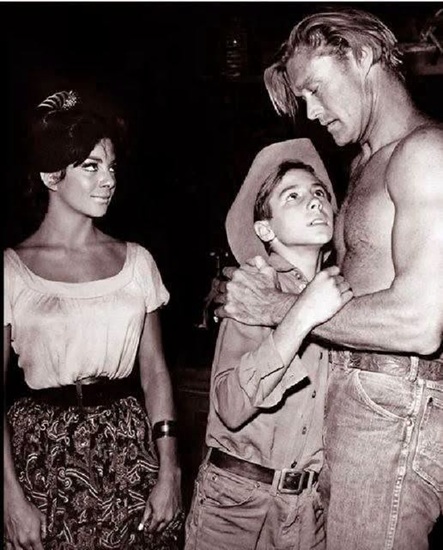
More than six decades after The Rifleman first appeared on American television, the Western remains memorable for much more than gunfights. At the heart of the series was Lucas McCain, a widowed rancher played by Chuck Connors, and his young son Mark, portrayed by Johnny Crawford. Their relationship gave the program an emotional dimension that distinguished it from many other Westerns of its era. Yet viewers returning to the series today can also discover historical inconsistencies, production shortcuts and behind-the-scenes details that reveal how this classic television Western was actually created.
The Rifleman premiered on ABC in September 1958 and remained on television for five seasons, producing 168 episodes before ending in 1963. The series was set primarily around the fictional town of North Fork in New Mexico Territory during the 1880s. Westerns were enormously popular on American television at the time, so a new program needed something distinctive if it hoped to stand apart from the competition.
The series found that distinction partly through its central family relationship. Lucas was not simply another wandering gunfighter moving from town to town. He was a rancher and single father responsible for raising Mark after the death of the boy’s mother. Stories frequently placed Lucas in situations where he had to protect his son while also teaching him about responsibility, honesty, courage and the consequences of violence.
That father-son relationship became one of the show’s defining strengths. Johnny Crawford later said that he and Connors quickly developed a comfortable working relationship and credited the scripts with helping make their on-screen connection believable. Crawford remembered Connors as entertaining to work with and spoke warmly about their professional partnership years after the series ended.
Connors himself brought an unusual background to Lucas McCain. Before becoming an established actor, he had been a professional athlete, playing both Major League Baseball and professional basketball. At approximately 6 feet 5 inches tall, he had the physical presence required for a television Western hero while still being able to portray Lucas as an affectionate father.
But the most recognizable object associated with Lucas was unquestionably his rifle.
The opening credits made it impossible to miss. Lucas walks down North Fork’s main street while rapidly firing a lever-action Winchester. The sequence immediately communicated what separated this Western hero from many others. Lucas did not rely primarily on the revolver traditionally associated with television cowboys; his customized rifle was his signature weapon.
There was just one historical problem.
The gun most closely associated with Lucas was a modified Winchester Model 1892 chambered in .44-40. As its name indicates, that particular Winchester model did not exist during the early 1880s period in which the series was set. The Model 1892 was designed later, making the show’s most famous prop an obvious historical anachronism.
The producers were not simply trying to reproduce an ordinary historical firearm. The rifle was modified specifically to create Lucas McCain’s distinctive rapid-fire style. Its oversized lever allowed Connors to perform the memorable spin-cocking movement associated with the character. A set screw could also be positioned so that cycling the lever activated the trigger, helping create the rapid firing seen in the series.
Gunsmiths prepared multiple rifles for production. Two Winchester Model 1892 carbines were modified for regular and close-up filming, while a Spanish-made El Tigre lever-action rifle was adapted for situations where the weapon might be dropped, thrown or otherwise damaged during stunt work. The production therefore protected its more valuable hero props by substituting another firearm when necessary.
Even the famous opening sequence involved television illusion. Blank ammunition differed from standard cartridges, allowing the production to create the rapid series of shots audiences heard and saw. Gunshot sounds were also enhanced for television. What viewers experienced as effortless frontier marksmanship was actually the product of specially prepared equipment, performance, editing and sound work.
The rifle was not the only detail that modern viewers have questioned.
Fans have identified clothing that reflects the period when the program was filmed rather than the historical era it portrayed. One particularly visible example involves Lucas’ jeans. In some episodes, the recognizable stitched “W” associated with Wrangler can be seen on his back pockets. Wrangler jeans were introduced in the 20th century, decades after the fictional events of The Rifleman.
Hairstyles can similarly reveal the show’s production era. Although the characters are supposed to inhabit the 19th-century American West, many hairstyles naturally resemble those worn during the late 1950s and early 1960s. Costume departments on historical television programs frequently balanced period atmosphere with what contemporary audiences expected their stars to look like.
Men’s shirts have also been identified as a source of historical inconsistency. Some clothing styles visible throughout the program became common much later than the 1880s. These details were unlikely to trouble most original viewers watching on relatively small television sets, but high-quality reruns and modern freeze-frame viewing make them easier to notice.
There are geographical and historical curiosities as well. The series connects Lucas and Mark with Enid, Oklahoma, yet Enid’s historical development does not neatly match the show’s early-1880s chronology. Oklahoma Territory itself underwent major settlement changes later in the century, and Enid became associated with the 1893 land opening. That makes references to the location another example of television storytelling taking precedence over precise chronology.
Individual episodes contain the sort of continuity errors familiar to virtually every long-running television production. Props can appear or disappear between shots. Clothing can change unexpectedly after an edit. A rifle that was missing from a horse in one shot can suddenly be present moments later. Such mistakes usually resulted from scenes being filmed from multiple angles or at different times and then assembled during editing.
These imperfections are particularly interesting because television production during the period operated very differently from today’s environment. Audiences originally watched episodes once per week on comparatively small screens. Producers had little reason to expect viewers to pause a scene, enlarge individual frames and compare props with historical photographs.
Modern audiences can do exactly that.
As a result, objects that might have passed unnoticed in 1959 can now become subjects of detailed discussion. A modern logo, incorrect firearm or continuity change can be isolated in seconds. These discoveries do not necessarily expose hidden messages; usually they reveal the practical realities of producing a weekly television series under deadlines.
One genuinely interesting behind-the-scenes story concerns Sam Peckinpah, who was involved with The Rifleman during its formative period. Before becoming famous for films such as The Wild Bunch, Peckinpah wrote for the series and played an important role in developing its early dramatic identity.
According to PBS’s Pioneers of Television, Peckinpah imagined something more psychologically demanding than a conventional action Western. He wanted young Mark McCain to confront difficult realities and learn about the harshness of frontier life through his relationship with his father.
That creative vision was not fully carried forward. Peckinpah left after the first season, while The Rifleman increasingly emphasized the warmer father-son relationship that audiences came to love. The gunplay remained, but the program’s emotional center developed into the connection between Lucas and Mark.
It would be misleading, however, to transform that creative disagreement into claims of a secret feud that nearly destroyed the program. Television productions frequently change direction as producers, networks and writers determine what works best. The documented history supports a difference in creative vision, not the more dramatic stories sometimes attached to old television programs online.
The same caution applies to claims that Chuck Connors and Johnny Crawford secretly disliked each other.
Crawford’s own interviews provide a much more complicated and generally affectionate picture. In a 2017 interview later republished by Cowboys & Indians, he said the two “hit it off” when they began working together. He described Connors as easy to work with and said the older actor tried to be a positive influence on him while treating him seriously as a fellow performer.
Crawford also acknowledged that the real Connors was not identical to Lucas McCain. In another interview, he described Connors as a practical joker who could be imposing and enjoyed intimidating people. That hardly means their relationship was hostile. Crawford also said he respected Connors and enjoyed working with him.
That distinction is valuable because audiences often assume that actors who convincingly portray relatives must have had exactly the same relationship when filming stopped. Connors was not literally Crawford’s father, and there was no reason their off-screen interaction had to duplicate Lucas and Mark’s fictional bond.
What mattered for the series was that viewers believed the relationship while watching.
The scripts gave Lucas responsibilities rarely explored with such emphasis in action-oriented Westerns. He could be physically formidable when danger appeared, but he also had to explain difficult decisions to his son. Violence often produced consequences that became part of Mark’s education rather than existing solely for spectacle.
That tension gave the series more emotional complexity than its famous rapid-fire introduction might suggest. Lucas owned a weapon capable of dominating a confrontation, yet many episodes emphasized judgment and restraint. The rifle attracted audiences, while the relationship between father and son gave them a reason to care about what happened afterward.
This also explains why the show’s historical inaccuracies have not destroyed its reputation among fans. The Rifleman was never a documentary reconstruction of 1880s New Mexico. It was a television drama produced between 1958 and 1963, using the costumes, props, production techniques and cultural assumptions available to filmmakers at that time.
The Model 1892 is perhaps the perfect example. Historically, it is wrong for the show’s setting. Dramatically, however, it became inseparable from Lucas McCain. The oversized lever, rapid-fire action and Connors’ ability to handle the rifle created one of the most instantly recognizable images in television Western history.
Correcting the firearm to something perfectly appropriate for the fictional year might have improved historical accuracy, but it could also have eliminated the visual gimmick that helped make the character distinctive.
The Wrangler jeans tell a similar story on a smaller scale. They clearly do not belong in the 1880s, but costume departments were creating a version of the Old West that needed to look believable to viewers in the middle of the 20th century. Television Westerns frequently reflected the era in which they were made as much as the historical periods they attempted to depict.
This does not mean errors should be ignored. Spotting them can be an enjoyable way to revisit a familiar program. Historical research can reveal which objects genuinely existed, how people actually dressed and where television production took shortcuts.
The important thing is distinguishing documented mistakes from unsupported claims.
A visible Wrangler logo can be compared with the company’s history. A Winchester Model 1892 can be dated against the show’s fictional timeline. A continuity mistake can be demonstrated by comparing consecutive shots. Those are observable issues.
Claims that an unidentified scene “confirms what everyone suspected” require considerably more caution. Without knowing precisely which scene is being discussed and what evidence supports the interpretation, such language creates mystery without establishing a fact.
The real history of The Rifleman is already interesting without inventing secrets.
It was a major television Western that premiered during an era crowded with competitors and still managed to establish a distinctive identity. Chuck Connors turned an anachronistic customized rifle into an iconic prop. Johnny Crawford helped create one of early television’s memorable father-son relationships. Sam Peckinpah contributed to the program’s formative creative vision before moving on.
And like virtually every large television production, it contained mistakes.
Some involved historical chronology. Others involved costumes or props. Still others were ordinary continuity problems created when different shots were edited together. Modern technology has simply made those imperfections much easier for viewers to discover.
There is something appealing about seeing them today. The mistakes remind audiences that classic television was built by real people working under schedules and practical limitations. North Fork was not an actual 1880s community captured by hidden cameras. It was a carefully constructed fictional world.
Recognizing that does not have to diminish the series.
If anything, knowing how the illusion was created can make the craftsmanship more interesting. The customized rifle, stunt substitutes, blank ammunition, sound effects, sets and costumes all worked together to create a world convincing enough that viewers continued returning every week.
The show’s greatest achievement may still be the relationship between Lucas and Mark. Long after the gunfights and historical inconsistencies are noticed, the emotional connection between father and son remains understandable. Crawford himself believed that relationship was a major reason audiences continued responding to the series years later.
So the most surprising truth about The Rifleman is not a hidden scandal contained in one unedited frame. It is that one of television’s most convincing Western worlds was filled with details that never actually belonged to the 1880s — including the very rifle that gave the program its name.
The Winchester was too new. Some clothing was far too modern. Certain locations and phrases did not fit the chronology, and continuity sometimes shifted between shots. Yet audiences accepted North Fork because television storytelling made those details feel convincing enough.
More than 60 years later, fans can enjoy both sides of that legacy. They can appreciate Lucas McCain and Mark’s enduring relationship while also spotting the seams in the fictional frontier surrounding them.
Those imperfections do not reveal that The Rifleman was secretly something entirely different from what audiences remembered. They reveal something simpler and more historically interesting: classic television was an illusion created with ingenuity, compromises and occasional mistakes — and in the case of The Rifleman, that illusion became memorable enough to survive long after the cameras stopped rolling.
