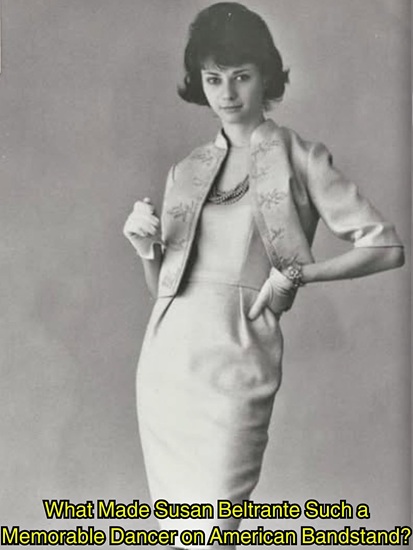
Long before Susan Beltrante became one of the familiar young faces associated with American Bandstand, she entered the Philadelphia television studio under unusual circumstances. Susan was the youngest of three Beltrante sisters who became connected with the enormously popular dance program during its Philadelphia years. According to historical accounts devoted to the show’s regular dancers, her older sister Rosalie first took Susan to American Bandstand when Susan was only twelve years old.
That presented an immediate problem because the program maintained an age requirement for the teenagers admitted to the studio. Susan was younger than the official minimum age, yet that did not completely prevent her from becoming part of the Bandstand story. The admission rules during Dick Clark’s early years as host were surprisingly specific. Historical research on the program states that teenagers younger than fourteen or older than eighteen were not supposed to be admitted.
Susan, at twelve, was therefore approximately two years below the minimum age when Rosalie first brought her along. An account focused specifically on the Bandstand dancers says Clark knew Susan’s real age and told her not to reveal that she was under fourteen because she would otherwise have to leave. Rather than immediately becoming a prominent dancer, Susan reportedly spent much of her early time sitting in the bleachers.
That detail offers an interesting perspective on how her relationship with the program began. Susan did not initially enter the studio as an established television personality or someone expecting national attention. She was a young girl accompanying an older sister who was already connected to the show. From the bleachers, she could watch teenagers dancing while cameras captured scenes that were being transmitted into homes across the United States. What began as an opportunity to accompany her sister gradually placed Susan inside one of the most influential television programs in American popular culture.

Rosalie’s role in Susan’s childhood extended beyond taking her to a television studio. Historical profiles of the Beltrante sisters describe Rosalie as the oldest daughter and an important caretaker within the household. Their mother worked as a waitress, reportedly on a shift running from approximately 3 p.m. until midnight. That schedule meant Rosalie frequently helped look after her younger sisters and brother. Susan was therefore following someone who was not simply an older sibling but a person who had taken on considerable responsibility within the family.
There were three Beltrante sisters associated with the Bandstand world: Rosalie, Mary, and Susan. Contemporary memories and later histories of the program identify all three as recognizable regulars. Mary, the middle sister, was born in 1943 and attended South Philadelphia High School. Historical accounts identify Steve Colanero as Mary’s regular dancing partner and date during part of her time on the program. Rosalie was also sufficiently well known among viewers that other Bandstand participants later remembered her decades after those broadcasts had ended.

The sisters entered television at an extraordinary moment in the development of American youth culture. Bandstand had begun as a Philadelphia television program on WFIL-TV in 1952 with radio personality Bob Horn as its host. Dick Clark replaced Horn in 1956. Clark did not create the original program, but his arrival would become crucial to its transformation. Under Clark, the program developed the carefully controlled, clean-cut presentation that millions of viewers would eventually associate with American Bandstand.
The biggest transformation occurred on August 5, 1957, when the program began broadcasting nationally on ABC as American Bandstand. Suddenly, teenagers dancing inside a Philadelphia television studio could be watched by young people across the country. Historical estimates place the program’s audience at approximately twenty million viewers during the height of its early national popularity. Local teenagers who had entered the studio to dance could consequently become recognizable to people living hundreds or even thousands of miles away.
That enormous audience helped turn some of the show’s regular dancers into an unusual early form of teenage television celebrity. They were not professional actors playing fictional characters, nor were most of them recording artists promoting albums. They were teenagers dancing to popular records in front of television cameras. Yet viewers learned their names, recognized their partners, followed their clothing choices, and sometimes sent them fan mail. The regular dancers became part of what made the program feel familiar from one broadcast to the next.

Susan eventually became one of those recognizable regulars. Historical listings generally place her regular involvement with American Bandstand from approximately 1958 through 1961. Sources devoted to the dancers connect her with Ed Kelly, also listed in Bandstand histories as Eddie Kelly, as one of her dancing partners. Other surviving photographs connect Susan with additional regular dancers, demonstrating that partnerships on the floor were not necessarily permanent. A surviving archival fan-site photograph, for example, identifies Susan dancing with Norman Kerr.
The environment Susan entered was much more regulated than the spontaneous dancing visible on television might have suggested. Dick Clark maintained a strict code of appearance and behavior for the teenagers appearing on camera. Boys were expected to arrive wearing appropriate shirts, ties, and jackets or sweaters. Girls were expected to wear dresses or skirts and conservative blouses. Tight sweaters, low necklines, and trousers for girls were among the clothing choices prohibited under the show’s rules.
The restrictions went beyond clothing. Historical accounts say gum chewing, smoking, profanity, and other behavior considered inappropriate for the show’s carefully cultivated image were prohibited. Clark wanted the teenagers appearing alongside rock-and-roll music to look respectable to parents watching at home. During an era when some adults regarded rock and roll as threatening or rebellious, American Bandstand deliberately presented its young audience as orderly and well behaved. That approach became a major part of the show’s public identity.

Fashion nevertheless emerged naturally from the teenagers appearing on screen. The young women on American Bandstand helped popularize styles that viewers around the country could imitate. Historians have specifically noted the popularity of Peter Pan collars worn by female dancers, some of which originated with Catholic school uniforms. Something as ordinary as the clothing worn by Philadelphia teenagers could suddenly influence fashion far beyond Pennsylvania because millions of viewers were watching them every week.
Music, of course, remained at the center of everything. Teenagers danced while Clark introduced records and performers, helping audiences discover new songs and new dance styles. The famous “Rate-a-Record” feature invited young participants to evaluate recordings, giving ordinary teenagers a small but highly visible role in judging popular music. The program became an important bridge connecting record companies, performers, teenage consumers, and television audiences during the rapidly changing musical culture of the late 1950s.
Susan and the other regulars occupied a fascinating position inside that system. They were ordinary young people, but television made them highly visible. They could leave the studio after a broadcast and return to normal family and school routines, yet viewers elsewhere might regard them almost like celebrities. Accounts from former Bandstand participants describe receiving fan mail and being recognized because of their appearances. The phenomenon demonstrates just how powerful television had become in shaping teenage culture.
There was also a more complicated side to the program’s carefully managed image. Historical scholarship has documented racial exclusion and discriminatory admission practices during the Philadelphia era of American Bandstand. Although Black performers appeared on the program and Black music was central to the development of rock and roll, researchers have found that African American teenagers faced significant barriers to appearing as dancers in the studio audience. That history is an important part of understanding the program rather than viewing its nostalgic image without context.
Susan’s own story remained centered on the experience of being one of the young regulars. What makes her early involvement particularly unusual is the contrast between the show’s strict admission rules and the circumstances under which she first entered. The official minimum age was fourteen, yet the historical profile of Susan says she arrived at twelve with Rosalie and that Clark knew her true age. During those early visits, spending time in the bleachers offered a way for her to remain around the program before becoming more visible as a dancer.
As Susan grew older, she moved beyond simply observing from the sidelines. Her name became part of lists of regular dancers from the late 1950s and early 1960s, alongside figures such as Mary Beltrante, Pat Molittieri, Janet Hamill, Carole Scaldeferri, Kenny Rossi, Arlene Sullivan, Justine Carrelli, Norman Kerr, and Eddie Kelly. These teenagers collectively created the visual identity viewers associated with the Philadelphia years of the show. Their dancing gave audiences something consistent to return to even when the records and musical guests changed.
The Beltrante name itself became memorable enough to survive in recollections from other Bandstand regulars. Oral histories preserved by the American Archive of Public Broadcasting contain participants remembering Rosalie and specifically recalling that there were three Beltrante sisters: Rosalie, Mary, and Susan. Such memories provide an indication of how recognizable the family became within the studio’s social world. They were not fictional television characters created by producers; they were sisters whose real teenage years happened to overlap with an extraordinary period in television history.
Susan’s years on the program were relatively brief when measured against an entire lifetime. Her regular appearances are generally associated with roughly 1958 to 1961, only a few years during adolescence. Yet those years coincided with American Bandstand’s explosive rise as a national phenomenon. She was present during a period when television, rock and roll, teenage fashion, and youth-oriented marketing were rapidly becoming intertwined in ways that would influence American popular culture for decades.
The Philadelphia chapter of American Bandstand eventually came to an end as well. The program moved its production to Los Angeles in 1964, leaving behind the studio and the generation of Philadelphia teenagers who had helped establish its national identity. By then Susan’s regular appearances had already ended. Like countless young people who briefly become recognizable during adolescence, she moved beyond the narrow period of her life that television happened to preserve.
That is why Susan Beltrante’s story is most interesting when it is told without unnecessary embellishment. There is no need to invent private conversations, thoughts, or dramatic incidents that cannot be documented. The established facts already tell a remarkable story. A twelve-year-old accompanied her older sister to a Philadelphia television studio despite being below the show’s official admission age, initially spent considerable time in the bleachers, and eventually became one of the recognizable young dancers associated with a nationally influential television program.
Her story is also inseparable from Rosalie and Mary. The three sisters shared an unusual connection to American Bandstand, but their origins were far more ordinary than their television visibility might suggest. They came from a working family in Philadelphia, with an older sister helping care for younger siblings while their mother worked long hours. Television fame did not begin with a carefully designed plan to create celebrities. It grew from ordinary teenagers repeatedly entering a local studio at precisely the moment that local program became a national sensation.
Looking back, the contrast is striking. Susan first entered the Bandstand world as someone technically too young to meet the program’s admission requirement. Within only a few years, she was appearing among dancers watched by an enormous national audience. The transition from a twelve-year-old sitting in the bleachers to a recognizable regular reflects how quickly circumstances could change during the earliest years of national youth television.
Today, those Philadelphia broadcasts provide a window into a particular moment in American cultural history. They show the clothes teenagers wore, the dances they performed, the music they followed, and the carefully controlled image television producers wanted audiences to see. They also reveal more complicated realities surrounding race, admission, gender expectations, and respectability that historians have continued to examine. Susan Beltrante’s experience represents one personal thread running through that much larger story.
Ultimately, Susan’s connection to American Bandstand did not begin with celebrity ambitions. The available historical accounts describe something much simpler: her older sister Rosalie brought her to the program when she was twelve. From that beginning came several years connected to one of television’s defining youth programs. Susan joined Mary and Rosalie among the Philadelphia teenagers whose faces became familiar to viewers during an important period in the history of popular music and television.
The image worth remembering, therefore, is not an invented dramatic scene but the documented beginning itself. Susan Beltrante was twelve years old when her older sister brought her into the world of American Bandstand. She was below the official age requirement, Dick Clark reportedly knew it, and Susan initially spent much of her time watching from the bleachers. Eventually she became one of the regular dancers whose names remain preserved in histories and memories of the program. What started as a younger sister following an older one into a television studio became a small but enduring piece of American Bandstand history.
