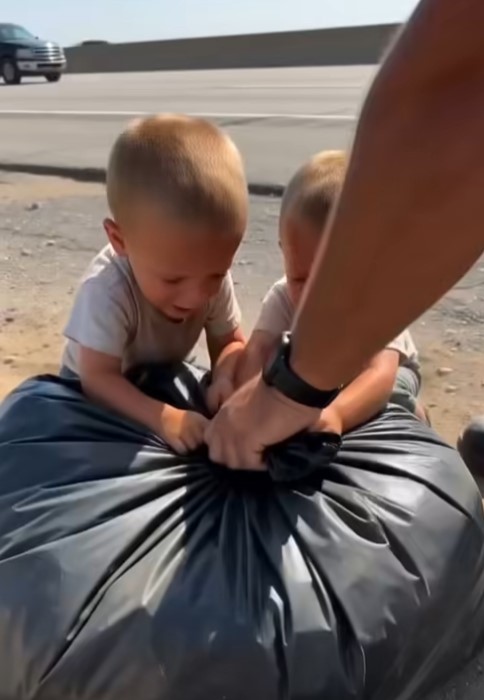
A highway patrol officer on a routine summer shift along a remote desert interstate encounters an unexpected and unusual situation that quickly turns into a large-scale welfare concern. What begins as a quiet patrol in extreme heat becomes a developing search and rescue response involving multiple agencies, all triggered by the discovery of two very young children near the roadside. The afternoon conditions are harsh, with high temperatures, minimal traffic, and long stretches of empty highway.
Officers working in such environments are trained to remain alert for stranded motorists or emergencies, but situations involving unattended children are rare and immediately raise serious concern. When the officer notices two toddlers sitting near the shoulder of the road, the situation becomes an immediate priority.
The children appear very young and vulnerable, and their presence alone on a deserted stretch of highway is unusual enough to warrant careful approach. Nearby, a large bag is placed close to them, and the children appear reluctant to move away from it. Their behavior suggests they are trying to protect or remain near the object, even while clearly being in an unsafe environment under the intense heat.
The officer approaches slowly to avoid causing alarm and begins asking simple questions to understand their situation. However, the children are unable to provide clear explanations. Instead, their attention repeatedly shifts back to the bag, suggesting it holds significance for them. At this stage, the officer prioritizes safety, ensuring they are hydrated and moved out of direct exposure to the heat.
After relocating the children to a safer and cooler environment, the officer inspects the surrounding area more closely. Inside the bag are personal belongings and clothing items, though nothing immediately explains how the children arrived there alone. The discovery deepens the uncertainty rather than resolving it, prompting further investigation and coordination with dispatch.
As additional units are contacted, child welfare services and investigators are alerted to the situation. The priority becomes locating any guardians or family members connected to the children. Given the environment and conditions, there is also urgency due to the risk of dehydration and heat-related illness, which can develop quickly in desert climates.
During initial questioning, the children provide fragmented information that suggests they may have been traveling with family nearby. One child mentions a vehicle located near an abandoned roadside area. While the details are unclear, this clue becomes the first lead for responding officers to follow. A coordinated search begins in the surrounding region.
Officers arrive at a nearby abandoned rest stop, a location with limited activity and minimal infrastructure. The environment appears largely unused, with open desert extending in multiple directions. Behind one of the structures, investigators locate a vehicle that appears to have been stationary for some time. The condition of the area suggests that whatever occurred did not happen recently in a controlled environment.
Despite the discovery of the vehicle, no immediate sign of adult supervision is present. This raises further concern and shifts the situation from a simple welfare check to a broader search operation. Officers begin tracking possible movement away from the vehicle, looking for signs such as footprints or disturbed terrain that might indicate where individuals went after leaving the area.
The search expands into difficult desert terrain, where conditions become more challenging due to heat and distance. Officers proceed cautiously, aware that anyone on foot in such conditions could be at significant risk. The search continues until signs of recent movement lead them toward a more isolated structure farther from the main roadway.
Inside the structure, responders locate individuals who appear to have been sheltering in place. Among them is an adult requiring medical attention and another young person who initially reacts with fear due to uncertainty about the situation. After communication is established and the situation is explained, the tension begins to ease, and it becomes clear that the individuals are connected to the children previously found.
Emergency medical assistance is requested immediately. A medical evacuation is arranged, and the injured individual is transported to a hospital for treatment. Family members are also brought together under supervision to ensure safety and provide necessary care. At this stage, the focus shifts from search operations to medical stabilization and reunification.
As the situation is further reviewed, investigators work to understand the sequence of events that led the family into this condition. It becomes clear that a series of difficult circumstances resulted in the family being separated and forced to move through a harsh environment under stress and urgency. The children’s presence near the highway is later understood as part of confusion during a stressful escape situation.
One of the key elements of the case involves misunderstanding by the youngest children, who interpreted events in a very limited and childlike way. Their actions, including staying close to personal belongings, were driven by instinct and confusion rather than awareness of danger. In their perspective, they believed they were acting in support of their family.
As the situation stabilizes, medical staff, social workers, and investigators coordinate care for all family members. The immediate crisis is resolved, and attention turns toward recovery, emotional support, and ensuring safe conditions moving forward. The children are provided with basic care and reassurance while their family members receive medical and psychological assistance.
Over time, the situation is reviewed as part of a broader safety and welfare response. Officers involved reflect on the importance of rapid identification, calm intervention, and coordinated response in situations involving vulnerable individuals in extreme environments. The incident highlights how quickly conditions in remote areas can become critical.
Ultimately, the event becomes a case study in emergency response and child welfare protection, demonstrating how routine patrol work can quickly evolve into life-saving intervention. What began as a quiet day on a desert highway transforms into a coordinated rescue effort that ensures a vulnerable family is brought to safety.
The most lasting impression for those involved is not the complexity of the investigation, but the outcome: a group of vulnerable individuals brought together, stabilized, and given the opportunity to recover. It serves as a reminder that even in isolated and difficult environments, timely action and awareness can make a critical difference in protecting lives.
