The day began with the kind of ordinary responsibility that homeowners constantly postpone until a small problem grows impossible to ignore. For me, that problem was a slow leak dripping steadily into the guest bedroom ceiling for nearly a week. Every morning, a fresh brown stain seemed to spread wider across the paint, and every night I promised myself I would finally deal with it the next day. By Saturday morning, the weather was calm, the sky was clear, and I convinced myself the repair would be quick and simple.
There was something strangely satisfying about preparing for the task. I dragged the ladder from the garage, filled a bucket with roofing tar, gathered gloves, nails, and replacement shingles, and stepped outside feeling unusually confident. The neighborhood was quiet except for birdsong and the distant hum of lawn mowers. Damp earth carried the scent of the previous night’s rain, and sunlight filtered gently through the trees surrounding the property. It felt like the perfect day for fixing something small before it turned into something expensive.
At that moment, I believed the leak would have an ordinary explanation. Maybe a cracked shingle had loosened during a storm. Maybe the flashing around the vent pipe had rusted. Perhaps leaves had trapped moisture against the roofline. Every homeowner eventually faces these annoyances, and I treated the situation as little more than another item on an endless maintenance checklist. I had absolutely no reason to suspect that by the end of the afternoon I would feel uncomfortable inside my own home.

The climb itself felt routine at first. The ladder creaked softly beneath my weight while sunlight reflected off the windows below. As I reached the roofline and carefully pulled myself onto the shingles, the neighborhood suddenly looked different from above. From that elevated position, fences seemed smaller, backyards appeared connected, and private moments unfolded quietly behind houses that normally felt isolated from one another. It gave me an unsettling awareness of how exposed everyday life truly is when viewed from the right angle.
I moved slowly toward the section directly above the guest bedroom. My boots scraped against the rough shingles while warm air drifted across the rooftop. The leak’s source appeared obvious almost immediately because several shingles near the edge looked warped and weather-damaged. I knelt beside them, relieved that the repair seemed manageable. But as I began lifting the damaged material, something about the exposed area instantly felt wrong in a way I could not yet explain.
At first, the discomfort was subtle. It wasn’t caused by a sound, a smell, or even movement. Instead, it was the strange sensation that something hidden beneath the roofline did not belong there. The shape partially visible through the rotted plywood disrupted the clean structure of the attic space. My brain struggled to process what I was seeing because it looked organic in a place that should have contained only beams, insulation, and dust.
Naturally, I tried to rationalize the sight before allowing myself to panic. Human beings instinctively search for harmless explanations when confronted with something unfamiliar. I told myself it was probably old insulation clumped together by moisture or perhaps debris trapped during previous repairs. I even considered the possibility that an animal had nested there years earlier. Yet the more material I cleared away, the less convincing those explanations became.
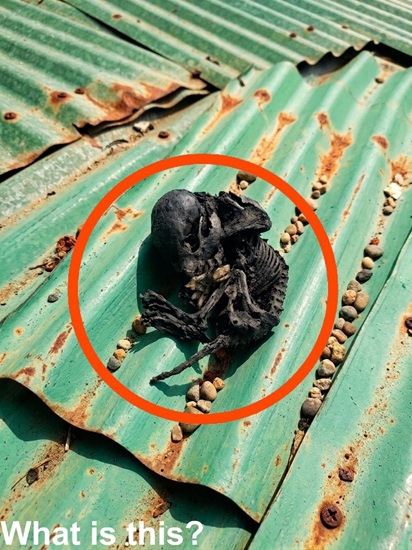
The moment I fully exposed the dark cavity beneath the roofline, my stomach tightened instantly. Hidden deep inside the crawlspace was an object tucked carefully into the corner between two support beams. It was oddly shaped, darkened with age, and positioned with deliberate precision. Even before I understood what I was looking at, I knew one thing immediately: it had not ended up there accidentally.
Suddenly the entire atmosphere around me changed. The peaceful sounds of the neighborhood no longer felt comforting. Birds chirping in nearby trees became sharp and irritating. The sunlight that had seemed warm minutes earlier now felt invasive, almost like a spotlight exposing something terrible. It is astonishing how quickly fear can distort ordinary surroundings once the mind begins imagining possibilities it desperately wishes were untrue.
As I stared into the hidden space, my thoughts spiraled uncontrollably. Was this evidence of something criminal connected to previous owners? Had someone secretly lived inside these walls years ago? Could the strange object somehow be connected to the house’s unexplained noises that I had dismissed countless times before? Fear transforms uncertainty into endless horrifying scenarios, and my imagination became far more dangerous than reality during those few tense moments.
The deeper problem was not simply the object itself. It was what the discovery represented psychologically. Homes are supposed to feel secure. We lock our doors, close our curtains, and surround ourselves with familiar walls because we believe they separate safety from danger. Finding something mysterious hidden inside those walls creates a deeply personal sense of violation. Suddenly the house no longer feels entirely yours because it contains secrets you never consented to inherit.
For several long seconds, I genuinely considered climbing down immediately and pretending I had never seen anything. Every instinct urged me to abandon the repair, seal the roof, and walk away from the growing unease tightening inside my chest. Yet curiosity is incredibly difficult to silence once it takes hold. Human beings are almost incapable of leaving mysteries unresolved, even when resolution threatens to destroy their peace of mind.
I swallowed hard, reached into my tool bag, and grabbed the flashlight. The beam sliced through the darkness beneath the roof, illuminating the hidden object more clearly. What emerged from the shadows looked disturbingly human at first glance because of its shape and texture. My pulse quickened as details slowly sharpened into focus beneath the pale circle of light.
The object appeared wrapped in something resembling aged leather or brittle parchment. Time and heat had yellowed the material into uneven shades of brown, while fine dust coated every exposed surface. It resembled a small trunk or satchel, but what disturbed me most was its placement. Someone had wedged it securely between the beams with obvious intention, hiding it where no casual inspection would ever uncover it.
Carefully, I reached into the crawlspace and pulled the object toward me. Its surprising weight nearly caused me to lose balance on the roof. Whatever was inside felt dense and solid, far heavier than old papers or forgotten construction materials. My fingertips brushed against a rusted metal clasp, and even that tiny sound seemed unnaturally loud in the stillness surrounding me.
The latch finally snapped open with a sharp metallic click. For a moment, I hesitated before lifting the lid completely. Some part of me already sensed that whatever waited inside would permanently alter the way I viewed the house. Still, the need to know overwhelmed caution. I slowly opened the container and stared down at contents that instantly erased every harmless explanation I had invented.
Inside were dozens of black-and-white photographs bundled together beneath yellowed envelopes tied carefully with faded ribbon. A large tarnished key rested near the bottom beside several loose pages covered in frantic handwriting. The photographs immediately unsettled me because they were not family memories or ordinary snapshots. They were surveillance images taken from elevated angles overlooking the exact street where I now lived.
My hands trembled while flipping through the pictures. The images appeared decades old, likely dating back to the late 1950s or early 1960s based on the cars and clothing visible throughout the neighborhood scenes. Yet the photographs felt deeply invasive. They captured ordinary people watering lawns, unloading groceries, walking dogs, and speaking beside driveways without any awareness they were being observed from above.
The realization crept over me slowly and horribly. Whoever took these photographs had done so from inside the roof where I currently sat. The angles matched perfectly. The elevated perspective overlooking neighboring homes could only have been achieved from this hidden crawlspace tucked beneath the shingles. Someone had used my house as a concealed observation point for years.
The letters proved even more disturbing. Most appeared unsent, filled with dense looping handwriting that grew increasingly frantic from page to page. Certain phrases repeated constantly: “watching,” “waiting,” “they never notice,” and “safe inside the walls.” Some passages described neighbors’ daily routines in obsessive detail, while others hinted at paranoia and isolation so intense it bordered on delusion.
I felt physically ill while reading them. The hidden space beneath my roof had not merely stored forgotten belongings. It had functioned as a private refuge for someone deeply disturbed. Whether the person had secretly lived there temporarily or simply used it regularly as a hiding place, the intent was unmistakable. My peaceful little house had once served as a silent watchtower overlooking unsuspecting lives below.
The heavy tarnished key became another unsettling mystery. It looked ancient compared to the house itself, with intricate grooves and a thick iron handle unlike modern keys. I searched mentally for any matching lock within the property but found nothing. That uncertainty somehow made the discovery worse because it implied there were still unanswered questions connected to the hidden collection.
Sitting there beside the open crawlspace, I suddenly noticed the neighborhood differently. A woman walked her dog across the sidewalk below while children rode bicycles near the corner. A man unloaded groceries from his trunk completely unaware of my gaze from above. The photographs inside the satchel captured identical moments decades earlier. Someone had watched ordinary lives unfold from this exact spot in complete secrecy.
That realization lingered heavily inside me long after I climbed down from the roof. Even after storing the photographs and letters carefully inside the house, the feeling never fully disappeared. Every hallway creak sounded more significant afterward. Every hidden corner of the attic suddenly seemed suspicious. I found myself imagining unseen eyes lingering behind walls, not because I believed someone was still there, but because the illusion of total privacy had been shattered permanently.
Later that evening, I researched the house’s history for hours. Previous owners blurred together through old records, but one name repeatedly surfaced connected to complaints involving unusual behavior and reclusive habits decades earlier. The details remained vague and incomplete, which somehow felt more unsettling than certainty would have. Mystery leaves room for imagination, and imagination often creates horrors reality never could.
What disturbed me most was understanding how easily entire hidden histories can exist inside ordinary homes. Houses absorb human behavior silently over decades. Behind fresh paint and renovated kitchens linger traces of forgotten lives, buried secrets, and unresolved stories. Most remain invisible forever. Occasionally, however, something resurfaces unexpectedly through a leaking roof or damaged wall, forcing the present to confront fragments of a hidden past.
The leak itself became almost irrelevant after that day. I eventually patched the damaged shingles and replaced the rotted plywood, but the repair no longer felt important. The real damage had already occurred internally. I could fix the ceiling stain with paint and plaster, yet I could not restore the unquestioning sense of safety I once associated with the house.
Even now, months later, I occasionally catch myself staring upward while sitting inside the guest bedroom. I think about the hidden crawlspace above the ceiling and the person who once occupied it silently for reasons I may never fully understand. Rationally, I know the danger exists only in memory now. Emotionally, however, the discovery changed something permanent about how the house feels after dark.
People often say homes have histories, but we usually imagine harmless stories involving birthdays, renovations, or generations of families sharing ordinary lives together. We rarely consider darker possibilities hiding quietly beneath the surface. Sometimes a structure carries traces of obsession, secrecy, loneliness, or fear long after the original owner disappears completely from memory.
I climbed onto the roof expecting to repair a minor leak before lunch. Instead, I uncovered evidence that transformed my understanding of privacy, security, and the hidden lives people are capable of living unnoticed beside us. The experience taught me something deeply uncomfortable: walls do not always protect us from secrets. Sometimes they preserve them patiently until the day someone finally tears the roof open and lets the light inside.
